Paoli Amélie, Weladji Robert B, Holand Øystein, Kumpula Jouko
Department of Biology, Concordia University, 7141 Sherbrooke Street West, Montreal, QC, H4B 1R6, Canada.
Department of Animal and Aquacultural Sciences, Norwegian University of Life Sciences, Ås, PO Box 5003, Norway.
Curr Zool. 2020 Apr;66(2):123-134. doi: 10.1093/cz/zoz032. Epub 2019 Jun 20.
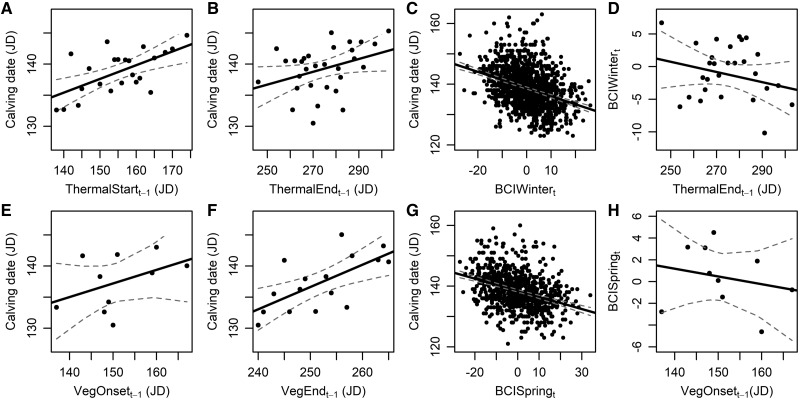
A developing trophic mismatch between the peak of energy demands by reproducing animals and the peak of forage availability has caused many species' reproductive success to decrease. The match-mismatch hypothesis (MMH) is an appealing concept that can be used to assess such fitness consequences. However, concerns have been raised on applying the MMH on capital breeders such as reindeer because the reliance on maternal capita rather than dietary income may mitigate negative effects of changing phenologies. Using a long-term dataset of reindeer calving dates recorded since 1970 in a semidomesticated reindeer population in Finnish Lapland and proxies of plant phenology; we tested the main hypothesis that the time lag between calving date and the plant phenology in autumn when females store nutrient reserves to finance reproduction would lead to consequences on reproductive success, as the time lag with spring conditions would. As predicted, the reproductive success of females of the Kutuharju reindeer population was affected by both the onset of spring green-up and vegetative senescence in autumn as calves were born heavier and with a higher first-summer survival when the onset of the vegetation growth was earlier and the end of the thermal growing season the previous year was earlier as well. Our results demonstrated that longer plant growing seasons might be detrimental to reindeer's reproductive success if a later end is accompanied by a reduced abundance of mushrooms.
繁殖动物的能量需求峰值与可获取草料峰值之间正在出现的营养不匹配,已导致许多物种的繁殖成功率下降。匹配-不匹配假说(MMH)是一个有吸引力的概念,可用于评估此类适应性后果。然而,有人对将MMH应用于驯鹿等资本繁殖者提出了担忧,因为依赖母体资本而非饮食收入可能会减轻物候变化的负面影响。利用自1970年以来在芬兰拉普兰一个半驯化驯鹿种群中记录的驯鹿产犊日期的长期数据集以及植物物候指标,我们检验了一个主要假设,即产犊日期与秋季植物物候之间的时间滞后(此时雌性储存营养储备以支持繁殖)会像与春季条件的时间滞后一样,对繁殖成功率产生影响。正如预测的那样,库图哈茹驯鹿种群中雌性的繁殖成功率受到春季返青开始和秋季植物衰老的影响,因为当植被生长开始较早且前一年热生长季结束也较早时,出生的幼崽更重且第一个夏季的存活率更高。我们的结果表明,如果生长季后期伴随着蘑菇丰度降低,那么更长的植物生长季可能对驯鹿的繁殖成功率不利。