Gustine David, Barboza Perry, Adams Layne, Griffith Brad, Cameron Raymond, Whitten Kenneth
U.S. Geological Survey, Alaska Science Center, Anchorage, Alaska, United States of America.
Wildlife and Fisheries Science, Texas A&M University, College Station, Texas, United States of America.
PLoS One. 2017 Feb 23;12(2):e0171807. doi: 10.1371/journal.pone.0171807. eCollection 2017.
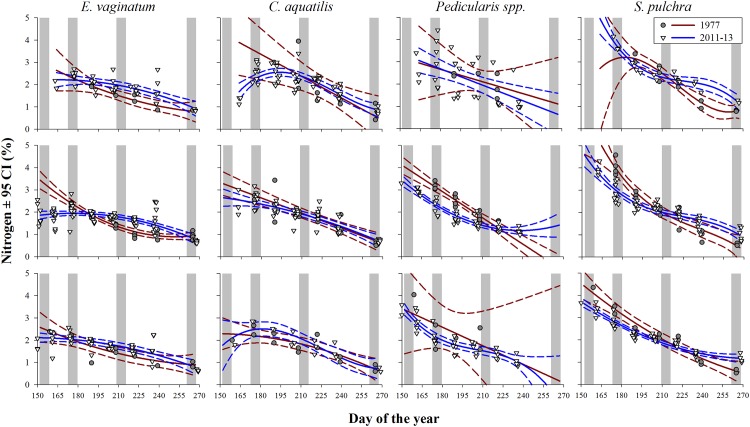
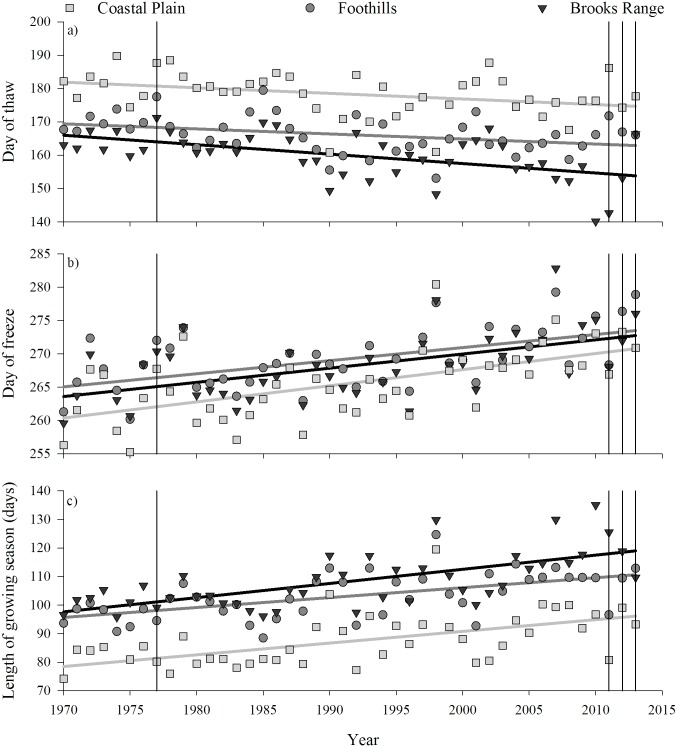
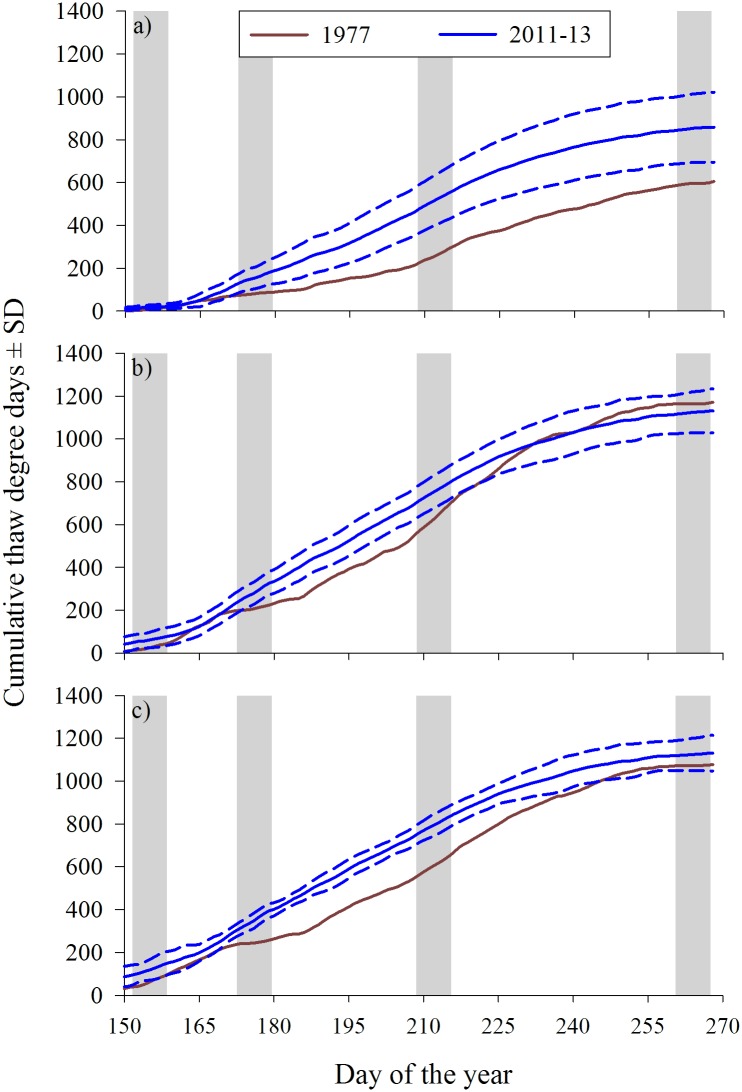
Climate-induced shifts in plant phenology may adversely affect animals that cannot or do not shift the timing of their reproductive cycle. The realized effect of potential trophic "mismatches" between a consumer and its food varies with the degree to which species rely on dietary income and stored capital. Large Arctic herbivores rely heavily on maternal capital to reproduce and give birth near the onset of the growing season but are they vulnerable to trophic mismatch? We evaluated the long-term changes in the temperatures and characteristics of the growing seasons (1970-2013), and compared growing conditions and dynamics of forage quality for caribou at peak parturition, peak lactation, and peak forage biomass, and plant senescence between two distinct time periods over 36 years (1977 and 2011-13). Despite advanced thaw dates (7-12 days earlier), increased growing season lengths (15-21 days longer), and consistent parturition dates, we found no decline in forage quality and therefore no evidence within this dataset for a trophic mismatch at peak parturition or peak lactation from 1977 to 2011-13. In Arctic ungulates that use stored capital for reproduction, reproductive demands are largely met by body stores deposited in the previous summer and autumn, which reduces potential adverse effects of any mismatch between food availability and timing of parturition. Climate-induced effects on forages growing in the summer and autumn ranges, however, do correspond with the demands of female caribou and their offspring to gain mass for the next reproductive cycle and winter. Therefore, we suggest the window of time to examine the match-mismatch framework in Arctic ungulates is not at parturition but in late summer-autumn, where the multiplier effects of small changes in forage quality are amplified by forage abundance, peak forage intake, and resultant mass gains in mother-offspring pairs.
气候导致的植物物候变化可能会对那些无法或不会改变其繁殖周期时间的动物产生不利影响。消费者与其食物之间潜在的营养“错配”所产生的实际影响,会因物种对饮食收入和储存资本的依赖程度而有所不同。大型北极食草动物在很大程度上依赖母体资本进行繁殖,并在生长季节开始时产仔,但它们是否容易受到营养错配的影响呢?我们评估了1970年至2013年期间温度和生长季节特征的长期变化,并比较了36年(1977年和2011 - 13年)两个不同时间段驯鹿在分娩高峰期、泌乳高峰期、牧草生物量高峰期以及植物衰老期的生长条件和牧草质量动态。尽管解冻日期提前(早7 - 12天)、生长季节长度增加(长15 - 21天)且分娩日期保持一致,但我们发现牧草质量并未下降,因此在该数据集中没有证据表明1977年至2011 - 13年期间在分娩高峰期或泌乳高峰期存在营养错配。在利用储存资本进行繁殖的北极有蹄类动物中,繁殖需求在很大程度上由前一个夏秋季节储存的身体物质来满足,这减少了食物供应与分娩时间之间任何错配可能产生的不利影响。然而,气候对夏秋牧场生长的牧草产生的影响,确实与雌性驯鹿及其后代为下一个繁殖周期和冬季增加体重的需求相呼应。因此,我们建议,研究北极有蹄类动物错配框架的时间窗口不是在分娩时,而是在夏末秋初,此时牧草质量的微小变化所产生的倍增效应会因牧草丰度、牧草摄入量峰值以及母婴对由此产生的体重增加而被放大。