Kruppa Philipp, Flies Anne, Wulsten Dag, Collette Robert, Duda Georg N, Schaser Klaus-Dieter, Becker Roland, Kopf Sebastian
Department of Plastic, Aesthetic and Reconstructive Microsurgery/Hand Surgery, Hospital Ernst von Bergmann, Potsdam, Germany.
Julius-Wolff-Institute, Charité-University Medicine Berlin, Berlin, Germany.
Orthop J Sports Med. 2020 May 4;8(5):2325967120916437. doi: 10.1177/2325967120916437. eCollection 2020 May.
Tibial-sided graft fixation is thought to be critical for the success of anterior cruciate ligament (ACL) reconstruction. Nevertheless, little is known about the graft force after fixation during the first 24 hours after surgery or the influence of screw diameter and length during this time.
To investigate the force, over the course of 24 hours, in soft tissue grafts secured with a tibial interference screw and to evaluate the effect of different screw diameters (7, 8, and 9 mm) and lengths (25 and 30 mm) on the force in these grafts.
Controlled laboratory study.
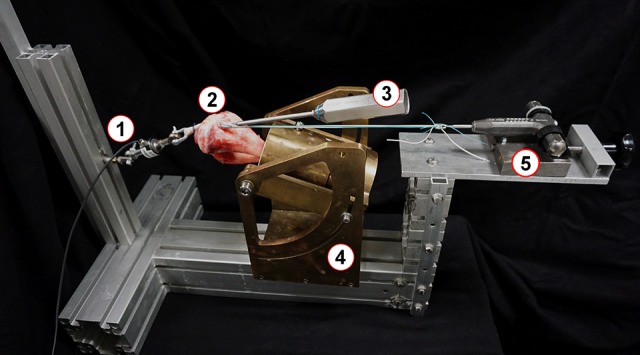
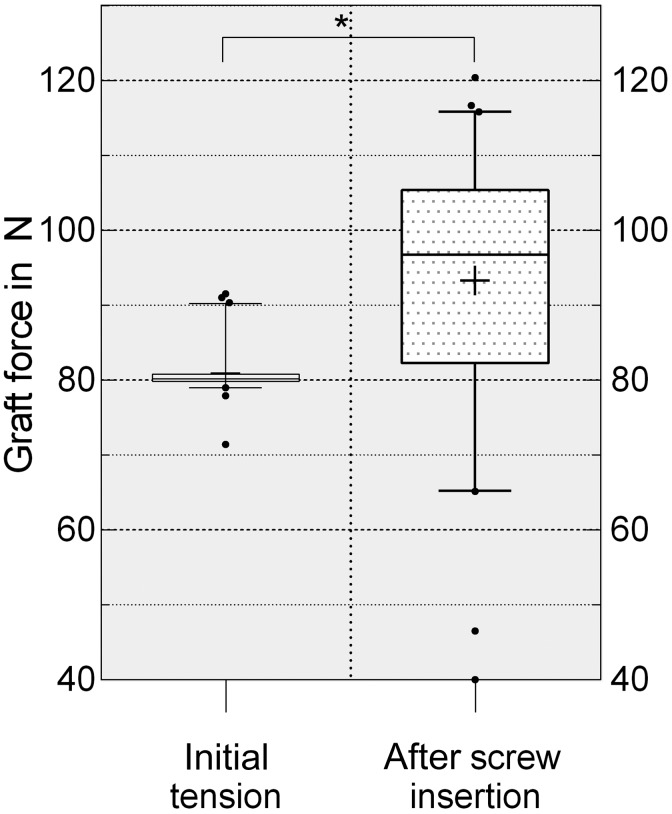
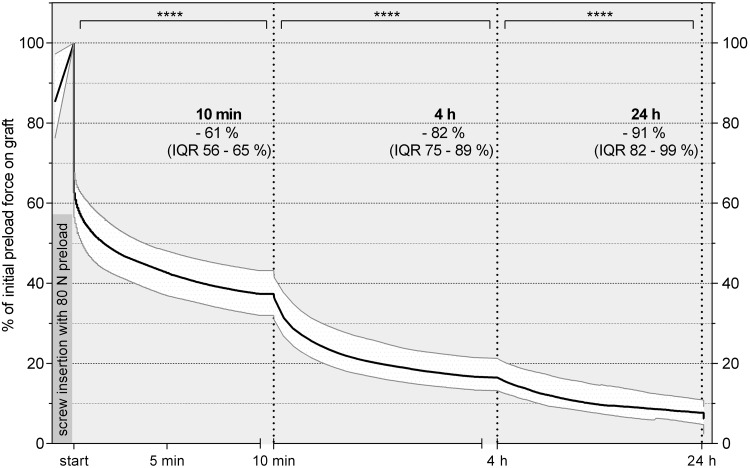
Quadruple-strand flexor tendon grafts were fixed with bioabsorbable interference screws in 60 porcine tibiae. Grafts were pretensioned at 80 N over 10 minutes, and screws were inserted outside-in while a preload force of 80 N was applied. Different screw lengths (25 and 30 mm) and diameters (7, 8, and 9 mm), resulting in 6 groups with 10 specimens each, were tested. After release of the preload, graft force was recorded over 24 hours.
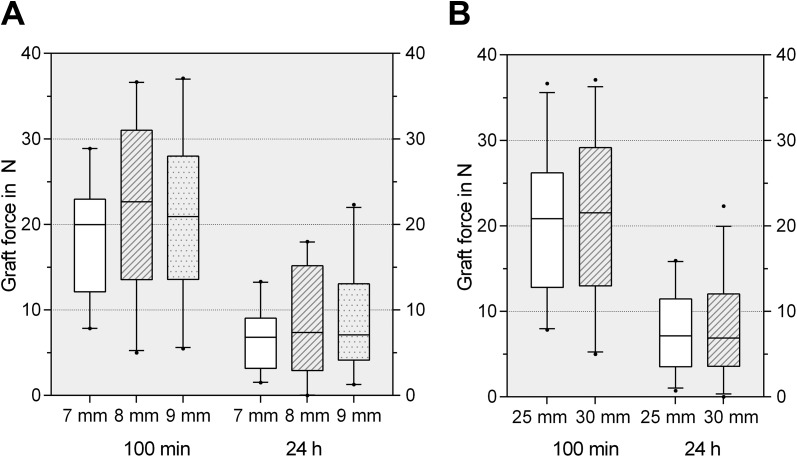
A significant decrease in graft force progressed in all groups over the 24-hour period. In total, a median loss of 75 N (IQR, 68-79 N) compared with the initial loading force was observed. Compared with the loading force of 80 N, this corresponded to a median loss of 91%. No significant differences in the remaining graft force could be found among the 6 different screw length and diameter groups after 10 minutes, 100 minutes, or 24 hours.
Graft force in soft tissue grafts secured with a tibial interference screw decreased substantially over the first 24 hours after fixation. Neither the screw diameter nor the screw length affected the decrease in graft force. This raises substantial questions regarding the remaining fixation strength in vivo.
It should not be expected that ACL reconstruction can mechanically restabilize an injured knee as would an intact ACL. Reconstructed knees should be protected from mechanical overload in the early postoperative period.
胫骨侧移植物固定被认为是前交叉韧带(ACL)重建成功的关键。然而,对于术后最初24小时内固定后移植物的受力情况,以及在此期间螺钉直径和长度的影响,人们了解甚少。
研究使用胫骨挤压螺钉固定的软组织移植物在24小时内的受力情况,并评估不同螺钉直径(7、8和9毫米)和长度(25和三十毫米)对这些移植物受力的影响。
对照实验室研究。
将四股屈肌腱移植物用可吸收挤压螺钉固定于60只猪的胫骨中。移植物在10分钟内以80牛的力进行预张紧,在施加80牛预加载力的同时由外向内插入螺钉。测试不同的螺钉长度(25和三十毫米)和直径(7、8和9毫米),共6组,每组10个标本。释放预加载力后,记录24小时内移植物的受力情况。
在24小时内,所有组的移植物受力均显著下降。总体而言,与初始加载力相比中位数损失75牛(四分位间距,68 - 79牛)。与80牛的加载力相比,这相当于中位数损失91%。在10分钟、100分钟或24小时后,6个不同螺钉长度和直径组之间剩余移植物受力无显著差异。
使用胫骨挤压螺钉固定的软组织移植物在固定后的最初24小时内受力大幅下降。螺钉直径和长度均未影响移植物受力的下降。这引发了关于体内剩余固定强度的重大问题。
不应期望ACL重建能像完整的ACL那样在机械上使受伤膝关节重新稳定。重建后的膝关节在术后早期应避免机械性过载。