Schoth Daniel E, Radhakrishnan Kanmani, Liossi Christina
Pain Research Laboratory, School of Psychology, University of Southampton, Southampton, United Kingdom.
Pain Rep. 2020 Mar 31;5(2):e816. doi: 10.1097/PR9.0000000000000816. eCollection 2020 Mar-Apr.
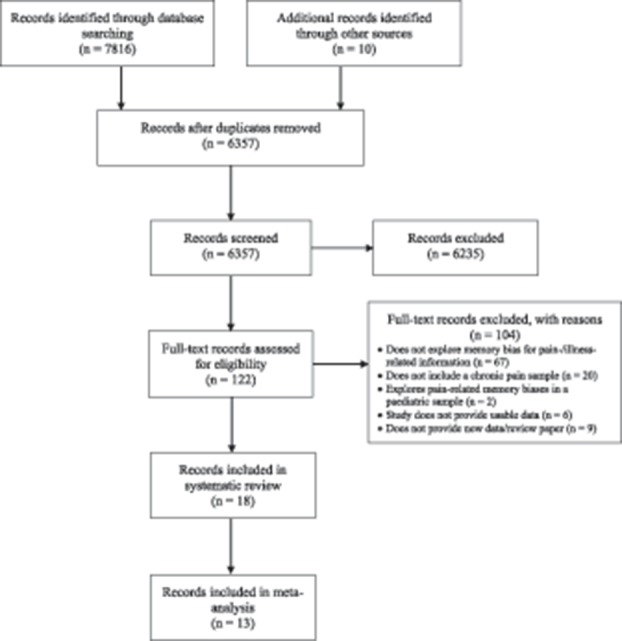
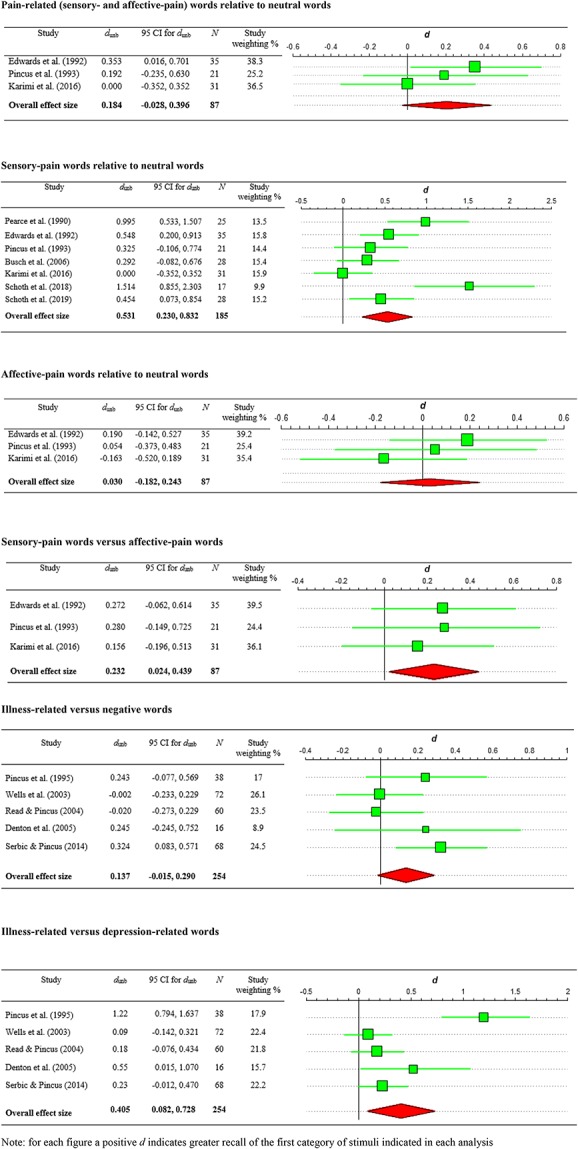
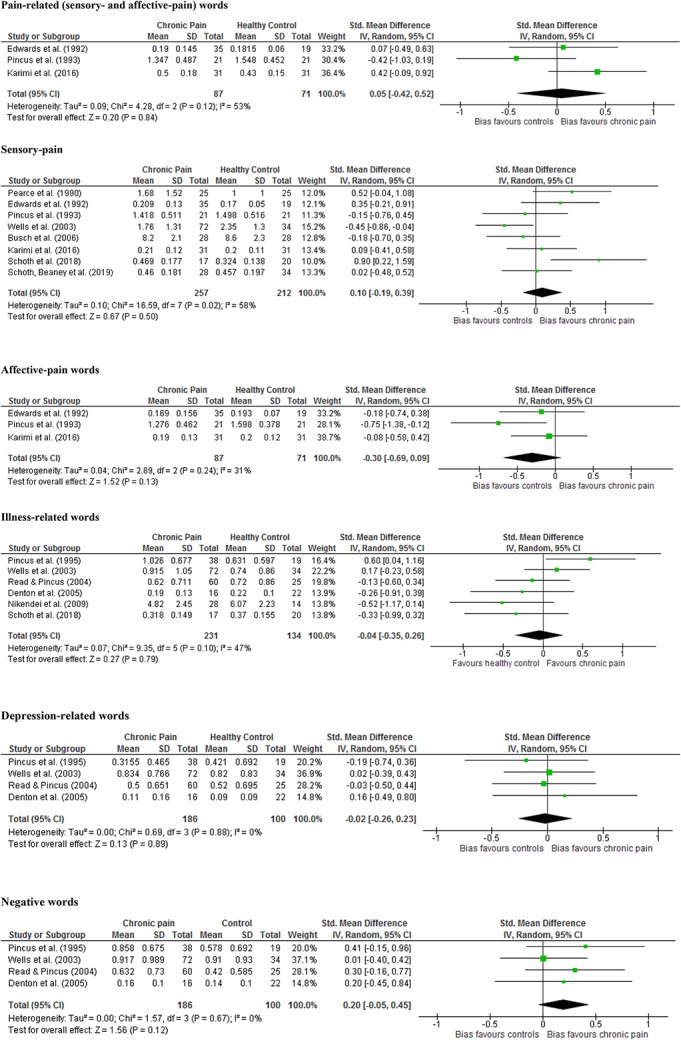
Pain-related memory biases have been frequently explored in individuals with chronic pain, and along with attentional and interpretation biases are hypothesised to contribute to the onset and/or maintenance of chronic pain. The aim of this review is to provide a systematic review and synthesis of studies exploring memory recall biases for pain-related information in individuals with chronic pain relative to healthy controls and the recall of neutral information. Studies were identified through a search of Medline, PsychINFO, Web of Science, CINAHL, Cochrane Library, and Open Grey databases. Search terms were memory, recall, recognition, and bias*, intersected with pain. Eighteen studies meeting the inclusion criteria were included. Subset meta-analyses are also reported from 12 studies with relevant between-groups data (comparing recall in chronic pain vs healthy control groups) and 12 studies with relevant within-groups data (eg, comparing recall of pain-related/emotional vs neutral words). Between-groups analysis revealed significantly weaker recall bias for affective-pain words in individuals with chronic pain relative to healthy controls, but only when nondepressed chronic pain individuals were included. No significant differences were found between groups in the recall of sensory-pain, illness-related, or depression-related words. Within-groups analysis revealed individuals with chronic pain show a significant recall bias favouring sensory-pain words relative to neutral and affective-pain words, and a bias for illness-related words relative to depression-related words. A recall bias favouring neutral words was found in healthy individuals. Evidence for the presence of pain-related memory biases in patients with chronic pain is inconclusive. Further methodologically rigorous research is required.
疼痛相关的记忆偏差在慢性疼痛患者中已得到频繁研究,并且与注意力和解释偏差一起被假设为导致慢性疼痛的发作和/或维持的因素。本综述的目的是对探索慢性疼痛患者相对于健康对照者对疼痛相关信息的记忆回忆偏差以及中性信息回忆的研究进行系统综述和综合分析。通过检索Medline、PsychINFO、科学网、护理学与健康领域数据库(CINAHL)、Cochrane图书馆和Open Grey数据库来识别研究。检索词为记忆、回忆、识别和偏差*,并与疼痛交叉。纳入了18项符合纳入标准的研究。还报告了来自12项具有相关组间数据(比较慢性疼痛组与健康对照组的回忆)和12项具有相关组内数据(例如,比较疼痛相关/情感性词语与中性词语的回忆)的研究的子集荟萃分析。组间分析显示,相对于健康对照者,慢性疼痛患者对情感性疼痛词语的回忆偏差明显较弱,但仅在纳入非抑郁的慢性疼痛个体时如此。在感觉性疼痛、疾病相关或抑郁相关词语的回忆方面,组间未发现显著差异。组内分析显示,慢性疼痛患者相对于中性和情感性疼痛词语,对感觉性疼痛词语表现出显著的回忆偏差,并且相对于抑郁相关词语,对疾病相关词语存在偏差。在健康个体中发现了对中性词语的回忆偏差。慢性疼痛患者中存在疼痛相关记忆偏差的证据尚无定论。需要进一步进行方法学严谨的研究。