Department of Didactics and School Organization, University of Granada, Granada, Spain.
Humanities and Education School, Tecnologico de Monterrey, Nuevo Leon, Mexico.
PLoS One. 2020 May 22;15(5):e0233655. doi: 10.1371/journal.pone.0233655. eCollection 2020.
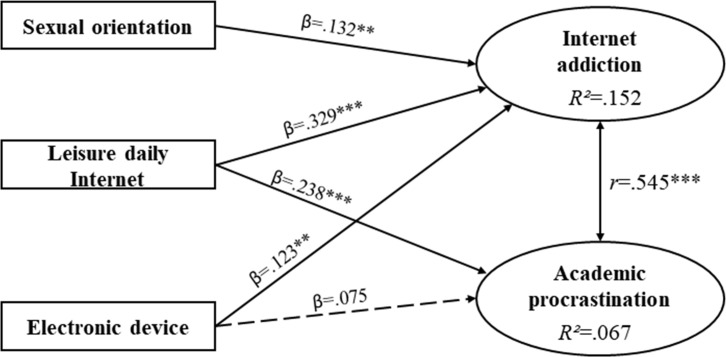
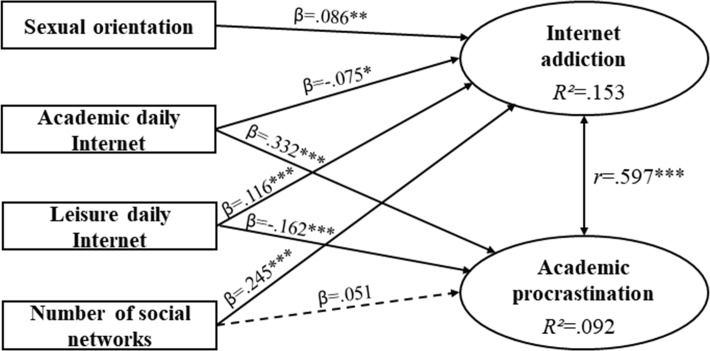
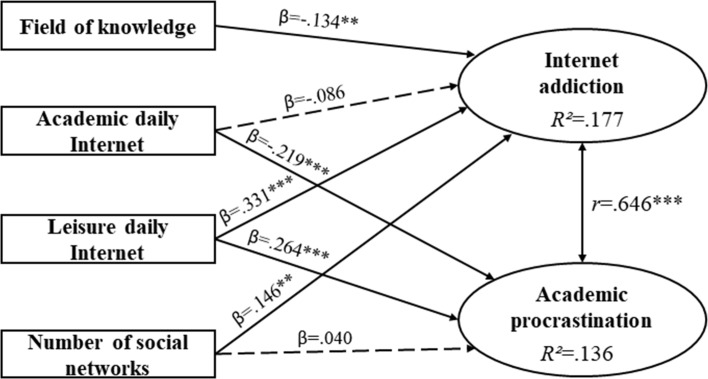
The 21st-century problem of Internet addiction is increasing globally, but especially among university students. Not surprisingly, then, problematic Internet use is associated with university students' academic procrastination. Because studies are scarce in Mexico and Spain has one of the highest rates of Internet addiction in Europe, this paper (i) analyzed the presence and degree of Internet addiction among university students in Mexico and Spain, (ii) determined potential sociodemographic factors influencing Internet addiction, and (iii) established the type of correlation between Internet addiction and academic procrastination. The cross-sectional study design used an online questionnaire to measure problematic Internet use and academic procrastination through convenience sampling at one university in Mexico and one in Spain. The questionnaire contained three sections: participants' sociodemographic data, the Internet Addiction Test, and the Academic Procrastination Scale. The final sample comprised 758 university students, 387 from Mexico, and 371 from Spain, aged from 18 to 35 (M = 20.08, SD = 3.16). Results revealed similar prevalence rates of problematic and daily Internet use for leisure, potentially influencing Internet addiction in all three models (i.e., Mexico, Spain, and Total). Additionally, significant positive correlation was revealed between problematic Internet use and academic procrastination (p < .001). Finally, findings showed relevant data on Internet addiction's prevalence in Mexican and Spanish university contexts, along with its influential sociodemographic factors.
21 世纪,全球范围内的网络成瘾问题日益严重,尤其是在大学生群体中。因此,大学生的网络成瘾问题与学术拖延密切相关也就不足为奇了。由于墨西哥的相关研究较少,而西班牙是欧洲网络成瘾率最高的国家之一,本研究(一)分析了墨西哥和西班牙大学生网络成瘾的现状和程度,(二)确定了可能影响网络成瘾的社会人口学因素,(三)建立了网络成瘾与学术拖延之间的相关性类型。本横断面研究采用在线问卷,通过便利抽样,在墨西哥和西班牙的一所大学对大学生进行了网络成瘾和学术拖延的测量。问卷包括三个部分:参与者的社会人口学数据、网络成瘾测试和学术拖延量表。最终样本由 758 名大学生组成,其中 387 名来自墨西哥,371 名来自西班牙,年龄在 18 至 35 岁之间(M = 20.08,SD = 3.16)。结果显示,在所有三个模型(即墨西哥、西班牙和总体)中,休闲时存在相似的网络成瘾和日常网络使用的流行率,这可能影响了所有人的网络成瘾。此外,还揭示了网络成瘾与学术拖延之间存在显著的正相关(p <.001)。最后,研究结果提供了关于墨西哥和西班牙大学生网络成瘾流行率及其相关社会人口学因素的重要数据。