Cerniglia Luca, Griffiths Mark D, Cimino Silvia, De Palo Valeria, Monacis Lucia, Sinatra Maria, Tambelli Renata
Department of Psychology, International Telematic University Uninettuno, Rome, Italy.
Centre for Advanced Studies on Cyberpsychology and Ethics (ASPEN), University of Bari, Bari, Italy.
Psychol Res Behav Manag. 2019 Aug 13;12:651-659. doi: 10.2147/PRBM.S211873. eCollection 2019.
For a small minority of individuals, the overuse of digital technologies has been associated with negative factors, including psychological distress and psychopathological symptoms. Two technology-based addictions - internet gaming disorder (IGD) and social media addiction (SMA) - have been found to be related to comorbid disorders and impulsivity especially in adolescents and emerging adults' populations, but results in this field are inconclusive.
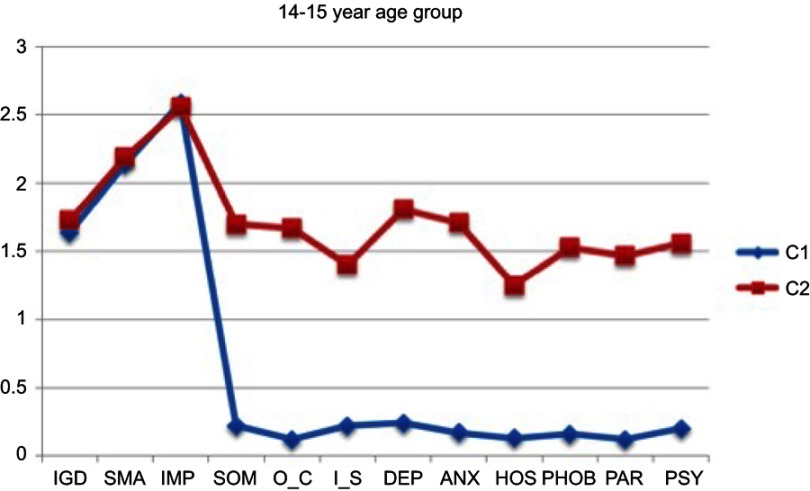
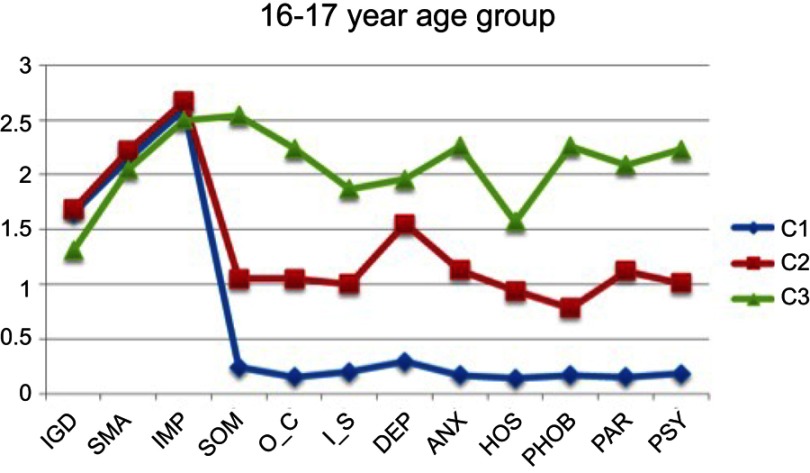
Using the latent profile analysis (LPA), this study identified different profiles of adolescents characterized by unique patterns of psychopathological risks, and similar levels of impulsivity, IGD, and SMA.
A total of 643 participants (312 males; M =16.02 years) were divided into three age groups (early, mid-, and late adolescence). They completed a battery of scales comprising: Internet Gaming Disorder Scale-Short Form, Bergen Social Media Addiction Scale, Barratt Impulsiveness Scale for Adolescents, and Symptom Checklist-90-R.
LPAs revealed distinct profiles across early, mid- and late adolescence with regards to the psychopathological variables taken into account. Specifically, only two profiles were identified in the 14-15 year age group, whereas three profiles emerged in the 16-17 year age group.
This study highlighted that the profiles identified in each age group differed in terms of psychopathological risk (low, medium and high), showing instead similar (and non-clinical) scores in technology-based addictions and impulsivity. Results could be useful in designing prevention and intervention programs in youth showing similar patterns for technology-based addictions, but different levels of psychopathological symptoms.
对于少数个体而言,数字技术的过度使用与包括心理困扰和精神病理症状在内的负面因素相关。已发现两种基于技术的成瘾——网络游戏障碍(IGD)和社交媒体成瘾(SMA)——与共病及冲动性有关,尤其是在青少年和刚成年人群中,但该领域的研究结果尚无定论。
本研究采用潜在类别分析(LPA),确定了具有独特精神病理风险模式、相似冲动性水平、IGD和SMA水平的青少年不同类别。
共有643名参与者(312名男性;平均年龄M = 16.02岁)被分为三个年龄组(青春期早期、中期和晚期)。他们完成了一系列量表,包括:网络游戏障碍量表简版、卑尔根社交媒体成瘾量表、青少年巴拉特冲动性量表和症状自评量表90修订版。
潜在类别分析显示,在考虑的精神病理变量方面,青春期早期、中期和晚期呈现出不同的类别。具体而言,14 - 15岁年龄组仅确定了两个类别,而16 - 17岁年龄组出现了三个类别。
本研究强调,每个年龄组确定的类别在精神病理风险(低、中、高)方面存在差异,但在基于技术的成瘾和冲动性方面显示出相似(且非临床)的分数。研究结果可能有助于为表现出相似基于技术的成瘾模式但精神病理症状水平不同的青少年设计预防和干预项目。