Liu Hui-Hui, Fang Yu, Wang Jing-Wen, Yuan Xiao-Dong, Fan Yu-Chen, Gao Shuai, Han Li-Yan, Wang Kai
Department of Hepatology, Qilu Hospital of Shandong University, Jinan.
Shenzhen Research Institute of Shandong University, Shenzhen.
Medicine (Baltimore). 2020 May;99(20):e20326. doi: 10.1097/MD.0000000000020326.
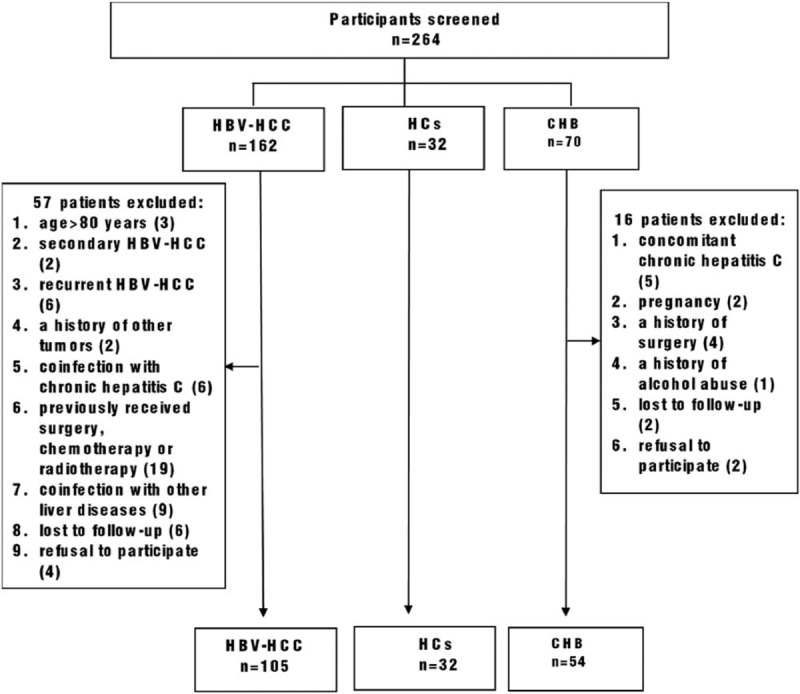
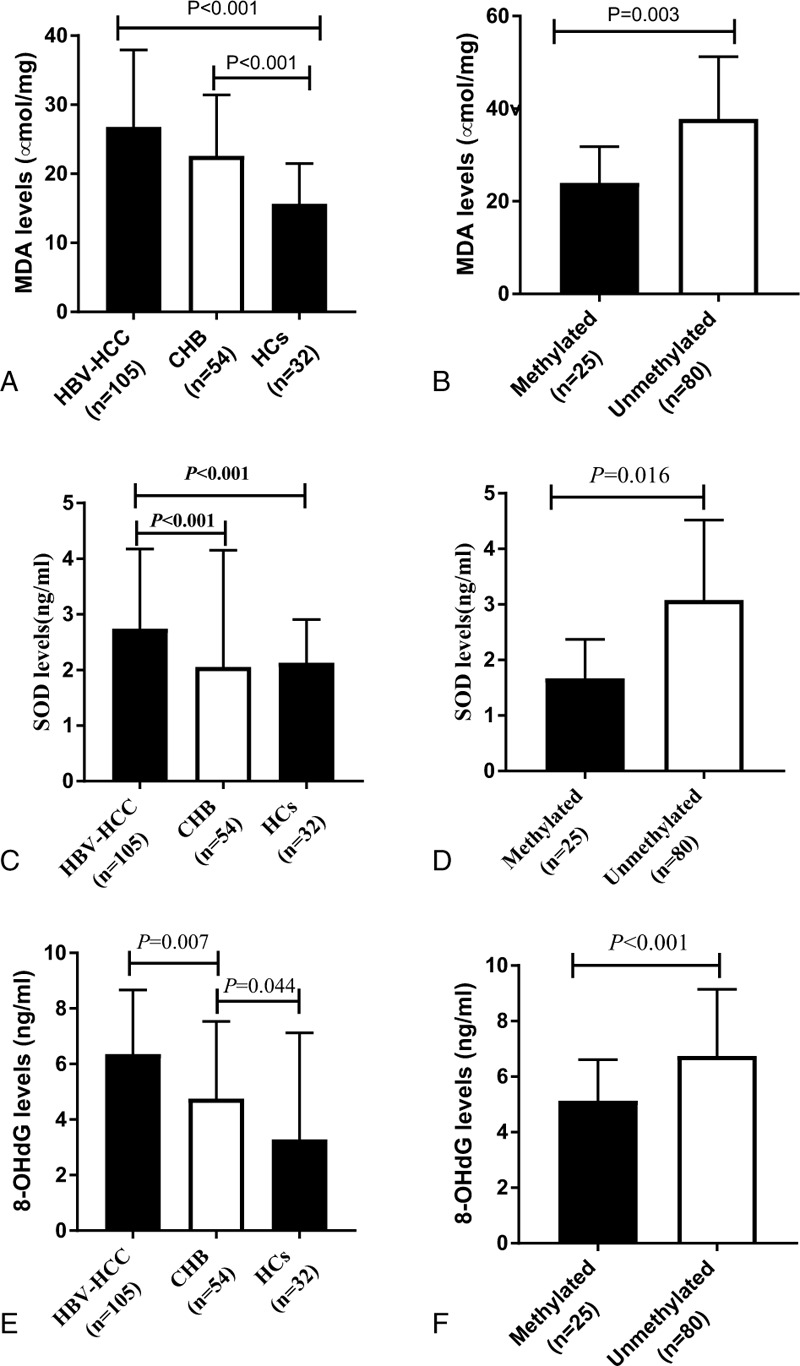
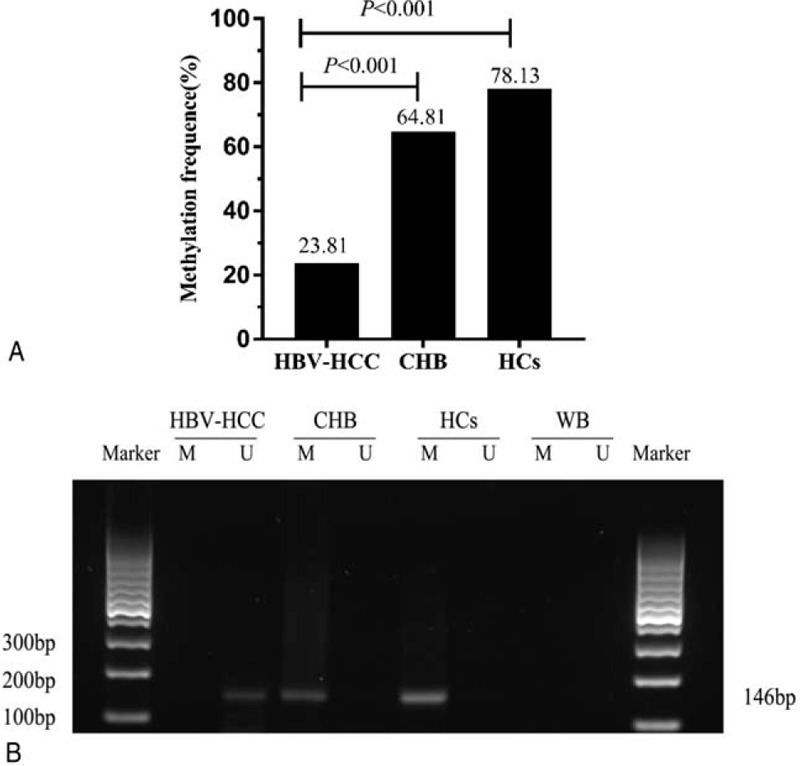
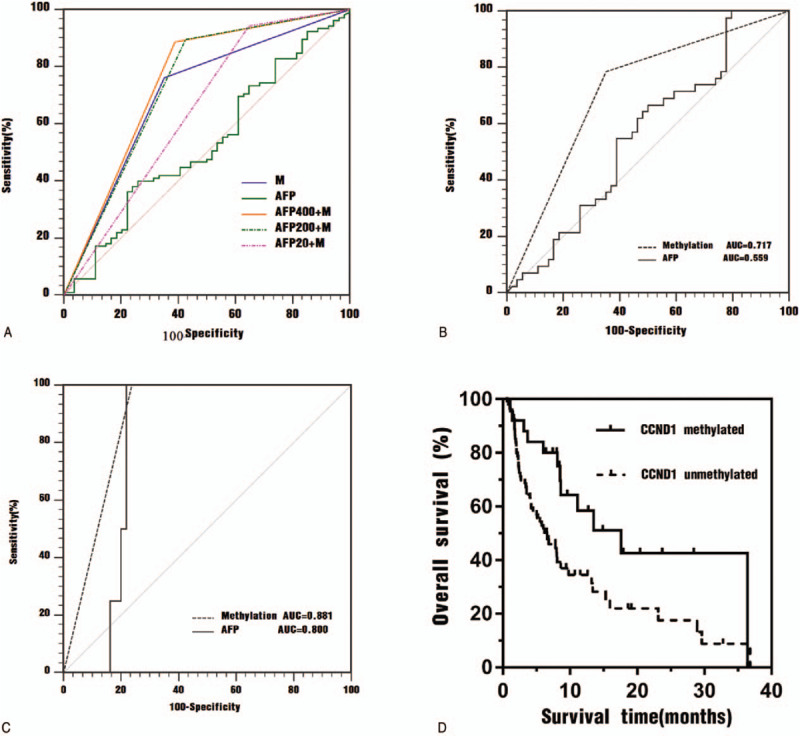
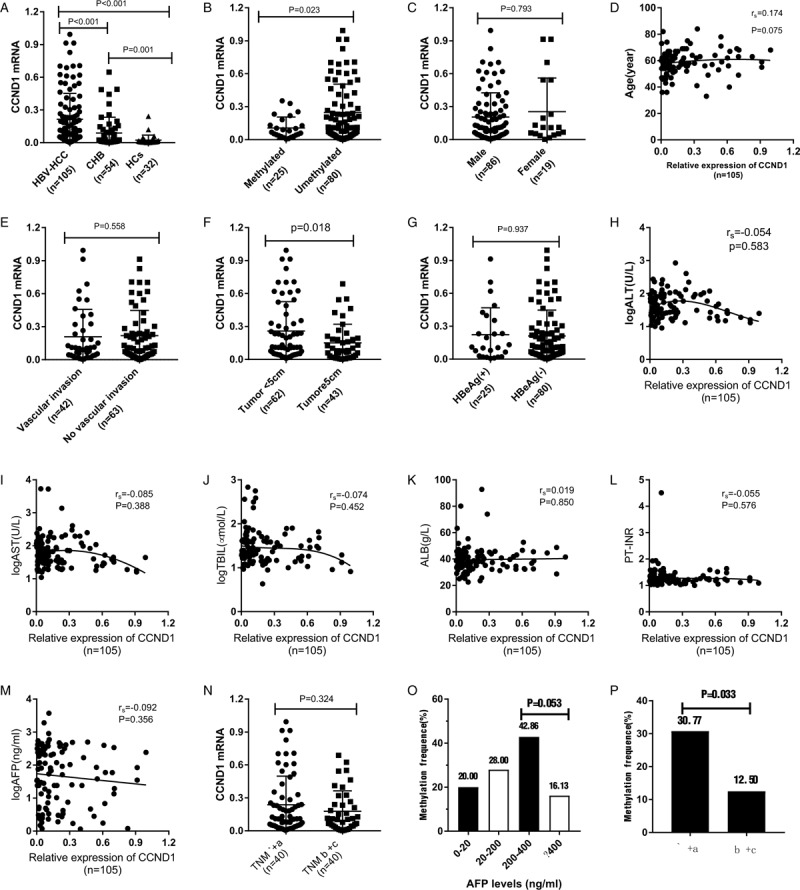
The hypomethylation of the Cyclin D1 (CCND1) promoter induced by excess oxidative stress likely promotes the development of hepatitis B virus-associated hepatocellular carcinoma (HBV-HCC). We aimed to evaluate methylation status of the CCND1 promoter as a new plasma marker for the detection of HBV-HCC.We consecutively recruited 191 participants, including 105 patients with HBV-HCC, 54 patients with chronic hepatitis B (CHB), and 32 healthy controls (HCs). Using methylation-specific polymerase chain reaction, we identified the methylation status of the CCND1 promoter in plasma samples. We analyzed the expression levels of the CCND1 mRNA in peripheral blood mononuclear cells by using quantitative real-time PCR. We assessed the plasma levels of superoxide dismutase, 8-hydroxydeoxyguanosine and malondialdehyde by using enzyme-linked immunosorbent assays.Patients with HBV-HCC (23.81%) presented a reduced methylation frequency compared with patients with CHB (64.81%) or HCs (78.13%) (P < .001). When receiver operating characteristic curves were plotted for patients with HBV-HCC versus CHB, the methylation status of the CCND1 promoter yielded diagnostic parameter values for the area under the curve of 0.705, sensitivity of 76.19%, and specificity of 64.81%, thus outperforming serum alpha-fetoprotein (AFP), which had an area under the curve of 0.531, sensitivity of 36.19%, and specificity of 90.74%. Methylation of the CCND1 promoter represents a prospective diagnostic marker for patients with AFP-negative HBV-HCC and AFP-positive CHB. The expression levels of CCND1 mRNA was increased in patients with HBV-HCC compared with patients with CHB (Z = -4.946, P < .001) and HCs (Z = -6.819, P < .001). Both the extent of oxidative injury and antioxidant capacity indicated by the superoxide dismutase, 8-hydroxydeoxyguanosine and malondialdehyde levels were increased in patients with HBV-HCC. Clinical follow up of patients with HBV-HCC revealed a worse overall survival (P = .012, log-rank test) and a decreased progression-free survival (HR = 0.109, 95%CI: 0.031-0.384) for the unmethylated CCND1 group than methylated CCND1 group.Our study confirms that oxidative stress appears to correlate with plasma levels of CCND1 promoter methylation, and the methylation status of the CCND1 promoter represents a prospective biomarker with better diagnostic performance than serum AFP levels.
过量氧化应激诱导的细胞周期蛋白D1(CCND1)启动子低甲基化可能促进乙型肝炎病毒相关肝细胞癌(HBV-HCC)的发生发展。我们旨在评估CCND1启动子的甲基化状态作为检测HBV-HCC的一种新型血浆标志物。我们连续招募了191名参与者,包括105例HBV-HCC患者、54例慢性乙型肝炎(CHB)患者和32名健康对照(HC)。使用甲基化特异性聚合酶链反应,我们确定了血浆样本中CCND1启动子的甲基化状态。我们通过定量实时PCR分析外周血单个核细胞中CCND1 mRNA的表达水平。我们使用酶联免疫吸附测定法评估血浆中超氧化物歧化酶、8-羟基脱氧鸟苷和丙二醛的水平。与CHB患者(64.81%)或HC(78.13%)相比,HBV-HCC患者(23.81%)的甲基化频率降低(P<0.001)。当绘制HBV-HCC患者与CHB患者的受试者工作特征曲线时,CCND1启动子的甲基化状态产生的曲线下面积诊断参数值为0.705,灵敏度为76.19%,特异性为64.81%,因此优于血清甲胎蛋白(AFP),其曲线下面积为0.531,灵敏度为36.19%,特异性为90.74%。CCND1启动子的甲基化是AFP阴性HBV-HCC患者和AFP阳性CHB患者的一种前瞻性诊断标志物。与CHB患者(Z=-4.946,P<0.001)和HC(Z=-6.819,P<0.001)相比,HBV-HCC患者中CCND1 mRNA的表达水平升高。超氧化物歧化酶、8-羟基脱氧鸟苷和丙二醛水平所表明的氧化损伤程度和抗氧化能力在HBV-HCC患者中均升高。对HBV-HCC患者的临床随访显示,未甲基化CCND1组的总生存期较差(P=0.012,对数秩检验),无进展生存期降低(HR=0.109,95%CI:0.031-0.384),而甲基化CCND1组则不然。我们的研究证实,氧化应激似乎与CCND1启动子甲基化的血浆水平相关,并且CCND1启动子的甲基化状态是一种前瞻性生物标志物,其诊断性能优于血清AFP水平。