Mwangi Peter N, Mogotsi Milton T, Rasebotsa Sebotsana P, Seheri Mapaseka L, Mphahlele M Jeffrey, Ndze Valantine N, Dennis Francis E, Jere Khuzwayo C, Nyaga Martin M
Next Generation Sequencing Unit, Division of Virology, Faculty of Health Sciences, University of the Free State, Bloemfontein 9300, South Africa.
Diarrhoeal Pathogens Research Unit, Sefako Makgatho Health Sciences University, Medunsa 0204, Pretoria, South Africa.
Pathogens. 2020 May 20;9(5):391. doi: 10.3390/pathogens9050391.
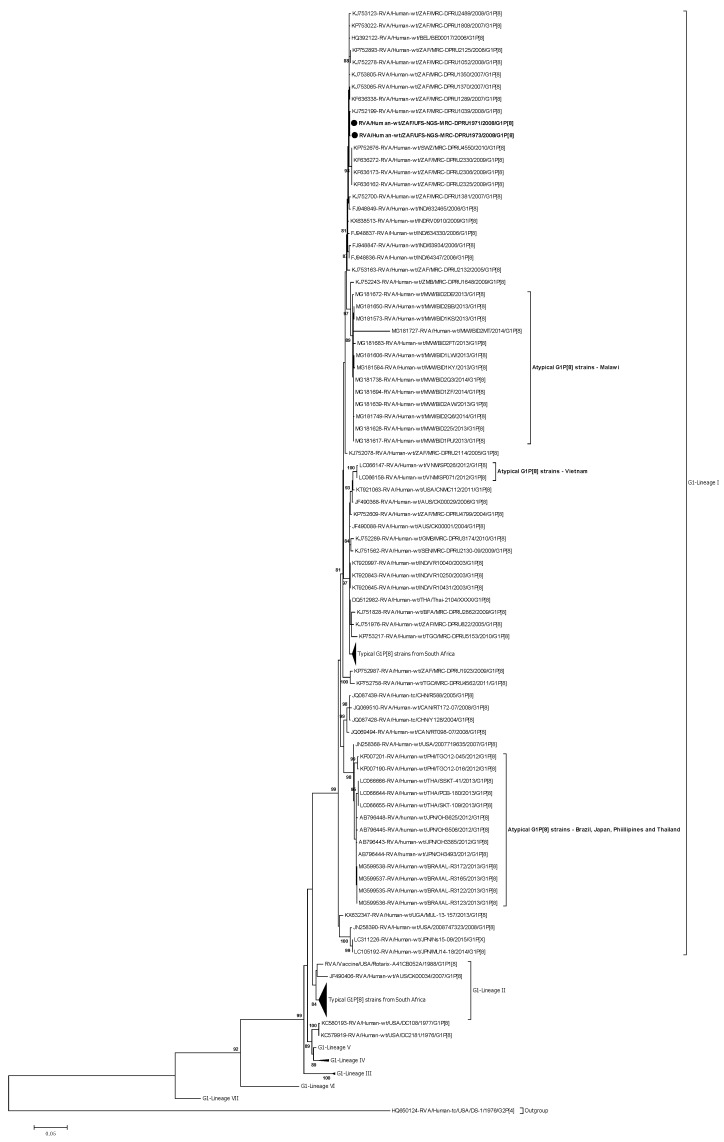
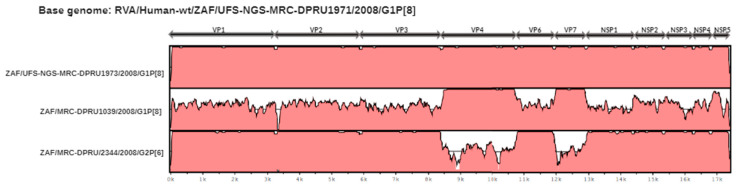
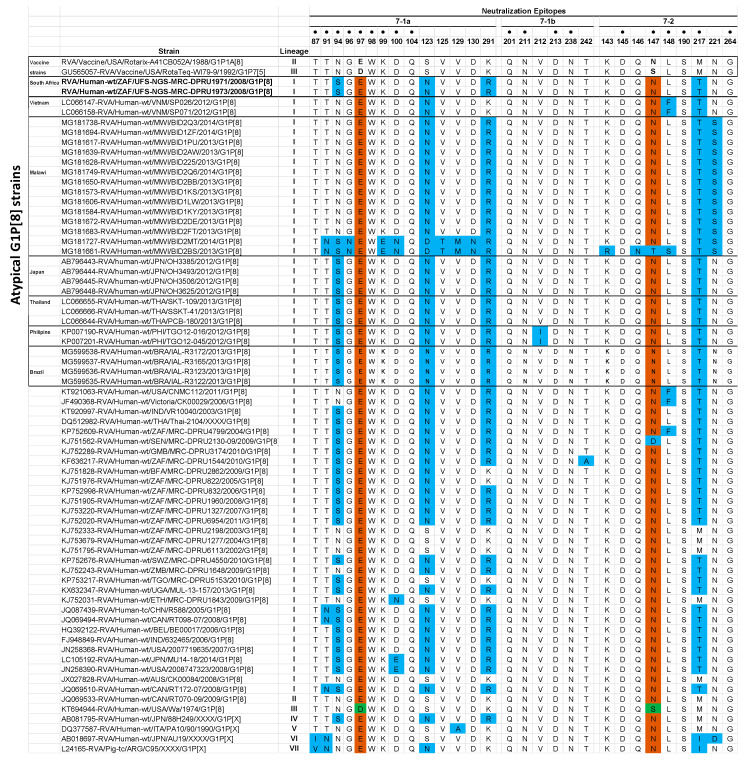
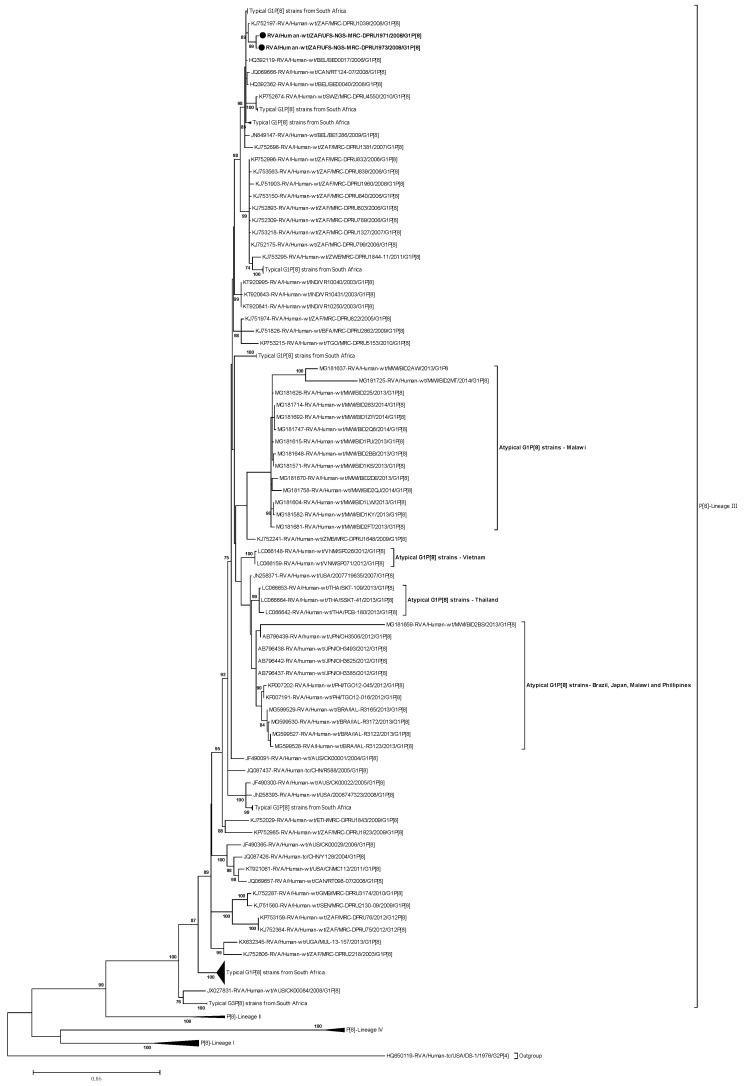
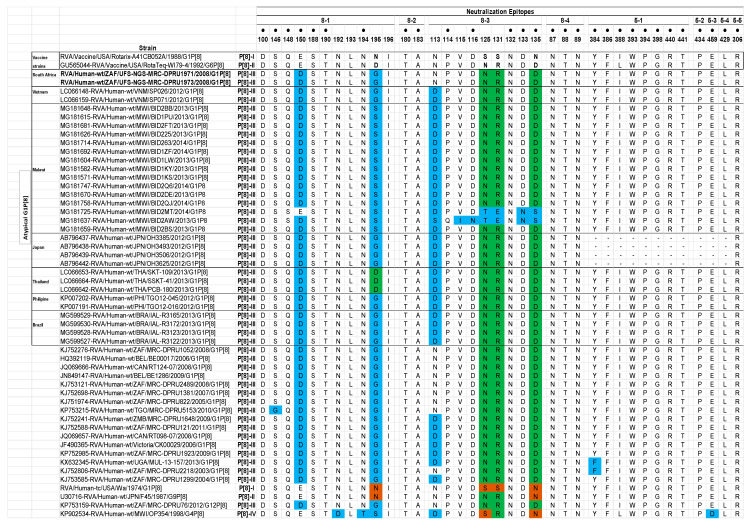
Emergence of DS-1-like G1P[8] group A rotavirus (RVA) strains during post-rotavirus vaccination period has recently been reported in several countries. This study demonstrates, for the first time, rare atypical DS-1-like G1P[8] RVA strains that circulated in 2008 during pre-vaccine era in South Africa. Rotavirus positive samples were subjected to whole-genome sequencing. Two G1P[8] strains (RVA/Human-wt/ZAF/UFS-NGS-MRC-DPRU1971/2008/G1P[8] and RVA/Human-wt/ZAF/UFS-NGS-MRC-DPRU1973/2008/G1P[8]) possessed a DS-1-like genome constellation background (I2-R2-C2-M2-A2-N2-T2-E2-H2). The outer VP4 and VP7 capsid genes of the two South African G1P[8] strains had the highest nucleotide (amino acid) nt (aa) identities of 99.6-99.9% (99.1-100%) with the VP4 and the VP7 genes of a locally circulating South African strain, RVA/Human-wt/ZAF/MRC-DPRU1039/2008/G1P[8]. All the internal backbone genes (VP1-VP3, VP6, and NSP1-NSP5) had the highest nt (aa) identities with cognate internal genes of another locally circulating South African strain, RVA/Human-wt/ZAF/MRC-DPRU2344/2008/G2P[6]. The two study strains emerged through reassortment mechanism involving locally circulating South African strains, as they were distinctly unrelated to other reported atypical G1P[8] strains. The identification of these G1P[8] double-gene reassortants during the pre-vaccination period strongly supports natural RVA evolutionary mechanisms of the RVA genome. There is a need to maintain long-term whole-genome surveillance to monitor such atypical strains.
近期,多个国家报告了在轮状病毒疫苗接种后出现的DS-1样G1P[8]型A组轮状病毒(RVA)毒株。本研究首次证实了2008年南非疫苗接种前时代罕见的非典型DS-1样G1P[8] RVA毒株的存在。对轮状病毒阳性样本进行全基因组测序。两个G1P[8]毒株(RVA/人类-wt/南非/UFS-NGS-MRC-DPRU1971/2008/G1P[8]和RVA/人类-wt/南非/UFS-NGS-MRC-DPRU1973/2008/G1P[8])具有DS-1样基因组星座背景(I2-R2-C2-M2-A2-N2-T2-E2-H2)。这两个南非G1P[8]毒株的外层VP4和VP7衣壳基因与当地流行的南非毒株RVA/人类-wt/南非/MRC-DPRU1039/2008/G1P[8]的VP4和VP7基因的核苷酸(氨基酸)身份最高,分别为99.6 - 99.9%(99.1 - 100%)。所有内部主干基因(VP1 - VP3、VP6和NSP1 - NSP5)与另一个当地流行的南非毒株RVA/人类-wt/南非/MRC-DPRU2344/2008/G2P[6]的同源内部基因的核苷酸(氨基酸)身份最高。这两个研究毒株是通过涉及当地流行的南非毒株的重配机制出现的,因为它们与其他报道的非典型G1P[8]毒株明显无关。在疫苗接种前时期鉴定出这些G1P[8]双基因重配体有力地支持了RVA基因组的自然进化机制。有必要进行长期全基因组监测以监测此类非典型毒株。