Munlela Benilde, João Eva D, Donato Celeste M, Strydom Amy, Boene Simone S, Chissaque Assucênio, Bauhofer Adilson F L, Langa Jerónimo, Cassocera Marta, Cossa-Moiane Idalécia, Chilaúle Jorfélia J, O'Neill Hester G, de Deus Nilsa
Instituto Nacional de Saúde (INS), Distrito de Marracuene, Maputo 3943, Mozambique.
Centro de Biotecnologia, Universidade Eduardo Mondlane, Maputo 3453, Mozambique.
Pathogens. 2020 Dec 6;9(12):1026. doi: 10.3390/pathogens9121026.
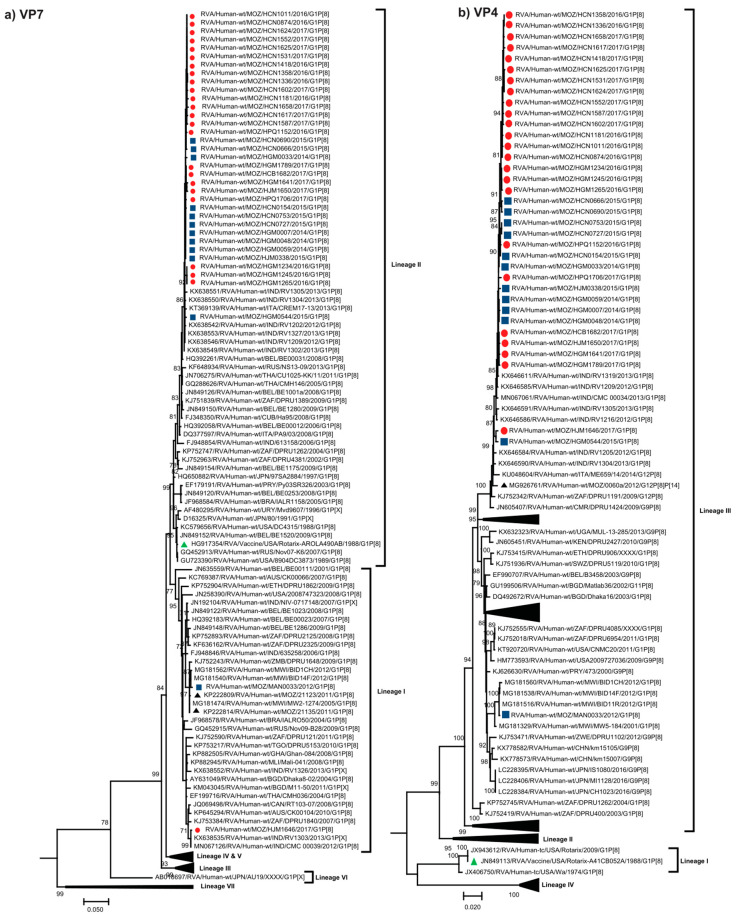
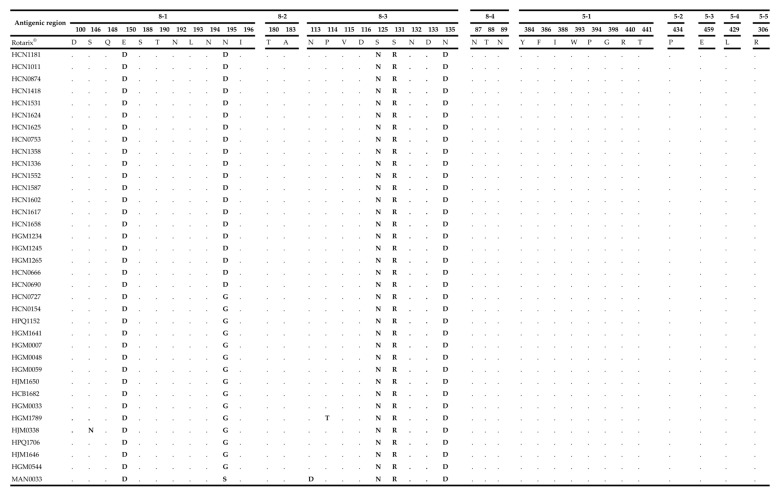
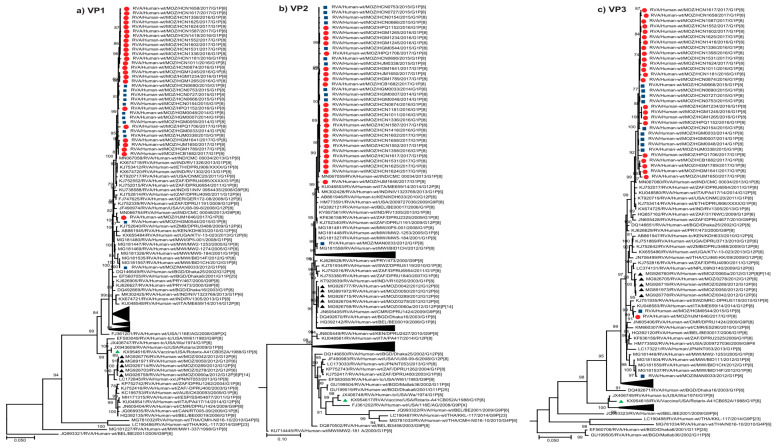
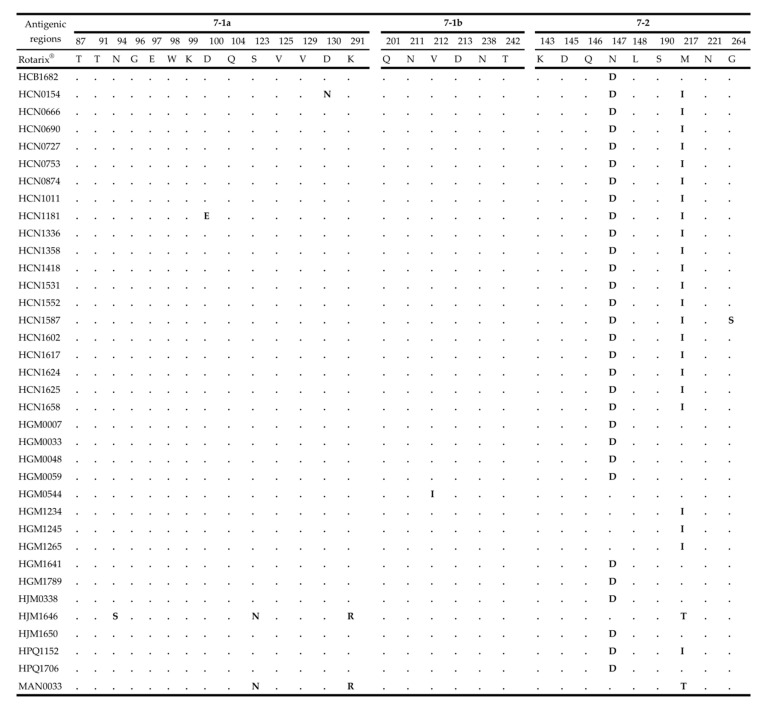
Mozambique introduced the Rotarix vaccine (GSK Biologicals, Rixensart, Belgium) into the National Immunization Program in September 2015. Although G1P[8] was one of the most prevalent genotypes between 2012 and 2017 in Mozambique, no complete genomes had been sequenced to date. Here we report whole genome sequence analysis for 36 G1P[8] strains using an Illumina MiSeq platform. All strains exhibited a Wa-like genetic backbone (G1-P[8]-I1-R1-C1-M1-A1-N1-T1-E1-H1). Phylogenetic analysis showed that most of the Mozambican strains clustered closely together in a conserved clade for the entire genome. No distinct clustering for pre- and post-vaccine strains were observed. These findings may suggest no selective pressure by the introduction of the Rotarix vaccine in 2015. Two strains (HJM1646 and HGM0544) showed varied clustering for the entire genome, suggesting reassortment, whereas a further strain obtained from a rural area (MAN0033) clustered separately for all gene segments. Bayesian analysis for the VP7 and VP4 encoding gene segments supported the phylogenetic analysis and indicated a possible introduction from India around 2011.7 and 2013.0 for the main Mozambican clade. Continued monitoring of rotavirus strains in the post-vaccine period is required to fully understand the impact of vaccine introduction on the diversity and evolution of rotavirus strains.
莫桑比克于2015年9月将Rotarix疫苗(葛兰素史克生物制品公司,比利时里克森萨特)引入国家免疫规划。尽管G1P[8]是2012年至2017年间莫桑比克最常见的基因型之一,但迄今为止尚未对完整基因组进行测序。在此,我们报告了使用Illumina MiSeq平台对36株G1P[8]毒株进行的全基因组序列分析。所有毒株均表现出类似Wa的遗传骨架(G1-P[8]-I1-R1-C1-M1-A1-N1-T1-E1-H1)。系统发育分析表明,大多数莫桑比克毒株在整个基因组的一个保守分支中紧密聚集在一起。未观察到疫苗接种前后毒株的明显聚类。这些发现可能表明2015年引入Rotarix疫苗没有产生选择压力。两株毒株(HJM1646和HGM0544)在整个基因组上表现出不同的聚类,表明发生了重配,而从农村地区获得的另一株毒株(MAN0033)在所有基因片段上单独聚类。对编码VP7和VP4的基因片段进行的贝叶斯分析支持了系统发育分析,并表明莫桑比克主要分支可能在2011.7年和2013.0年左右从印度传入。疫苗接种后时期需要持续监测轮状病毒毒株,以充分了解疫苗引入对轮状病毒毒株多样性和进化的影响。