University of Vienna, Department of Palaeontology, Althanstraße 14, Geocenter, 1090, Vienna, Austria.
Centro de Investigación en Recursos Naturales y Sustentabilidad, Universidad Bernardo O'Higgins, Santiago, Chile.
Sci Rep. 2020 May 22;10(1):8502. doi: 10.1038/s41598-020-65101-1.
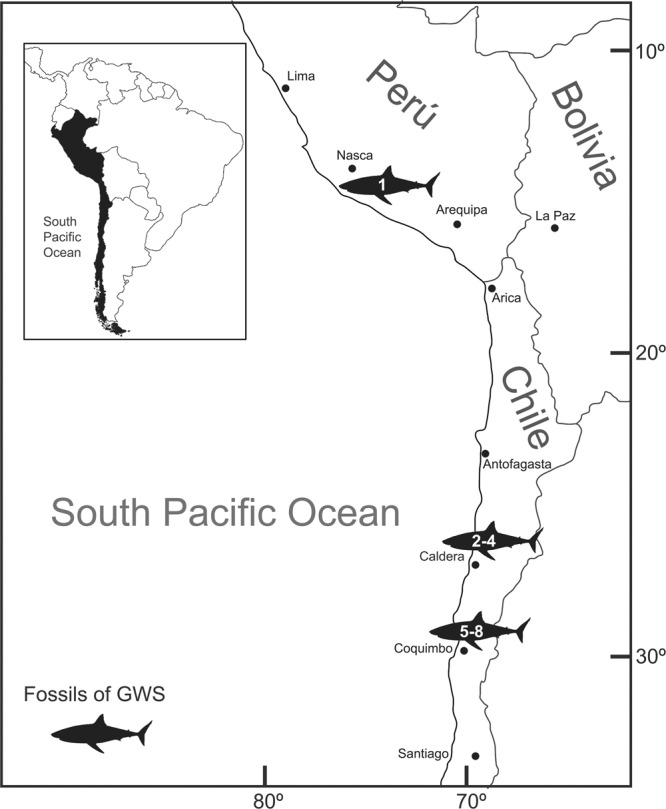
Shark nurseries are essential habitats for shark survival. Notwithstanding the rich fossil record of the modern great white shark (Carcharodon carcharias, GWS), its use of nursery areas in the fossil record has never been assessed before. Here, we analysed the fossil record of the GWS from three South American Pliocene localities, assessed body size distributions and applied previously established criteria to identify palaeo-nurseries. We found that juveniles dominate the Coquimbo locality (Chile), whereas subadults and adults characterize Pisco (Peru) and Caldera (Chile), respectively. These results, summed to the paleontological and paleoenvironmental record of the region, suggest that Coquimbo represents the first nursery area for the GWS in the fossil record. Our findings demonstrate that one of the top predators in today's oceans has used nursery areas for millions of years, highlighting their importance as essential habitats for shark survival in deep time.
鲨鱼类幼鱼养育场是鲨鱼生存的重要栖息地。尽管现代大白鲨(Carcharodon carcharias,GWS)的化石记录丰富,但它在化石记录中使用幼鱼养育场的情况以前从未被评估过。在这里,我们分析了来自三个南美的上新世地点的 GWS 化石记录,评估了体型分布,并应用了先前建立的标准来识别古幼鱼养育场。我们发现,在科金博地区(智利),幼年个体占主导地位,而皮斯科(秘鲁)和卡尔德拉(智利)则分别以亚成年个体和成年个体为特征。这些结果,加上该地区的古生物学和古环境记录,表明科金博代表了 GWS 在化石记录中的第一个幼鱼养育场。我们的研究结果表明,当今海洋中的顶级掠食者之一已经在幼鱼养育场中生活了数百万年,这凸显了它们作为鲨鱼在深远时间里生存的重要栖息地的重要性。