Department of Otorhinolaryngology, Amsterdam University Medical Centers, Location AMC, Amsterdam, The Netherlands.
Department of Otorhinolaryngology, Clinical and Experimental Audiology, Amsterdam University Medical Centers, Location AMC, Amsterdam, The Netherlands.
Eur Arch Otorhinolaryngol. 2020 Dec;277(12):3307-3313. doi: 10.1007/s00405-020-06041-4. Epub 2020 May 22.
The purpose of this study is the evaluation of post-operative hearing threshold after revision surgery and obliteration of troublesome canal wall down mastoidectomy cavities (CWDMCs). The ability to use and tolerate conventional hearing aids (CHAs) was also evaluated.
A retrospective chart analysis of 249 patients with chronically draining CWDMCs who underwent revision surgery including obliteration of the mastoid cavity between 2007 and 2017 at the AMC location of the Amsterdam University Medical Centers (Amsterdam UMC) was performed. Patient characteristics, pre- and post-operative Merchant grade, surgical outcomes, pre- and post-operative hearing thresholds, and the ability/necessity to use a CHA or the ability/necessity to use a Bone Conduction Device (BCD) were recorded.
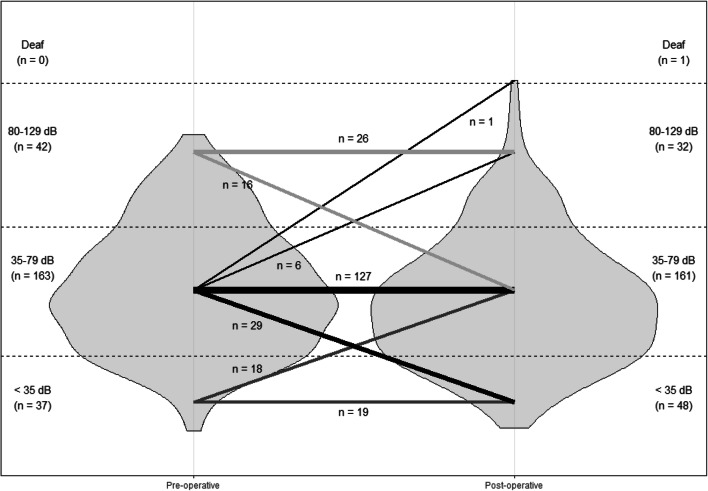
Dry ears were found in 95% of the total cohort. Residual disease was detected in 1.6% during MRI follow-up with no residual cholesteatoma in the obliterated area. In 3.2% of the patients, recurrent disease was found. A significant improvement in mean air conduction level, mean bone conduction level, and mean air-bone gap (ABG) was found post-operatively (p < 0.05). For all types of ossicular chain reconstruction, a significant improvement in mean Pure Tone Average was observed (p < 0.05). The percentage of patients with an indication for CHA was similar pre- and post-operatively (67% both pre- and post-operatively). The ability to use a CHA improved from 3% pre-operatively to 57% post-operatively (p < 0.001).
This study shows that revision surgery and obliteration of CWDMCs enable successful CHA rehabilitation post-operatively. Upon this type of surgery, hearing thresholds improve significantly, but the need for rehabilitation with a CHA remains necessary in most cases.
本研究旨在评估复发性手术和麻烦的完壁式乳突腔(CWDMC)填塞术后的听力阈值。同时评估了使用和耐受传统助听器(CHA)的能力。
回顾性分析了 2007 年至 2017 年期间在阿姆斯特丹大学医学中心(阿姆斯特丹 UMC)的 AMC 位置行复发性手术和 CWDMC 填塞术的 249 例慢性引流性 CWDMC 患者的病历。记录患者特征、术前和术后 Merchant 分级、手术结果、术前和术后听力阈值以及使用 CHA 或骨导设备(BCD)的能力/必要性。
总队列中有 95%的患者出现干耳。在 MRI 随访中,1.6%的患者发现残留疾病,在填塞区域无残留胆脂瘤。3.2%的患者发现复发病例。术后平均气导水平、平均骨导水平和平均气骨间隙(ABG)显著改善(p<0.05)。所有类型的听骨链重建后,平均纯音平均值均显著提高(p<0.05)。有 CHA 适应证的患者比例术前和术后相似(术前和术后均为 67%)。使用 CHA 的能力从术前的 3%提高到术后的 57%(p<0.001)。
本研究表明,复发性手术和 CWDMC 填塞术使患者术后能够成功地进行 CHA 康复。行此类手术后,听力阈值显著改善,但在大多数情况下仍需要通过 CHA 进行康复治疗。