Division of Gastroenterology, John T. Milliken Department of Medicine, Washington University School of Medicine in St. Louis, St. Louis, Missouri.
Center for Advanced Endoscopy, Division of Gastroenterology, Beth Israel Deaconess Medical Center, Harvard Medical School, Boston, Massachusetts.
Clin Gastroenterol Hepatol. 2020 Sep;18(10):2287-2294.e1. doi: 10.1016/j.cgh.2020.05.030. Epub 2020 May 22.
BACKGROUND & AIMS: Practices dramatically reduced endoscopy services due to the COVID-19 pandemic. Because practices now are considering reintroduction of elective endoscopy, we conducted a survey of North American practices to identify reactivation barriers and strategies.
We designed and electronically distributed a web-based survey to North American gastroenterologists consisting of 7 domains: institutional demographics, impact of COVID-19 on endoscopy practice, elective endoscopy resumption plans, anesthesia modifications, personal protective equipment policies, fellowship training, and telemedicine use. Responses were stratified by practice type: ambulatory surgery center (ASC) or hospital-based.
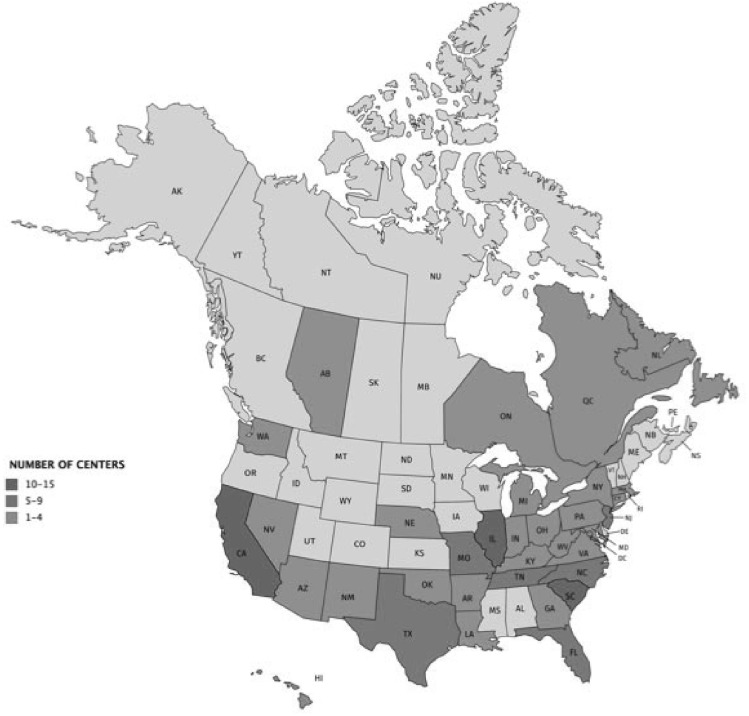
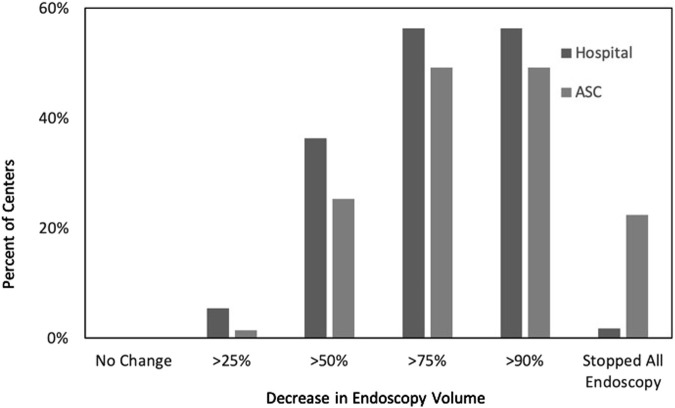
In total, 123 practices (55% ASC-based and 45% hospital-based) responded. At the pandemic's peak (as reported by the respondents), practices saw a 90% decrease in endoscopy volume, with most centers planning to resume elective endoscopy a median of 55 days after initial restrictions. Declining community prevalence of COVID-19, personal protective equipment availability, and preprocedure severe acute respiratory syndrome coronavirus 2 (SARS-CoV-2) testing availability were ranked as the 3 primary factors influencing reactivation timing. ASC-based practices were more likely to identify preprocedure testing availability as a major factor limiting elective endoscopy resumption (P = .001). Preprocedure SARS-CoV-2 testing was planned by only 49.2% of practices overall; when testing is performed and negative, 52.9% of practices will continue to use N95 masks.
This survey highlights barriers and variable strategies for reactivation of elective endoscopy services after the COVID-19 pandemic. Our results suggest that more widespread access to preprocedure SARS-CoV-2 tests with superior performance characteristics is needed to increase provider and patient comfort in proceeding with elective endoscopy.
由于 COVID-19 大流行,实践中大幅减少了内镜服务。由于现在各实践都在考虑重新开展择期内镜检查,我们对北美各实践进行了一项调查,以确定重新开展的障碍和策略。
我们设计并以电子方式向北美胃肠病学家分发了一项包含 7 个领域的网络调查:机构人口统计学、COVID-19 对内镜实践的影响、择期内镜检查恢复计划、麻醉修改、个人防护设备政策、住院医师培训和远程医疗使用。根据实践类型(门诊手术中心或医院)对回答进行分层。
共有 123 个实践(55%基于 ASC,45%基于医院)做出回应。在大流行高峰期(由受访者报告),内镜检查量下降了 90%,大多数中心计划在最初限制后中位数 55 天恢复择期内镜检查。社区 COVID-19 流行率下降、个人防护设备供应情况以及术前严重急性呼吸综合征冠状病毒 2(SARS-CoV-2)检测供应情况被列为影响重新激活时间的 3 个主要因素。基于 ASC 的实践更有可能将术前检测供应情况视为限制择期内镜检查恢复的主要因素(P=0.001)。总体而言,只有 49.2%的实践计划进行术前 SARS-CoV-2 检测;当检测结果为阴性时,52.9%的实践将继续使用 N95 口罩。
本调查突出了 COVID-19 大流行后重新开展择期内镜服务的障碍和可变策略。我们的结果表明,需要更广泛地获得具有更好性能特征的术前 SARS-CoV-2 检测,以增加提供者和患者对进行择期内镜检查的舒适度。