Department of Medicine, Perelman School of Medicine, University of Pennsylvania, Philadelphia, Pennsylvania, USA.
Department of Respiratory Medicine, Nagasaki University Hospital, Nagasaki, Japan.
Clin Infect Dis. 2021 Jul 15;73(2):283-290. doi: 10.1093/cid/ciaa595.
Pneumonia is a common, serious illness in the elderly, with a poorly characterized long-term impact on health-related quality of life (HRQoL). The Japanese Goto Epidemiology Study is a prospective, active, population-based surveillance study of adults with X-ray/CT scan-confirmed community-onset pneumonia, assessing the HRQoL outcome quality-adjusted life-years (QALYs). We report QALY scores and losses among a subset of participants in this study.
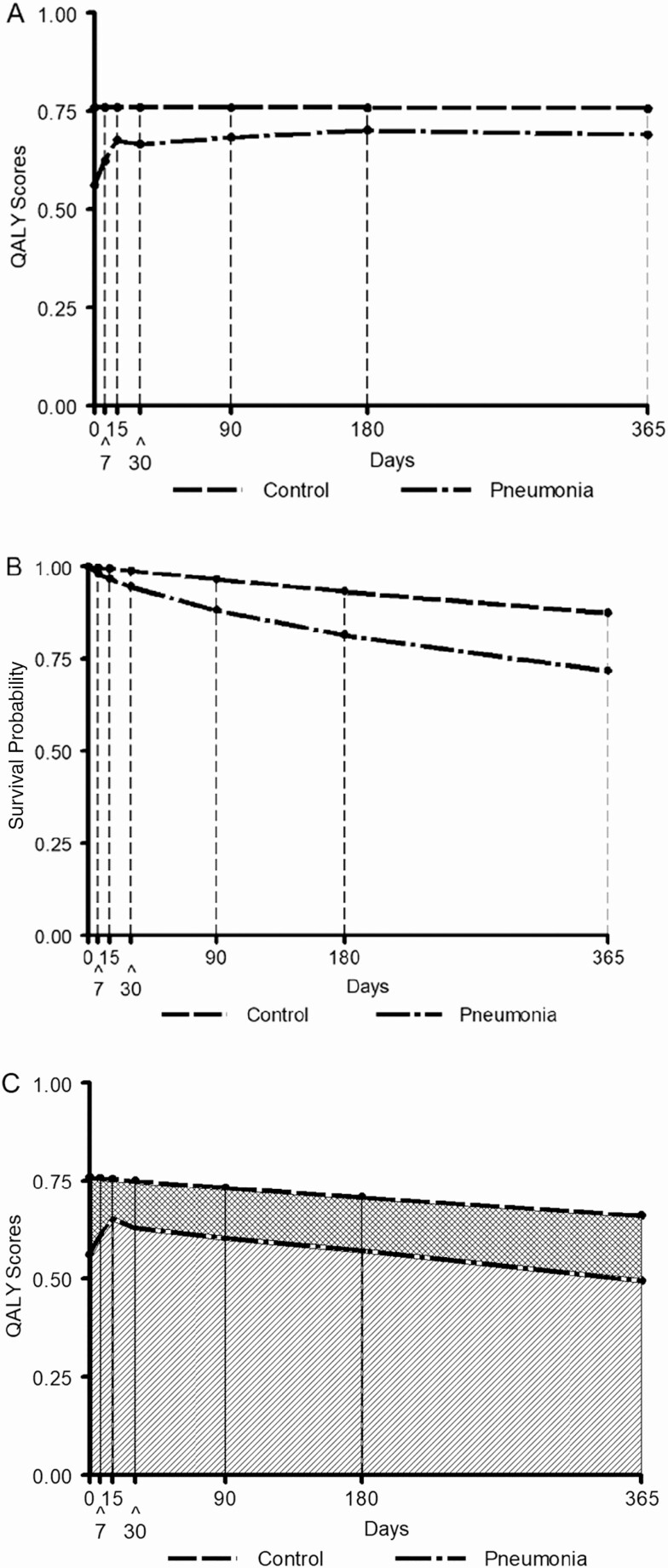
QALYs were derived from responses to the Japanese version of the EuroQol-5D-5L health-state classification instrument at days 0, 7, 15, 30, 90, 180, and 365 after pneumonia diagnosis from participants enrolled from June 2017 to May 2018. We used patients as their own controls, calculating comparison QALYs by extrapolating EuroQol-5D-5L scores for day -30, accounting for mortality and changes in scores with age.
Of 405 participants, 85% were aged ≥65 years, 58% were male, and 69% were hospitalized for clinically and radiologically confirmed pneumonia. Compliance with interviews by patients or proxies was 100%. Adjusted EuroQol-5D-5L scores were 0.759, 0.561, 0.702, and 0.689 at days -30, 0 (diagnosis), 180, and 365, respectively. Average scores at all time points remained below the average day -30 scores (P ≤ .001). Pneumonia resulted in a 1-year adjusted loss of 0.13 QALYs (~47.5 quality-adjusted days) (P < .001).
Substantial QALY losses were observed among Japanese adults following pneumonia diagnosis, and scores had not returned to prediagnosis levels at 1 year postdiagnosis. QALY scores and cumulative losses were comparable to those in US adults with chronic heart failure, stroke, or renal failure.
肺炎是老年人中常见的严重疾病,其对健康相关生活质量(HRQoL)的长期影响特征不明显。日本后藤流行病学研究是一项针对经 X 射线/CT 扫描确诊为社区获得性肺炎的成年人的前瞻性、主动、基于人群的监测研究,评估了与健康相关的生活质量调整后生命年(QALYs)。我们报告了该研究部分参与者的 QALY 评分和损失。
从 2017 年 6 月至 2018 年 5 月招募的参与者中,在肺炎诊断后第 0、7、15、30、90、180 和 365 天,通过回答日本版 EuroQol-5D-5L 健康状态分类量表,获得 QALY 评分。我们使用患者自身作为对照,通过外推第-30 天的 EuroQol-5D-5L 评分来计算比较 QALY,同时考虑死亡率和年龄变化的影响。
在 405 名参与者中,85%的人年龄≥65 岁,58%的人为男性,69%的人因临床和影像学确诊的肺炎住院。患者或其代理人对访谈的依从率为 100%。调整后的 EuroQol-5D-5L 评分分别为 -30 天、0 天(诊断)、180 天和 365 天的 0.759、0.561、0.702 和 0.689。所有时间点的平均评分均低于 -30 天的平均评分(P≤0.001)。肺炎导致 1 年调整后的 QALY 损失为 0.13(约 47.5 个质量调整生命日)(P<0.001)。
日本成年人肺炎诊断后,QALY 大量损失,且在诊断后 1 年时评分尚未恢复到诊断前水平。QALY 评分和累计损失与美国患有慢性心力衰竭、中风或肾衰竭的成年人相当。