Department of Health Services Research & Policy, London School of Hygiene & Tropical Medicine, WC1H 9SH, London, UK.
Modus Outcomes, Spirella Building, Letchworth Garden City, SG6 4ET, UK.
Health Qual Life Outcomes. 2020 May 24;18(1):148. doi: 10.1186/s12955-020-01396-y.
The growing move towards personalised health and social care systems means that every effort needs to be made to generate patient-reported outcome data. However, the deteriorating nature of dementia can make it difficult for people with dementia to complete self-reported questionnaires and it is often necessary to rely on a family member (proxy) to report on their behalf. There is little evidence to guide how the difference between self- and proxy-reports of health reported quality of life (HRQL) in dementia can be interpreted.
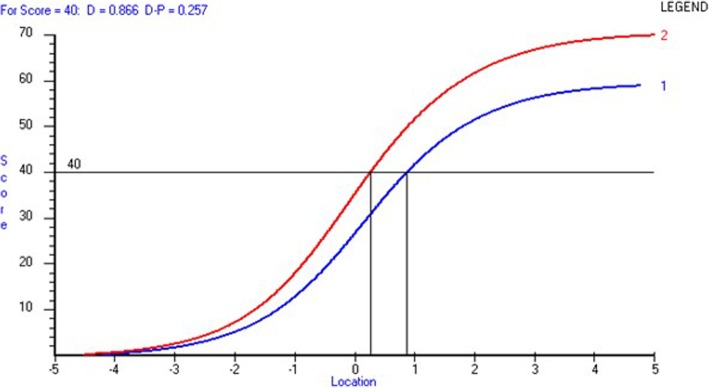
We recruited people with dementia and their family carers from 78 memory Assessment Services in the UK. We used Rasch measurement methods to investigate whether a HRQL questionnaire known as DEMQOL (self-reported by the person with dementia) and DEMQOL-Proxy (proxy-reported by a family carer) can be placed on the same continuum and whether a revised scoring algorithm, based on this equated model, can be developed that takes account of the relationship between self- and proxy-reports.
In a sample of 1434 patients and 1030 carers, our findings supported equating DEMQOL/DEMQOL-Proxy (overall fit to the model; no mis-fitting items) after addressing specific issues (eight disordered items requiring re-scoring, four pairs locally dependent items, and five items showing DIF). Cross walk tables have been produced.
We have established for the first time that DEMQOL and DEMQOL-Proxy can be placed on the same continuum and that patients and carer proxies are reporting on the same construct when they complete these questionnaires. Where possible both DEMQOL and DEMQOL-Proxy should still be administered together, using the improved scoring algorithm reported here. Where only DEMQOL-Proxy is available, the cross walk tables provide an estimate of DEMQOL for a particular person from their DEMQOL-Proxy score.
个性化健康和社会关怀系统的发展趋势意味着需要尽一切努力生成患者报告的结果数据。然而,痴呆症的恶化性质使得痴呆症患者难以完成自我报告的问卷,通常需要依靠家庭成员(代理人)代表他们报告。几乎没有证据可以指导如何解释痴呆症患者自我报告和代理报告的健康报告生活质量(HRQL)之间的差异。
我们从英国的 78 个记忆评估服务中招募了痴呆症患者及其家庭照顾者。我们使用 Rasch 测量方法来研究一种称为 DEMQOL(由痴呆症患者自我报告)和 DEMQOL-Proxy(由家庭照顾者代理报告)的 HRQL 问卷是否可以放在同一连续体上,以及是否可以开发基于该等效模型的修订评分算法,以考虑自我报告和代理报告之间的关系。
在 1434 名患者和 1030 名照顾者的样本中,我们的发现支持 DEMQOL/DEMQOL-Proxy 的等效(总体符合模型;无拟合不良项目),在解决特定问题后(需要重新评分的 8 个失调项目、4 对局部依赖项目和 5 个显示 DIF 的项目)。已制作交叉行走表。
我们首次建立了 DEMQOL 和 DEMQOL-Proxy 可以放在同一连续体上,并且患者和照顾者代理人在填写这些问卷时报告的是同一结构。在可能的情况下,仍然应该一起使用 DEMQOL 和 DEMQOL-Proxy,使用这里报告的改进评分算法。如果只有 DEMQOL-Proxy 可用,则交叉行走表可根据特定人员的 DEMQOL-Proxy 分数估算出 DEMQOL。