Akuta Norio, Kawamura Yusuke, Fujiyama Shunichiro, Sezaki Hitomi, Hosaka Tetsuya, Kobayashi Masahiro, Kobayashi Mariko, Saitoh Satoshi, Suzuki Fumitaka, Suzuki Yoshiyuki, Arase Yasuji, Ikeda Kenji, Kumada Hiromitsu
Department of Hepatology, Toranomon Hospital and Okinaka Memorial Institute for Medical Research, Japan.
Liver Research Laboratory, Toranomon Hospital, Japan.
Intern Med. 2020 Aug 15;59(16):1931-1937. doi: 10.2169/internalmedicine.4398-19. Epub 2020 May 23.
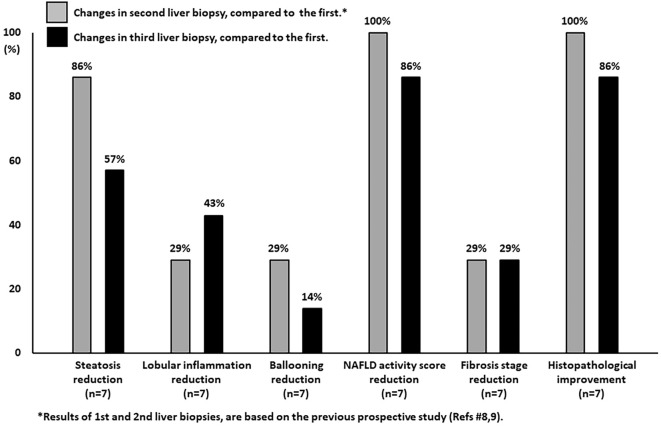
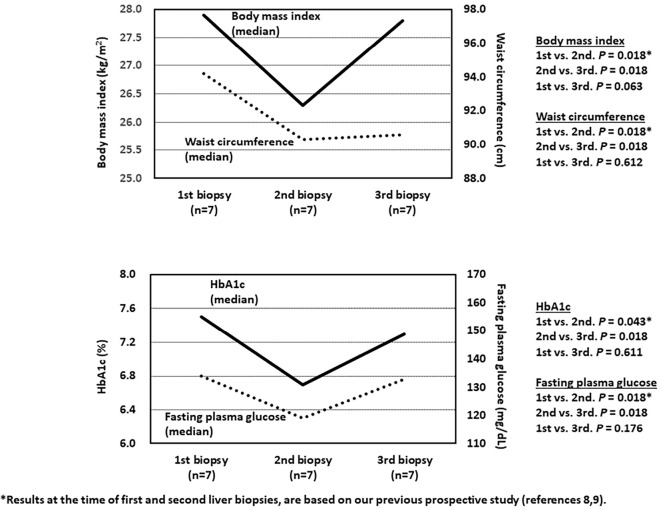
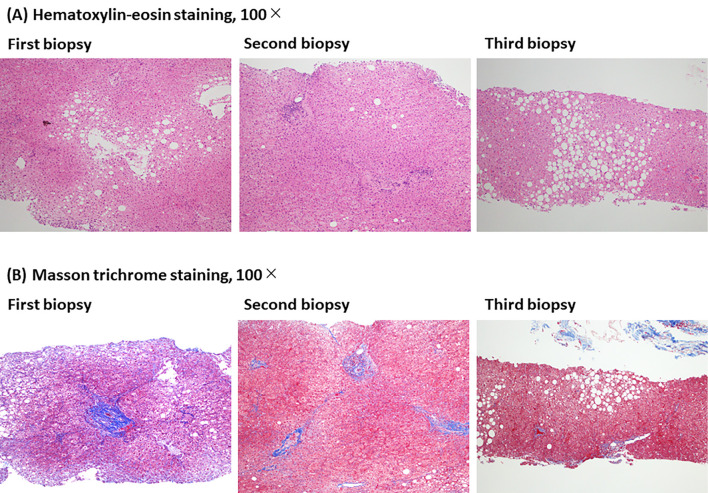
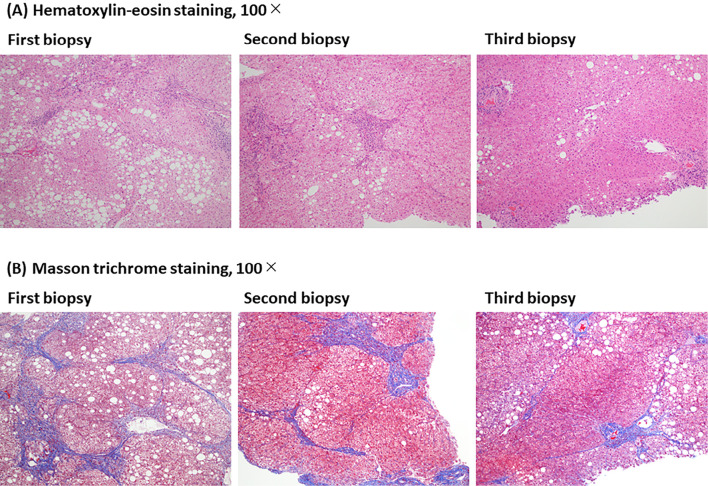
Objective The aim of this study was to determine the long-term effects of a sodium-glucose cotransporter 2 inhibitor (SGLT2i) in nonalcoholic fatty liver disease (NAFLD) patients with type 2 diabetes mellitus (T2DM) on the clinical features and liver histopathology. Methods In this retrospective study, the long-term histological impacts of SGLT2i in NAFLD patients with T2DM were investigated. Patients Seven patients with NAFLD and T2DM were treated for the long term with 100 mg/day canagliflozin, an SGLT2i, and liver biopsies were obtained at the 3 points of pretreatment, 24 weeks, and ≥1 year (third liver biopsy) after the start of treatment. Six of seven patients were evaluated with third liver biopsy at the point of three or more years. The primary outcome was liver histopathological changes (defined as a decrease in the NAFLD activity score of one point or more without worsening of the fibrosis stage, compared to pretreatment). Results All 7 patients showed worsening of body mass index and waist circumference at the third liver biopsy compared to 24 weeks. However, the scores of steatosis, lobular inflammation, ballooning, and fibrosis stage improved at the third liver biopsy in 57%, 43%, 14%, and 29% of the patients, respectively, compared to pretreatment. One of the seven patients showed histopathological worsening at the third liver biopsy compared to pretreatment, but the improvement was maintained in the other six patients. Conclusion The long-term treatment of NAFLD complicated by T2DM using an SGLT2i is associated with long-term improvement in liver histopathology despite the worsening of clinical features.
目的 本研究旨在确定钠-葡萄糖协同转运蛋白2抑制剂(SGLT2i)对2型糖尿病(T2DM)合并非酒精性脂肪性肝病(NAFLD)患者的临床特征和肝脏组织病理学的长期影响。方法 在这项回顾性研究中,调查了SGLT2i对T2DM合并NAFLD患者的长期组织学影响。患者 7例T2DM合并NAFLD患者长期接受100 mg/天的SGLT2i卡格列净治疗,并在治疗开始前、24周以及治疗开始后≥1年(第三次肝脏活检)这3个时间点进行肝脏活检。7例患者中有6例在三年或更长时间时接受了第三次肝脏活检评估。主要结局是肝脏组织病理学变化(定义为与治疗前相比,NAFLD活动评分降低1分或更多且纤维化阶段未恶化)。结果 与24周时相比,所有7例患者在第三次肝脏活检时体重指数和腰围均恶化。然而,与治疗前相比,第三次肝脏活检时分别有57%、43%、14%和29%的患者脂肪变性、小叶炎症、气球样变和纤维化阶段评分改善。7例患者中有1例在第三次肝脏活检时组织病理学较治疗前恶化,但其他6例患者维持改善。结论 使用SGLT2i对T2DM合并NAFLD进行长期治疗,尽管临床特征恶化,但与肝脏组织病理学的长期改善相关。