Population Health Sciences Institute, Newcastle University, Baddiley-Clark Building, Newcastle upon Tyne, NE2 4BN, UK.
MRC Biostatistics Unit, University of Cambridge, Institute of Public Health, Robinson Way, Cambridge, CB2 0SR, UK.
Trials. 2020 May 25;21(1):427. doi: 10.1186/s13063-020-04353-8.
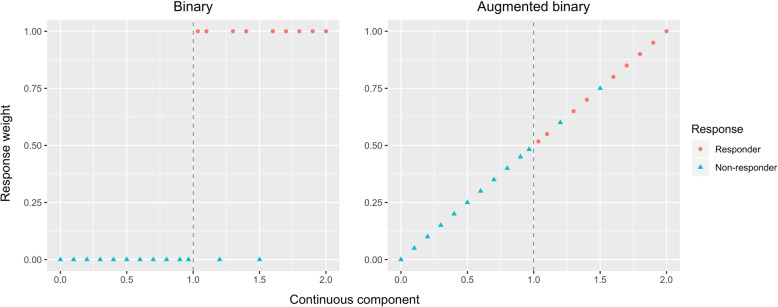
Clinical trials and other studies commonly assess the effectiveness of an intervention through the use of responder-based endpoints. These classify patients based on whether they meet a number of criteria which often involve continuous variables categorised as being above or below a threshold. The proportion of patients who are responders is estimated and, where relevant, compared between groups. An alternative method called the augmented binary method keeps the definition of the endpoint the same but utilises information contained within the continuous component to increase the power considerably (equivalent to increasing the sample size by > 30%). In this article we summarise the method and investigate the variety of clinical conditions that use endpoints to which it could be applied.
We reviewed a database of core outcome sets (COSs) that covered physiological and mortality trial endpoints recommended for collection in clinical trials of different disorders. We identified responder-based endpoints where the augmented binary method would be useful for increasing power.
Out of the 287 COSs reviewed, we identified 67 new clinical areas where endpoints were used that would be more efficiently analysed using the augmented binary method. Clinical areas that had particularly high numbers were rheumatology (11 clinical disorders identified), non-solid tumour oncology (10 identified), neurology (9 identified) and cardiovascular (8 identified).
The augmented binary method can potentially provide large benefits in a vast array of clinical areas. Further methodological development is needed to account for some types of endpoints.
临床试验和其他研究通常通过基于应答者的终点来评估干预措施的有效性。这些终点根据患者是否符合一系列标准对患者进行分类,这些标准通常涉及连续变量,分为高于或低于阈值。应答者的比例是估计的,并在相关情况下在组间进行比较。一种称为扩充二进制方法的替代方法保持终点的定义不变,但利用连续成分中的信息来显著提高功效(相当于将样本量增加>30%)。本文总结了该方法,并研究了可应用于该方法的各种临床情况。
我们回顾了一个涵盖不同疾病临床试验中推荐收集的生理和死亡率试验终点的核心结局集(COS)数据库。我们确定了基于应答者的终点,对于这些终点,扩充二进制方法可用于提高功效。
在审查的 287 个 COS 中,我们确定了 67 个新的临床领域,其中使用的终点如果使用扩充二进制方法进行分析,效率会更高。数量特别多的临床领域是风湿病学(确定了 11 种临床疾病)、非实体瘤肿瘤学(确定了 10 种)、神经病学(确定了 9 种)和心血管(确定了 8 种)。
扩充二进制方法可能在广泛的临床领域中提供巨大的好处。需要进一步的方法学发展来考虑某些类型的终点。