Singapore Immunology Network, Agency for Science, Technology, and Research (A*STAR), Singapore, 138648, Singapore.
Division of Medical Oncology, National Cancer Centre Singapore, Singapore, 169610, Singapore.
Cancer Gene Ther. 2021 Feb;28(1-2):5-17. doi: 10.1038/s41417-020-0183-x. Epub 2020 May 27.
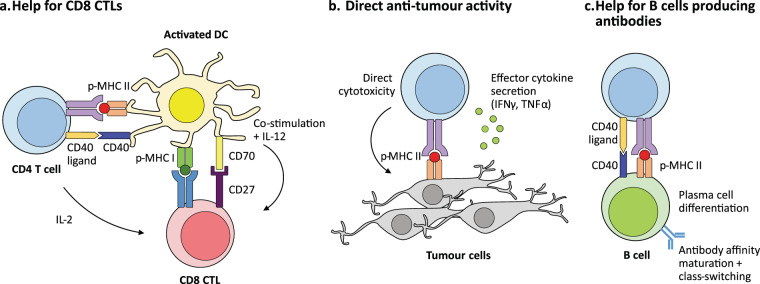
Cancer immunotherapy has revolutionised cancer treatment, with immune checkpoint blockade (ICB) therapy and adoptive cell therapy (ACT) increasingly becoming standard of care across a growing number of cancer indications. While the majority of cancer immunotherapies focus on harnessing the anti-tumour CD8 cytotoxic T cell response, the potential role of CD4 'helper' T cells has largely remained in the background. In this review, we give an overview of the multifaceted role of CD4 T cells in the anti-tumour immune response, with an emphasis on recent evidence that CD4 T cells play a bigger role than previously thought. We illustrate their direct anti-tumour potency and their role in directing a sustained immune response against tumours. We further highlight the emerging observation that CD4 T cell responses against tumours tend to be against self-derived epitopes. These recent trends raise vital questions and considerations that will profoundly affect the rational design of immunotherapies to leverage on the full potential of the immune system against cancer.
癌症免疫疗法已经彻底改变了癌症治疗方式,免疫检查点阻断(ICB)疗法和过继细胞疗法(ACT)越来越多地成为越来越多癌症适应症的标准治疗方法。虽然大多数癌症免疫疗法都专注于利用抗肿瘤 CD8 细胞毒性 T 细胞反应,但 CD4“辅助”T 细胞的潜在作用在很大程度上仍处于次要地位。在这篇综述中,我们概述了 CD4 T 细胞在抗肿瘤免疫反应中的多方面作用,重点介绍了最近的证据表明 CD4 T 细胞的作用比以前认为的更大。我们说明了它们直接的抗肿瘤效力及其在指导针对肿瘤的持续免疫反应中的作用。我们还强调了一个新的观察结果,即针对肿瘤的 CD4 T 细胞反应往往针对源自自身的表位。这些新趋势提出了至关重要的问题和考虑因素,这些问题和考虑因素将深刻影响免疫疗法的合理设计,以充分发挥免疫系统对抗癌症的潜力。