Liebe Franziska, Liebe Hendrik, Kaessmeyer Sabine, Sponder Gerhard, Stumpff Friederike
Institute of Veterinary Physiology, Freie Universität Berlin, Oertzenweg 19b, 14163, Berlin, Germany.
Department of Biology, Chemistry, and Pharmacy, Freie Universität Berlin, Arnimallee 22, 14195, Berlin, Germany.
Pflugers Arch. 2020 Jun;472(6):693-710. doi: 10.1007/s00424-020-02393-2. Epub 2020 May 26.
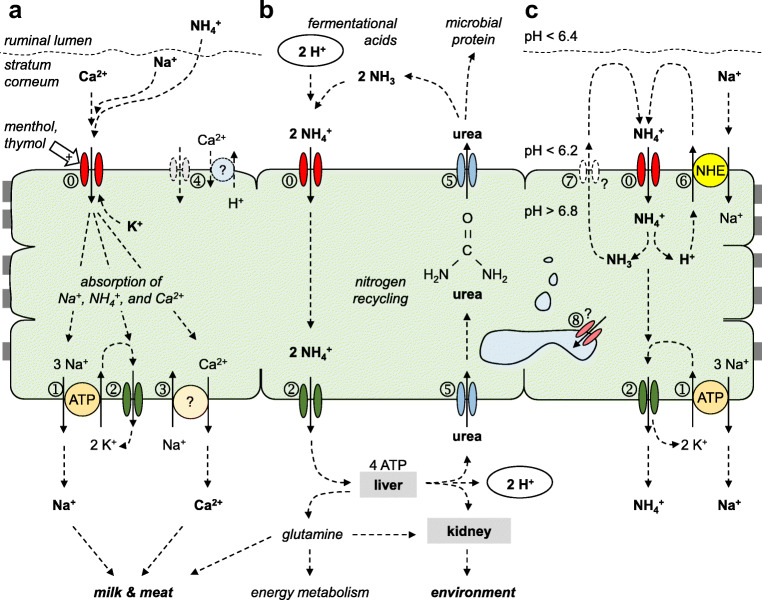
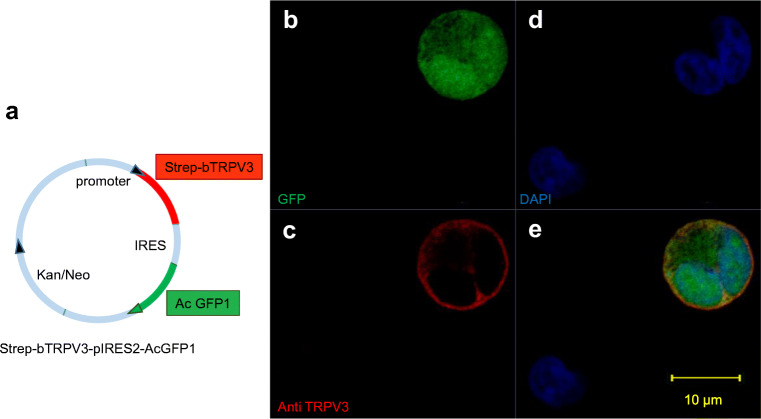
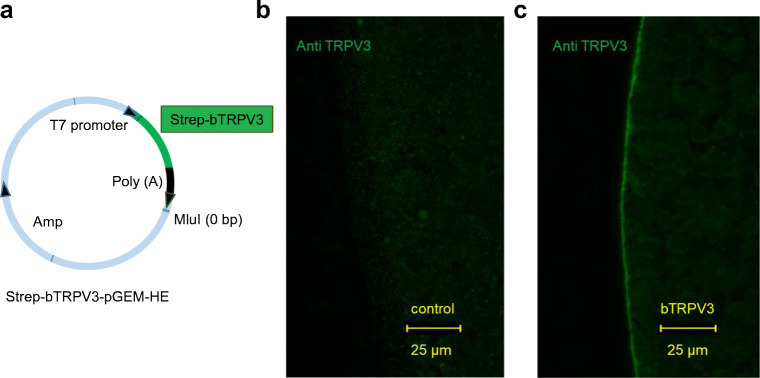
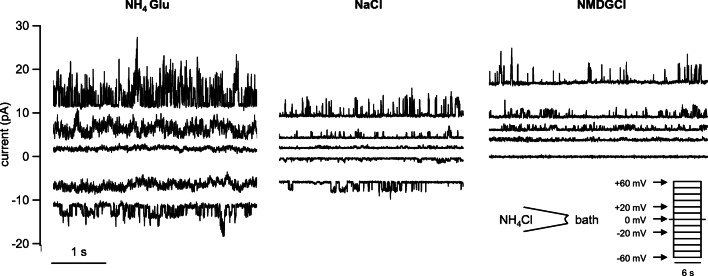
Large quantities of ammonia (NH or NH) are absorbed from the gut, associated with encephalitis in hepatic disease, poor protein efficiency in livestock, and emissions of nitrogenous climate gasses. Identifying the transport mechanisms appears urgent. Recent functional and mRNA data suggest that absorption of ammonia from the forestomach of cattle may involve TRPV3 channels. The purpose of the present study was to sequence the bovine homologue of TRPV3 (bTRPV3), localize the protein in ruminal tissue, and confirm transport of NH. After sequencing, bTRPV3 was overexpressed in HEK-293 cells and Xenopus oocytes. An antibody was selected via epitope screening and used to detect the protein in immunoblots of overexpressing cells and bovine rumen, revealing a signal of the predicted ~ 90 kDa. In rumen only, an additional ~ 60 kDa band appeared, which may represent a previously described bTRPV3 splice variant of equal length. Immunohistochemistry revealed staining from the ruminal stratum basale to stratum granulosum. Measurements with pH-sensitive microelectrodes showed that NH acidifies Xenopus oocytes, with overexpression of bTRPV3 enhancing permeability to NH. Single-channel measurements revealed that Xenopus oocytes endogenously expressed small cation channels in addition to fourfold-larger channels only observed after expression of bTRPV3. Both endogenous and bTRPV3 channels conducted NH, Na, and K. We conclude that bTRPV3 is expressed by the ruminal epithelium on the protein level. In conjunction with data from previous studies, a role in the transport of Na, Ca, and NH emerges. Consequences for calcium homeostasis, ruminal pH, and nitrogen efficiency in cattle are discussed.
大量的氨(NH₃或NH₄⁺)从肠道吸收,与肝脏疾病中的脑炎、家畜蛋白质利用效率低下以及含氮气候气体排放有关。确定其转运机制显得十分迫切。近期的功能和mRNA数据表明,牛前胃对氨的吸收可能涉及瞬时受体电位香草酸亚型3(TRPV3)通道。本研究的目的是对牛TRPV3同源物(bTRPV3)进行测序,在瘤胃组织中定位该蛋白,并证实氨的转运。测序后,bTRPV3在人胚肾293(HEK-293)细胞和非洲爪蟾卵母细胞中过表达。通过表位筛选选择了一种抗体,并用于检测过表达细胞和牛瘤胃免疫印迹中的蛋白,显示出预测的约90 kDa的信号。仅在瘤胃中出现了一条额外的约60 kDa条带,这可能代表先前描述的等长bTRPV3剪接变体。免疫组织化学显示从瘤胃基底层到颗粒层均有染色。用pH敏感微电极测量表明,氨使非洲爪蟾卵母细胞酸化,bTRPV3过表达增强了对氨的通透性。单通道测量显示,非洲爪蟾卵母细胞内源性表达小阳离子通道,此外仅在bTRPV3表达后才观察到四倍大的通道。内源性通道和bTRPV3通道都能传导氨、钠和钾。我们得出结论,bTRPV3在蛋白水平上由瘤胃上皮表达。结合先前研究的数据,其在钠、钙和氨的转运中发挥作用。讨论了对牛钙稳态、瘤胃pH值和氮效率的影响。