Department of Orthopedics, Beijing Friendship Hospital, Capital Medical University, Beijing 100050, China.
Department of Orthopedics, Beijing Chao-Yang Hospital, Capital Medical University, Beijing 100020, China.
Biomed Res Int. 2020 May 1;2020:8078641. doi: 10.1155/2020/8078641. eCollection 2020.
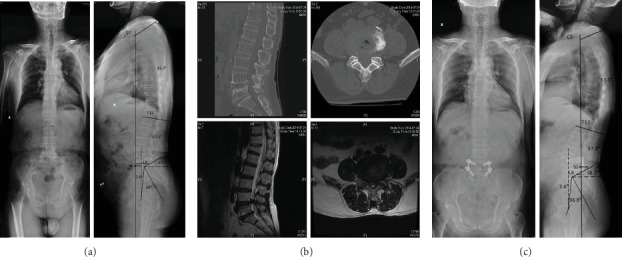
To evaluate the clinical significance of spinal decompression and fusion for lumbar spinal stenosis in old patients under Roussouly classification, 160 old patients (>60 year old) with lumbar spinal stenosis underwent spinal decompression, and fusion were retrospectively studied. According to Roussouly classification, patients were divided into 4 groups, in which Roussouly types I, II, and IV were the nonstandard group and Roussouly type III was the standard group. Visual analog scale (waist, leg) and Oswestry disability index (ODI) scores were recorded before operation and at the final follow-up. All patients improved the sagittal curvature: for patients in Roussouly types I and II, there were statistically significant differences in terms of postoperative global lordosis (GL), global kyphosis (GK), sacral slope (SS), sagittal vertical axis (SVA), and pelvic tilt (PT) compared with that before surgery (all < 0.001); patients in Roussouly type IV obtained similar results with type III after surgery. The four groups showed significant improvement in ODI and VAS scores at final follow-up (all < 0.001). After regrouping at the final follow-up, the proportion of the standard type (Roussouly type III) patients was increased compared with preoperative. In conclusion, Roussouly classification has important guiding significance in spinal decompression and fusion for old patients (>60 years) with lumbar spinal stenosis.
为了评估 Roussouly 分类下老年腰椎管狭窄症患者脊柱减压融合的临床意义,回顾性研究了 160 例老年(>60 岁)腰椎管狭窄症患者行脊柱减压融合术。根据 Roussouly 分类,患者分为 4 组,其中 Roussouly 类型 I、II 和 IV 为非标准组,Roussouly 类型 III 为标准组。记录术前和末次随访时的视觉模拟评分(腰、腿)和 Oswestry 功能障碍指数(ODI)评分。所有患者的矢状曲度均得到改善:Roussouly 类型 I 和 II 的患者术后整体后凸(GL)、整体前凸(GK)、骶骨倾斜角(SS)、矢状轴垂直距离(SVA)和骨盆倾斜角(PT)与术前相比均有统计学差异(均<0.001);Roussouly 类型 IV 患者术后与 Roussouly 类型 III 相似。四组患者末次随访时 ODI 和 VAS 评分均明显改善(均<0.001)。末次随访时重新分组后,标准型(Roussouly 类型 III)患者的比例较术前增加。总之,Roussouly 分类对老年(>60 岁)腰椎管狭窄症患者脊柱减压融合具有重要的指导意义。