Leiden Institute of Advanced Computer Science (LIACS), Leiden University, Leiden, The Netherlands.
Understanding Evolution, Naturalis Biodiversity Center, Leiden, The Netherlands.
J Integr Bioinform. 2020 May 28;17(1):20190046. doi: 10.1515/jib-2019-0046.
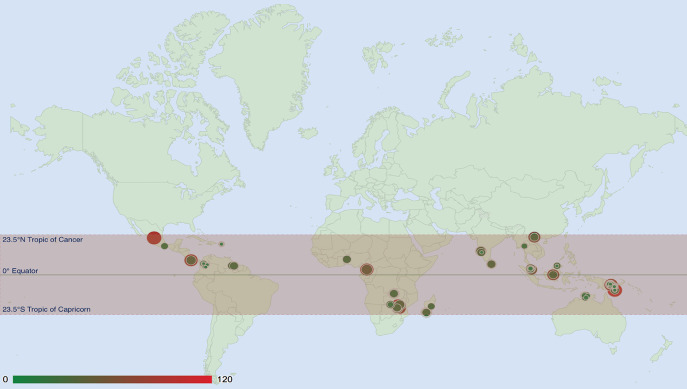
Fungi have crucial roles in ecosystems, and are important associates for many organisms. They are adapted to a wide variety of habitats, however their global distribution and diversity remains poorly documented. The exponential growth of DNA barcode information retrieved from the environment is assisting considerably the traditional ways for unraveling fungal diversity and detection. The raw DNA data in association to environmental descriptors of metabarcoding studies are made available in public sequence read archives. While this is potentially a valuable source of information for the investigation of Fungi across diverse environmental conditions, the annotation used to describe environment is heterogenous. Moreover, a uniform processing pipeline still needs to be applied to the available raw DNA data. Hence, a comprehensive framework to analyses these data in a large context is still lacking. We introduce the MycoDiversity DataBase, a database which includes public fungal metabarcoding data of environmental samples for the study of biodiversity patterns of Fungi. The framework we propose will contribute to our understanding of fungal biodiversity and aims to become a valuable source for large-scale analyses of patterns in space and time, in addition to assisting evolutionary and ecological research on Fungi.
真菌在生态系统中起着至关重要的作用,是许多生物的重要伙伴。它们适应于各种各样的栖息地,但它们的全球分布和多样性仍然记录不佳。从环境中检索到的 DNA 条形码信息的指数增长,极大地帮助了传统的方法来揭示真菌多样性和检测。与宏条形码研究的环境描述符相关的原始 DNA 数据可在公共序列读取档案中获得。虽然这是一个潜在的有价值的信息来源,用于调查不同环境条件下的真菌,但用于描述环境的注释是异构的。此外,仍然需要对可用的原始 DNA 数据应用统一的处理管道。因此,在大范围内分析这些数据的综合框架仍然缺乏。我们引入了 MycoDiversity DataBase,这是一个数据库,其中包括环境样本的真菌宏条形码数据,用于研究真菌生物多样性模式。我们提出的框架将有助于我们理解真菌生物多样性,并旨在成为大规模分析空间和时间模式的有价值的资源,除了协助真菌的进化和生态研究。