Coluccio Maria Laura, Gentile Francesco, Presta Ivan, Donato Giuseppe, Coppedè Nicola, Valprapuram Immanuel, Mignogna Chiara, Lavecchia Annamaria, Figuccia Federica, Garo Virginia M, Fabrizio Enzo Di, Candeloro Patrizio, Viglietto Giuseppe, Malara Natalia
Department of Experimental and Clinical Medicine, University Magna Graecia, 88100 Catanzaro, Italy.
Department of Electrical Engineering and Information Technology, University Federico II, 80125 Naples, Italy.
Cancers (Basel). 2020 May 26;12(6):1362. doi: 10.3390/cancers12061362.
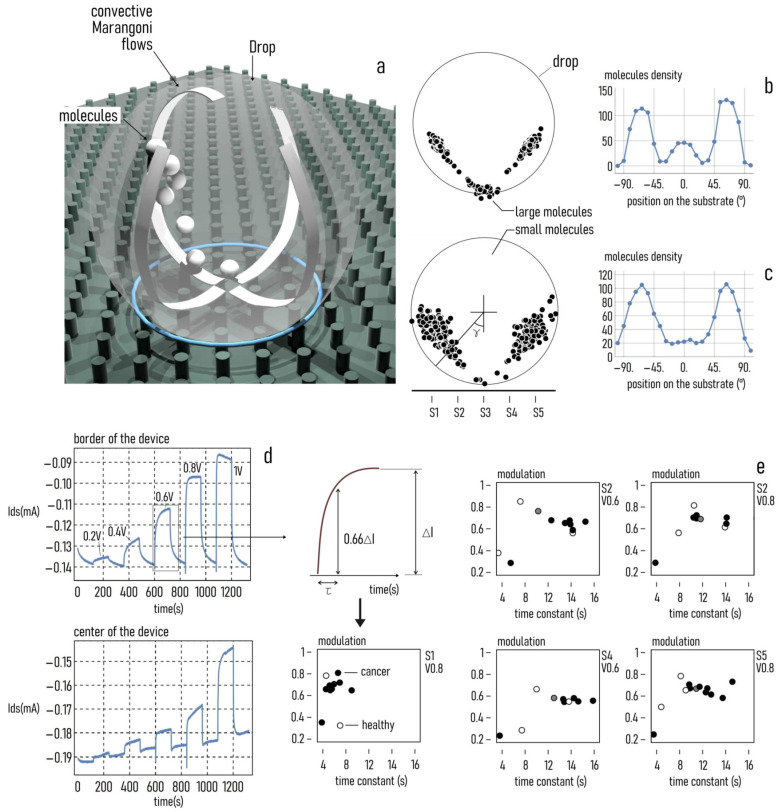
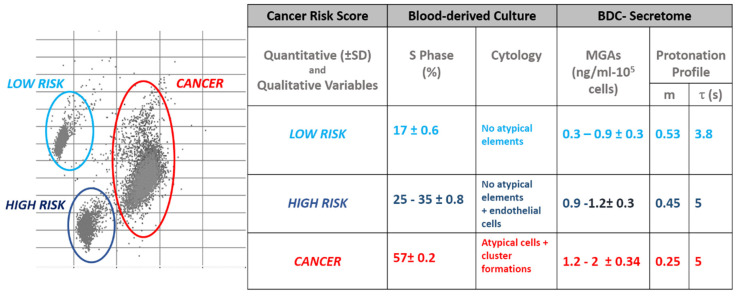
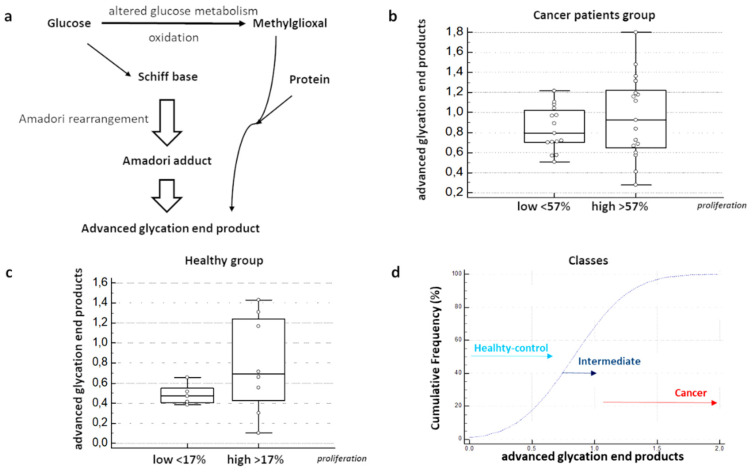
The molecular protonation profiles obtained by means of an organic electrochemical transistor, which is used for analysis of molecular products released by blood-derived cultures, contain a large amount of information The transistor is based on the conductive polymer PEDOT:PSS comprising super hydrophobic SU8 pillars positioned on the substrate to form a non-periodic square lattice to measure the state of protonation on secretomes derived from liquid biopsies. In the extracellular space of cultured cells, the number of glycation products increase, driven both by a glycolysis metabolism and by a compromised function of the glutathione redox system. Glycation products are a consequence of the interaction of the reactive aldehydes and side glycolytic products with other molecules. As a result, the amount of the glycation products reflects the anti-oxidative cellular reserves, counteracting the reactive aldehyde production of which both the secretome protonation profile and cancer risk are related. The protonation profiles can be profitably exploited through the use of mathematical techniques and multivariate statistics. This study provides a novel chemometric approach for molecular analysis of protonation and discusses the possibility of constructing a predictive cancer risk model based on the exploration of data collected by conventional analysis techniques and novel nanotechnological devices.
通过用于分析血液来源培养物释放的分子产物的有机电化学晶体管获得的分子质子化谱包含大量信息。该晶体管基于导电聚合物PEDOT:PSS,其包括位于基板上的超疏水SU8柱,以形成非周期性方格,用于测量源自液体活检的分泌蛋白组上的质子化状态。在培养细胞的细胞外空间中,糖基化产物的数量增加,这是由糖酵解代谢和谷胱甘肽氧化还原系统功能受损共同驱动的。糖基化产物是反应性醛与糖酵解副产物与其他分子相互作用的结果。因此,糖基化产物的量反映了抗氧化细胞储备,抵消了与分泌蛋白组质子化谱和癌症风险相关的反应性醛的产生。质子化谱可以通过使用数学技术和多元统计进行有效利用。本研究提供了一种用于质子化分子分析的新型化学计量方法,并讨论了基于对传统分析技术和新型纳米技术设备收集的数据进行探索构建预测性癌症风险模型的可能性。