Zhang Chen, Gou Xin, He Weiyang, Yang Huaan, Yin Hubin
2Department of Gynecology and Obstetrics, The First Affiliated Hospital of Chongqing Medical University, No.1 Youyi Road, Chongqing, 400016 China.
4Chongqing Key Laboratory of Maternal and Fetal Medicine, The First Affiliated Hospital of Chongqing Medical University, No.1 Youyi Road, Chongqing, 400016 China.
Cancer Cell Int. 2020 May 20;20:177. doi: 10.1186/s12935-020-01255-2. eCollection 2020.
Bladder cancer is one of the most prevalent malignancies worldwide. However, traditional indicators have limited predictive effects on the clinical outcomes of bladder cancer. The aim of this study was to develop and validate a glycolysis-related gene signature for predicting the prognosis of patients with bladder cancer that have limited therapeutic options.
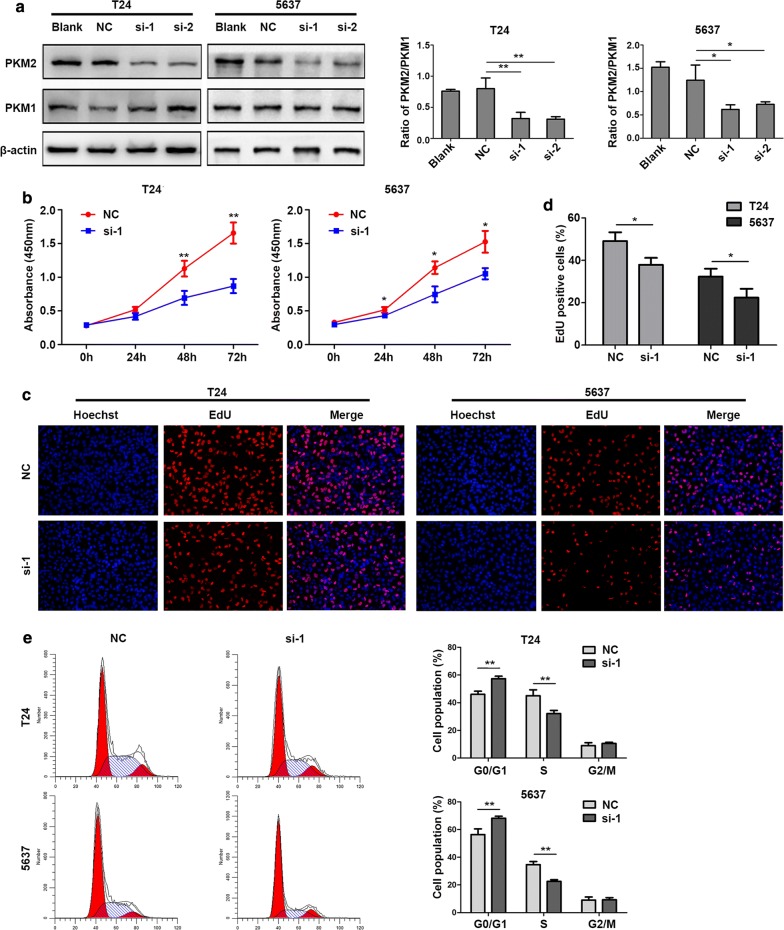
mRNA expression profiling was obtained from patients with bladder cancer from The Cancer Genome Atlas (TCGA) database. Gene set enrichment analysis (GSEA) was conducted to identify glycolytic gene sets that were significantly different between bladder cancer tissues and paired normal tissues. A prognosis-related gene signature was constructed by univariate and multivariate Cox analysis. Kaplan-Meier curves and time-dependent receiver operating characteristic (ROC) curves were utilized to evaluate the signature. A nomogram combined with the gene signature and clinical parameters was constructed. Correlations between glycolysis-related gene signature and molecular characterization as well as cancer subtypes were analyzed. RT-qPCR was applied to analyze gene expression. Functional experiments were performed to determine the role of PKM2 in the proliferation of bladder cancer cells.
Using a Cox proportional regression model, we established that a 4-mRNA signature (NUP205, NUPL2, PFKFB1 and PKM) was significantly associated with prognosis in bladder cancer patients. Based on the signature, patients were split into high and low risk groups, with different prognostic outcomes. The gene signature was an independent prognostic indicator for overall survival. The ability of the 4-mRNA signature to make an accurate prognosis was tested in two other validation datasets. GSEA was performed to explore the 4-mRNA related canonical pathways and biological processes, such as the cell cycle, hypoxia, p53 pathway, and PI3K/AKT/mTOR pathway. A heatmap showing the correlation between risk score and cell cycle signature was generated. RT-qPCR revealed the genes that were differentially expressed between normal and cancer tissues. Experiments showed that PKM2 plays essential roles in cell proliferation and the cell cycle.
The established 4‑mRNA signature may act as a promising model for generating accurate prognoses for patients with bladder cancer, but the specific biological mechanism needs further verification.
膀胱癌是全球最常见的恶性肿瘤之一。然而,传统指标对膀胱癌临床结局的预测作用有限。本研究的目的是开发并验证一种与糖酵解相关的基因特征,用于预测治疗选择有限的膀胱癌患者的预后。
从癌症基因组图谱(TCGA)数据库中获取膀胱癌患者的mRNA表达谱。进行基因集富集分析(GSEA)以鉴定膀胱癌组织与配对正常组织之间存在显著差异的糖酵解基因集。通过单因素和多因素Cox分析构建预后相关基因特征。利用Kaplan-Meier曲线和时间依赖性受试者工作特征(ROC)曲线评估该特征。构建结合基因特征和临床参数的列线图。分析与糖酵解相关基因特征与分子特征以及癌症亚型之间的相关性。应用RT-qPCR分析基因表达。进行功能实验以确定PKM2在膀胱癌细胞增殖中的作用。
使用Cox比例回归模型,我们确定了一个由4个mRNA组成的特征(NUP205、NUPL2、PFKFB1和PKM)与膀胱癌患者的预后显著相关。基于该特征,患者被分为高风险组和低风险组,预后结果不同。该基因特征是总生存的独立预后指标。在另外两个验证数据集中测试了4个mRNA特征进行准确预后判断的能力。进行GSEA以探索与这4个mRNA相关的典型通路和生物学过程,如细胞周期、缺氧、p53通路和PI3K/AKT/mTOR通路。生成了显示风险评分与细胞周期特征之间相关性的热图。RT-qPCR揭示了正常组织和癌组织之间差异表达的基因。实验表明PKM2在细胞增殖和细胞周期中起重要作用。
所建立的4个mRNA特征可能是为膀胱癌患者生成准确预后的有前景的模型,但具体生物学机制需要进一步验证。