Hooley Cole, Baumann Ana A, Mutabazi Vincent, Brown Angela, Reeds Dominic, Cade W Todd, de las Fuentes Lisa, Proctor Enola K, Karengera Stephen, Schecthman Kenneth, Goss Charles, Launois Pascal, Davila-Roman Victor G, Mutimura Eugene
1Brown School of Social Work, WUSTL, St. Louis, MO USA.
2Regional Alliance for Sustainable Development (RASD) Rwanda, Kigali, Rwanda.
Pilot Feasibility Stud. 2020 May 15;6:66. doi: 10.1186/s40814-020-00607-z. eCollection 2020.
Hypertension (HTN) affects nearly 1 billion people globally and is a major cause of morbidity and mortality. In low- and middle-income countries (LMICs), HTN represents an unmet health care gap that can be addressed by strengthening national health care systems. The National Heart, Lung, and Blood Institute recently funded the T4 Translation Research Capacity Building Initiative in Low Income Countries (TREIN) program to build capacity in dissemination and implementation (D&I) research in HTN in LMICs. The Special Programme for Research and Training in Tropical Diseases (TDR) at the World Health Organization (WHO) recently developed a massive open online course (MOOC) to train in D&I. Herein, we report on the use of the TDR WHO MOOC in D&I for the TREIN program in Rwanda, assessing feasibility of the MOOC and D&I competencies after MOOC training.
Participants in one-group MOOC training completed pre- and post-training questionnaires to assess dissemination and implementation (D&I) competency outcomes and feasibility. D&I competencies were measured by use of a scale developed for a US-based training program, with the change in competency scores assessed by paired test. Feasibility was measured by completion of homework and final project assignment and analyzed using descriptive statistics.
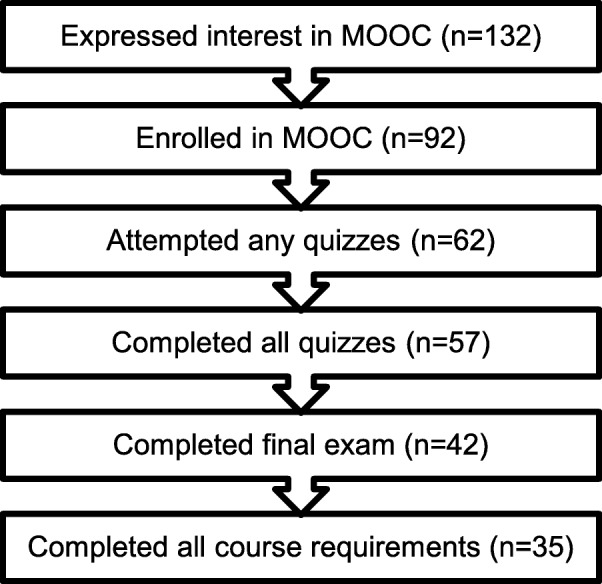
Of the 92 trainees enrolled, 35 (38%) completed all MOOC components. D&I competency scores showed strong evidence of improvements from pre- to post-test. The full-scale average score improved by an average of 1.09 points, representing an effect size of 1.25 (CI 0.48-2.00); all four subscales also showed strong evidence of improvements. Trainees reported challenges to MOOC course completion that included technological issues (i.e., limited internet access) and competing demands (i.e., work, family).
In the context of LMIC training, the MOOC course was feasible and course completion showed improvement in D&I competency scores. While the program was designed with a focus on training for tropical diseases, there is potential for scalability to a wider audience of health care researchers, workers, administrators, and policymakers in LMIC interested in D&I research in non-communicable diseases.
高血压(HTN)全球影响近10亿人,是发病和死亡的主要原因。在低收入和中等收入国家(LMICs),高血压代表了一个未得到满足的医疗保健差距,可通过加强国家医疗保健系统来解决。美国国立心肺血液研究所最近资助了低收入国家T4翻译研究能力建设倡议(TREIN)项目,以建设LMICs高血压传播与实施(D&I)研究的能力。世界卫生组织(WHO)的热带病研究和培训特别规划(TDR)最近开发了一门大规模开放在线课程(MOOC)用于D&I培训。在此,我们报告卢旺达TREIN项目中TDR WHO MOOC在D&I中的使用情况,评估MOOC的可行性以及MOOC培训后的D&I能力。
一组MOOC培训的参与者完成培训前和培训后的问卷,以评估传播与实施(D&I)能力结果和可行性。D&I能力通过使用为美国一个培训项目开发的量表进行测量,能力得分的变化通过配对检验进行评估。可行性通过完成作业和最终项目任务来衡量,并使用描述性统计进行分析。
在登记的92名学员中,35名(38%)完成了所有MOOC组件。D&I能力得分显示出从测试前到测试后有显著改善的有力证据。全量表平均得分平均提高了1.09分,效应大小为1.25(CI 0.48 - 2.00);所有四个子量表也显示出有显著改善的有力证据。学员报告了MOOC课程完成方面的挑战,包括技术问题(即互联网接入有限)和相互竞争的需求(即工作、家庭)。
在LMIC培训背景下,MOOC课程是可行的,课程完成情况显示D&I能力得分有所提高。虽然该项目的设计重点是热带病培训,但有可能扩大到对非传染性疾病D&I研究感兴趣的LMIC的更广泛医疗保健研究人员、工作者、管理人员和政策制定者群体。