Dana-Farber Cancer Institute, Boston, MA.
University of Colorado Cancer Center, Aurora, CO.
J Clin Oncol. 2020 Aug 10;38(23):2610-2619. doi: 10.1200/JCO.20.00775. Epub 2020 May 29.
In the HER2CLIMB study, patients with human epidermal growth factor receptor 2 (HER2)-positive breast cancer with brain metastases (BMs) showed statistically significant improvement in progression-free survival (PFS) with tucatinib. We describe exploratory analyses of intracranial efficacy and survival in participants with BMs.
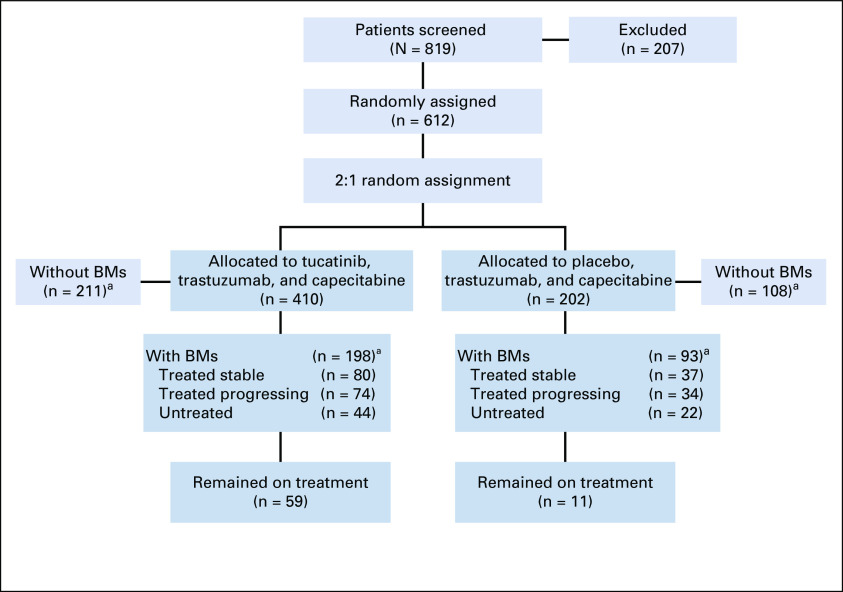
Patients were randomly assigned 2:1 to tucatinib or placebo, in combination with trastuzumab and capecitabine. All patients underwent baseline brain magnetic resonance imaging; those with BMs were classified as active or stable. Efficacy analyses were performed by applying RECIST 1.1 criteria to CNS target lesions by investigator assessment. CNS-PFS (intracranial progression or death) and overall survival (OS) were evaluated in all patients with BMs. Confirmed intracranial objective response rate (ORR-IC) was evaluated in patients with measurable intracranial disease.
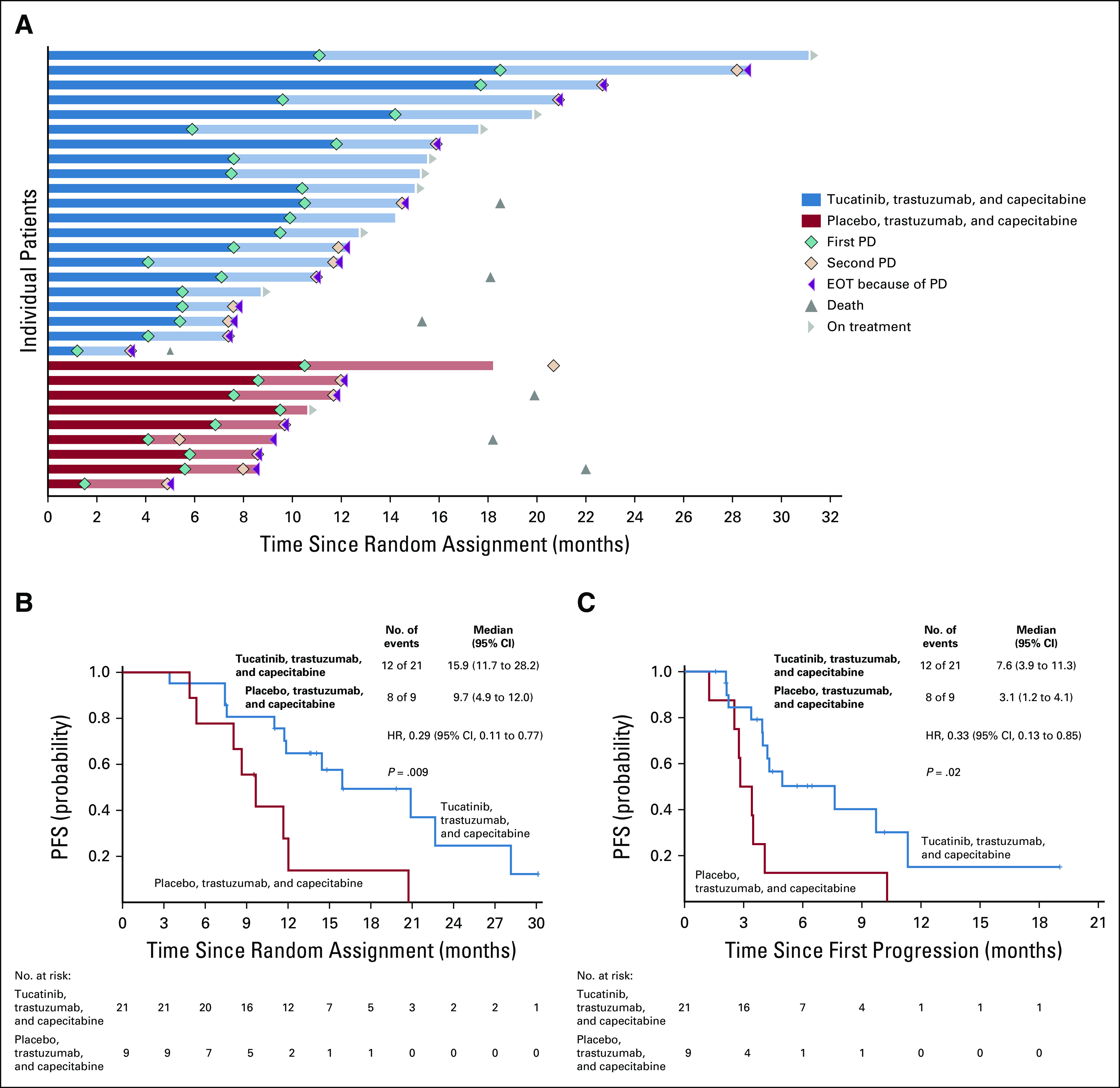
There were 291 patients with BMs: 198 (48%) in the tucatinib arm and 93 (46%) in the control arm. The risk of intracranial progression or death was reduced by 68% in the tucatinib arm (hazard ratio [HR], 0.32; 95% CI, 0.22 to 0.48; < .0001). Median CNS-PFS was 9.9 months in the tucatinib arm versus 4.2 months in the control arm. Risk of death was reduced by 42% in the tucatinib arm (OS HR, 0.58; 95% CI, 0.40 to 0.85; = .005). Median OS was 18.1 versus 12.0 months. ORR-IC was higher in the tucatinib arm (47.3%; 95% CI, 33.7% to 61.2%) versus the control arm (20.0%; 95% CI, 5.7% to 43.7%; = .03).
In patients with HER2-positive breast cancer with BMs, the addition of tucatinib to trastuzumab and capecitabine doubled ORR-IC, reduced risk of intracranial progression or death by two thirds, and reduced risk of death by nearly half. To our knowledge, this is the first regimen to demonstrate improved antitumor activity against BMs in patients with HER2-positive breast cancer in a randomized, controlled trial.
在 HER2CLIMB 研究中,患有脑转移(BMs)的人表皮生长因子受体 2(HER2)阳性乳腺癌患者,接受曲妥珠单抗联合 Tucatinib 治疗,其无进展生存期(PFS)有显著统计学改善。我们对 BMs 患者的颅内疗效和生存情况进行了探索性分析。
患者按 2:1 的比例随机分配接受 Tucatinib 或安慰剂治疗,联合曲妥珠单抗和卡培他滨。所有患者均接受基线脑部磁共振成像检查;有 BMs 的患者分为活动或稳定型。研究者评估的中枢神经系统(CNS)靶病灶采用 RECIST 1.1 标准进行颅内疗效分析。所有 BMs 患者均评估中枢神经系统无进展生存期(CNS-PFS,颅内进展或死亡)和总生存期(OS)。在有可测量颅内疾病的患者中评估了颅内确证客观缓解率(ORR-IC)。
291 例患者患有 BMs:198 例(48%)在 Tucatinib 组,93 例(46%)在对照组。 Tucatinib 组颅内进展或死亡的风险降低了 68%(风险比[HR],0.32;95%CI,0.22 至 0.48;<0.0001)。Tucatinib 组的中枢神经系统无进展生存期中位数为 9.9 个月,而对照组为 4.2 个月。 Tucatinib 组的死亡风险降低了 42%(OS HR,0.58;95%CI,0.40 至 0.85;=0.005)。中位 OS 为 18.1 个月和 12.0 个月。Tucatinib 组的颅内确证客观缓解率(ORR-IC)较高(47.3%;95%CI,33.7%至 61.2%),对照组(20.0%;95%CI,5.7%至 43.7%;=0.03)。
在患有 BMs 的 HER2 阳性乳腺癌患者中,Tucatinib 联合曲妥珠单抗和卡培他滨治疗可将 ORR-IC 提高一倍,将颅内进展或死亡的风险降低三分之二,并将死亡风险降低近一半。据我们所知,这是第一项在随机对照试验中显示对 HER2 阳性乳腺癌患者的 BMs 具有改善抗肿瘤活性的方案。