Department of Anesthesiology, Heidelberg University Hospital, Heidelberg, Germany.
Department of Anesthesiology and Intensive Care Medicine, University Hospital Tübingen, Eberhard-Karls-University Tübingen, Tübingen, Germany.
PLoS One. 2020 May 29;15(5):e0233789. doi: 10.1371/journal.pone.0233789. eCollection 2020.
With more than 18 million annual new cases, cancer belongs to the major challenges of modern healthcare. Surgical resection of solid tumours under general anaesthesia is the prime therapy. Different aspects of anaesthesia are under discussion to independently influence the long-term outcome of cancer patients. Most recently, the commonly used volatile anaesthetics like sevoflurane have entered the spotlight, as retrospective studies suggest a detrimental outcome in certain cancer aetiologies with sparse mechanistic understanding. Our objective was to investigate this concept in a murine melanoma model, herein comparing the consequence of inhalative and injection anesthesia on tumour composition and growth.
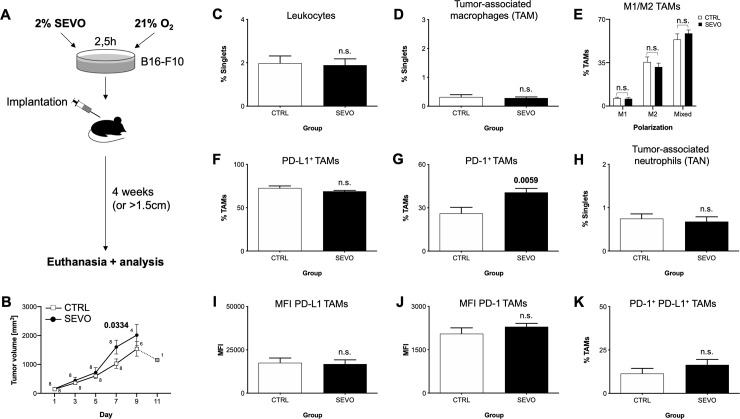
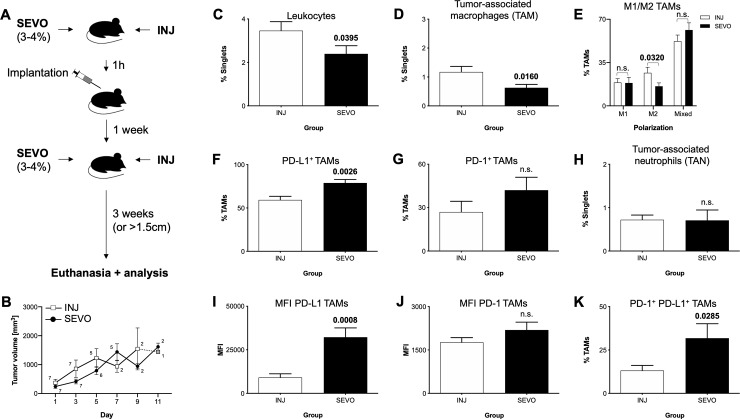
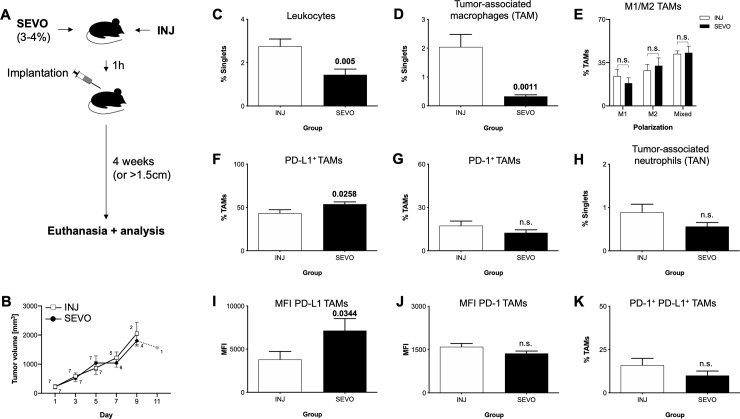
We used a murine model of malignant melanoma in male, adult C57BL/6 mice (n = 92), induced by the subcutaneous injection of B16-F10 cells. We either exposed the melanoma cells to sevoflurane before implantation or subjected the animals to single or double anaesthesia with either volatile or injection drugs. After a maximum follow-up of 4 weeks, leucocytes within the tumour microenvironment (TME) were comprehensively analysed by flow cytometry with focus on tumor-associated macrophages (TAM).
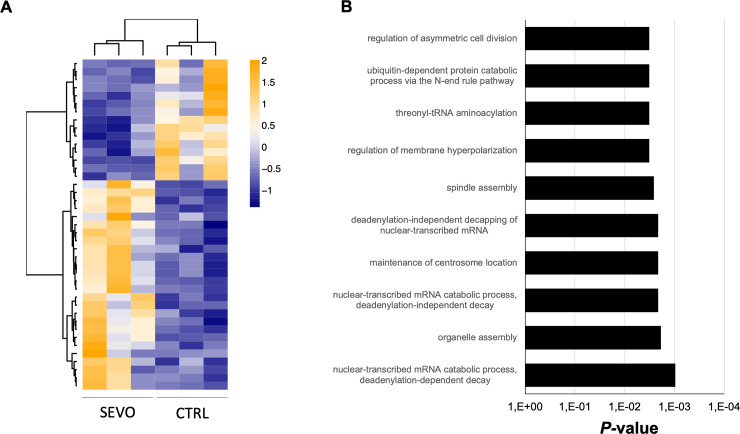
We found that exposure of melanoma cells to sevoflurane before implantation induced long-lasting transcriptome changes and aggravated tumour growth, without extensive changes of the TME. Contrastingly, both a single and double anaesthesia with sevoflurane led to a significant reduction of TAMs (injection vs. sevoflurane: 2,0 vs. 0.3% and 1.2 vs. 0.6%, respectively), whilst increasing PD-L1 expression on the remaining cells (mean fluorescent intensity injection vs. sevoflurane: 3,804 vs. 7,143 and 9,090 vs. 32,228, respectively). No changes in tumour growth were observed in these groups.
In sharp contrast to the detrimental impact of sevoflurane on patients' outcome reported in retrospective clinical studies, we propose here that sevoflurane might actually exert a beneficial effect by decreasing TAMs within the TME, rendering the tumour again susceptible for cytotoxic T cells and immunotherapies. Further research is warranted to delineate, how these results translate into the clinic.
癌症每年新增病例超过 1800 万,属于现代医疗保健的主要挑战之一。全身麻醉下的实体瘤切除术是主要治疗方法。麻醉的不同方面正在被讨论,以独立影响癌症患者的长期预后。最近,像七氟醚这样常用的挥发性麻醉剂引起了人们的关注,因为回顾性研究表明,在某些癌症病因中,这种麻醉剂的使用与稀疏的机制理解一起会产生不利的结果。我们的目的是在一种小鼠黑色素瘤模型中研究这一概念,在此比较吸入麻醉和注射麻醉对肿瘤组成和生长的影响。
我们使用雄性成年 C57BL/6 小鼠(n = 92)皮下注射 B16-F10 细胞诱导的恶性黑色素瘤小鼠模型。我们要么在植入前将黑色素瘤细胞暴露于七氟醚中,要么让动物接受单次或双重麻醉,使用挥发性或注射药物。在最长 4 周的随访后,通过流式细胞术全面分析肿瘤微环境(TME)中的白细胞,重点是肿瘤相关巨噬细胞(TAM)。
我们发现,在植入前将黑色素瘤细胞暴露于七氟醚中会诱导持久的转录组变化并加重肿瘤生长,而不会对 TME 产生广泛的变化。相比之下,单次和双重使用七氟醚麻醉都会导致 TAMs 显著减少(注射 vs. 七氟醚:2.0% vs. 0.3%和 1.2% vs. 0.6%),同时增加剩余细胞上 PD-L1 的表达(平均荧光强度注射 vs. 七氟醚:3804 vs. 7143 和 9090 vs. 32228)。这些组中没有观察到肿瘤生长的变化。
与回顾性临床研究报告的七氟醚对患者预后的不利影响形成鲜明对比的是,我们在这里提出,七氟醚实际上可能通过减少 TME 中的 TAMs 而发挥有益作用,使肿瘤再次对细胞毒性 T 细胞和免疫疗法敏感。需要进一步的研究来阐明这些结果如何转化为临床实践。