Department of Infectious Diseases, Tongji Hospital, Tongji Medical College, Huazhong University of Science and Technology, Wuhan, China.
Department of Pathogen Biology, School of Basic Medicine, Tongji Medical College, Huazhong University of Science and Technology, Wuhan, China.
J Med Virol. 2020 Nov;92(11):2600-2606. doi: 10.1002/jmv.26070. Epub 2020 Jun 9.
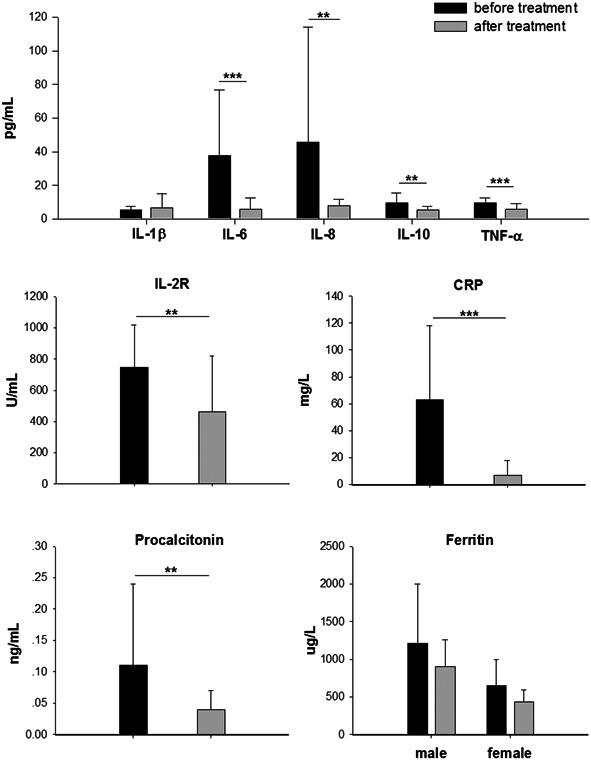
To investigate the inflammatory factors and lymphocyte subsets which play an important role in the course of severe coronavirus disease 2019 (COVID-19). A total of 27 patients with severe COVID-19 who were admitted to Tongji Hospital in Wuhan from 1 to 21 February 2020 were recruited to the study. The characteristics of interleukin-1β (IL-1β), IL-2 receptor (IL-2R), IL-6, IL-8, IL-10, tumor necrosis factor-α (TNF)-α, C-reactive protein (CRP), serum ferritin and procalcitonin (PCT), and lymphocyte subsets of these patients were retrospectively compared before and after treatment. Before treatment, there was no significant difference in most inflammatory factors (IL-1β, IL-2R, IL-6, IL-8, IL-10, CRP, and serum ferritin) between male and female patients. Levels of IL-2R, IL-6, TNF-α, and CRP decreased significantly after treatment, followed by IL-8, IL-10, and PCT. Serum ferritin was increased in all patients before treatment but did not decrease significantly after treatment. IL-1β was normal in most patients before treatment. Lymphopenia was common among these patients with severe COVID-19. Analysis of lymphocyte subsets showed that CD4+ and particularly CD8+ T lymphocytes increased significantly after treatment. However, B lymphocytes and natural killer cells showed no significant changes after treatment. A pro-inflammatory response and decreased level of T lymphocytes were associated with severe COVID-19.
为了研究在严重 2019 年冠状病毒病(COVID-19)病程中起重要作用的炎症因子和淋巴细胞亚群。共招募了 27 名 2020 年 2 月 1 日至 21 日期间入住武汉同济医院的重症 COVID-19 患者。回顾性比较了这些患者治疗前后白细胞介素-1β(IL-1β)、白细胞介素-2 受体(IL-2R)、白细胞介素-6(IL-6)、白细胞介素-8(IL-8)、白细胞介素-10(IL-10)、肿瘤坏死因子-α(TNF-α)、C 反应蛋白(CRP)、血清铁蛋白和降钙素原(PCT)以及淋巴细胞亚群的特征。治疗前,男女患者之间大多数炎症因子(IL-1β、IL-2R、IL-6、IL-8、IL-10、CRP 和血清铁蛋白)无显著差异。治疗后 IL-2R、IL-6、TNF-α和 CRP 水平显著下降,随后是 IL-8、IL-10 和 PCT。所有患者在治疗前血清铁蛋白均升高,但治疗后并未显著下降。治疗前大多数患者的 IL-1β 正常。严重 COVID-19 患者中常见淋巴细胞减少症。淋巴细胞亚群分析显示,治疗后 CD4+和特别是 CD8+T 淋巴细胞显著增加。然而,B 淋巴细胞和自然杀伤细胞治疗后无明显变化。促炎反应和 T 淋巴细胞水平降低与严重 COVID-19 相关。