
二苯并吡嗪衍生物在监测光聚合和测定阳离子光引发剂生成超强酸效率中的双重作用:荧光传感器。
Double Role of Diphenylpyridine Derivatives as Fluorescent Sensors for Monitoring Photopolymerization and the Determination of the Efficiencies of the Generation of Superacids by Cationic Photoinitiators.
机构信息
Faculty of Chemical Engineering and Technology, Cracow University of Technology, Warszawska 24, 30-155 Cracow, Poland.
Photo HiTech Ltd., Bobrzyńskiego 14, 30-348 Cracow, Poland.
出版信息
Sensors (Basel). 2020 May 27;20(11):3043. doi: 10.3390/s20113043.
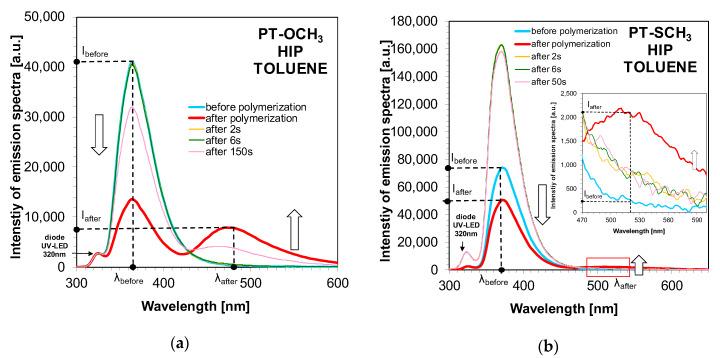
Novel fluorescent sensors with electron-donating or electron-withdrawing substituents incorporated into a chromophore group based on 2,6-diphenylpyridine were designed and synthesised. The spectroscopic properties of these compounds were studied. Moreover, the positive solvatochromism of 2,6-bis-(4-methylsulphanylphenyl)pyridine (PT-SCH) in selected solvents was studied by measurement of the absorption and emission spectra and analysed using the Dimroth-Reichardt solvent parameter set. After that, the performance of a series of 2,6-diphenylpyridine derivatives as fluorescent molecular sensors for monitoring free-radical and cationic photopolymerization processes by the Fluorescence Probe Technique (FPT) was studied. As a consequence of this stage of research, the effect of substituents on the sensitivity of the 2,6-diphenylpyridine derivatives as sensors during photopolymerization has been evaluated and discussed. It has been found that compounds containing strong electron-donating substituent (PT-SCH) slightly shift their fluorescence spectrum during the free-radical polymerization of monomer, which enables the monitoring of the polymerization progress using the fluorescence intensity ratio measured at two different wavelengths as the progress indicator. The position of the fluorescence spectrum of 2,6-diphenylpyridine derivatives with electron-withdrawing substituents is practically insensitive to changes occurring in their environment. Hence, it is recommended to use these compounds with different indicators of the progress of the photopolymerization process based on normalised intensity of fluorescence (I/I). Among the compounds studied, 2,6-bis(4-methylsulphanylphenyl)pyridine (PT-SCH) turned out to be the best fluorescent sensor for the purpose of monitoring free-radical polymerization by FPT. Consequently, the dual application of the selected 2,6-diphenylpyridine derivatives is proposed: (a) as fluorescent sensors for monitoring the free-radical photopolymerization progress, and (b) as spectroscopic sensors for the determination of efficiencies of the generation of superacids by cationic photoinitiators during the cationic photopolymerization process. Finally, a new method for determining the relative efficiency of the photogeneration of superacids during the photo cleavage of onium salt has been devised and applied for the evaluation of the performance of 2,6-diphenylpyridine derivatives.
基于 2,6-二苯基吡啶的发色团,设计并合成了带有供电子或吸电子取代基的新型荧光传感器。研究了这些化合物的光谱性质。此外,通过测量吸收和发射光谱并使用 Dimroth-Reichardt 溶剂参数集对 2,6-双-(4-甲基巯基苯基)吡啶(PT-SCH)在选定溶剂中的正溶剂化变色进行了研究。之后,研究了一系列 2,6-二苯基吡啶衍生物作为荧光分子传感器,通过荧光探针技术(FPT)监测自由基和阳离子光聚合过程的性能。作为这一研究阶段的结果,评估并讨论了取代基对 2,6-二苯基吡啶衍生物作为光聚合过程中传感器的灵敏度的影响。研究发现,含有强供电子取代基的化合物(PT-SCH)在单体的自由基聚合过程中略微改变其荧光光谱,这使得可以使用在两个不同波长处测量的荧光强度比作为进展指示来监测聚合进展。含有吸电子取代基的 2,6-二苯基吡啶衍生物的荧光光谱的位置对其环境中发生的变化实际上不敏感。因此,建议使用这些化合物与基于荧光强度归一化(I/I)的不同光聚合过程进展指标一起使用。在所研究的化合物中,2,6-双(4-甲基巯基苯基)吡啶(PT-SCH)是通过 FPT 监测自由基聚合的最佳荧光传感器。因此,提出了所选 2,6-二苯基吡啶衍生物的双重应用:(a)作为监测自由基光聚合进展的荧光传感器,和(b)作为测定阳离子光引发剂在阳离子光聚合过程中生成超强酸效率的光谱传感器。最后,设计并应用了一种新方法来确定在翁盐的光解过程中光生超强酸的相对效率,用于评估 2,6-二苯基吡啶衍生物的性能。




 Zotero 插件