Department of Otorhinolaryngology Head and Neck Surgery, People's Hospital of Xinjiang Uygur Autonomous Region, 91 Tianchi Road, Tianshan, Ürümqi, Xinjiang, 830001, China.
Department of Otolaryngology-Head and Neck Surgery, Beijing Tongren Hospital, Capital Medical University, Beijing, China.
J Otolaryngol Head Neck Surg. 2020 May 29;49(1):31. doi: 10.1186/s40463-020-00421-w.
Several recent studies have indicated that the lymph node ratio (LNR) is an independent prognostic factor for laryngeal and hypopharyngeal squamous cell carcinoma (LHSCC). The purpose of this paper is to assess the prognostic value of LNR and explore appropriate cutoff values by conducting a systematic review and meta-analysis.
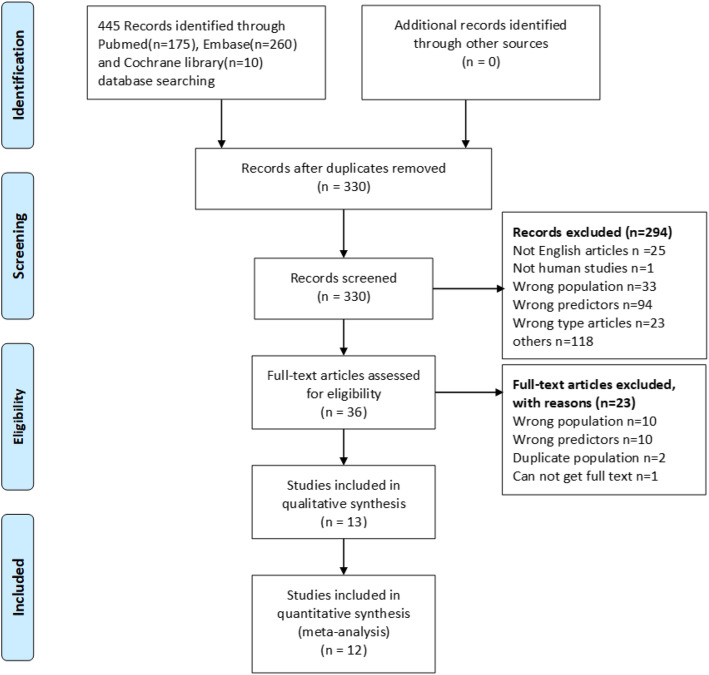
Pubmed, Embase (via Ovid), and Cochrane library were systematically searched for studies on the prognostic value of LNR in LHSCC up to October 31, 2019. Then, Literature review, data extraction, and quality assessment of eligible studies were performed by two independent reviewers back-to-back. Lastly, Stata 14.0 software was hired to conduct a meta-analysis.
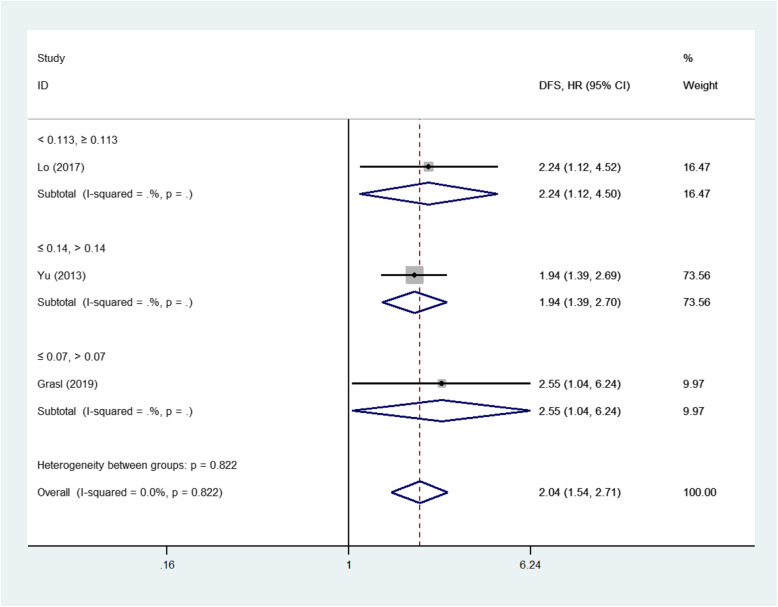
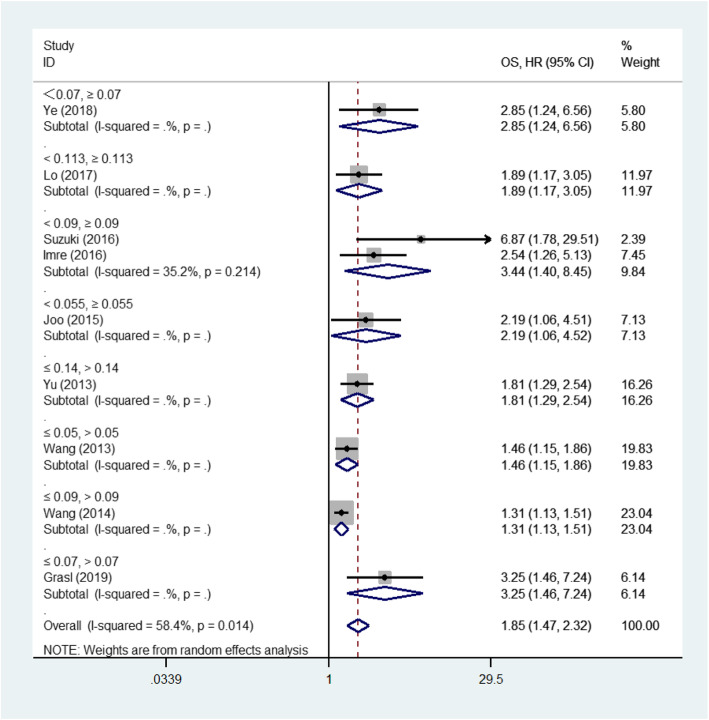
A total of 445 articles were retrieved, and 13 studies published in English between 2013 and 2019 were included after the title/abstract and full-text screening. Among the 13 studies contributed to 4197 patients, seven studies were about hypopharyngeal squamous cell carcinoma (HPSCC), four studies about laryngeal squamous cell carcinoma (LSCC), and the remaining two studies about LHSCC. The meta-analysis results showed that shorter overall survival (OS) (HR 1.49; 95%CI: 1.18 to 1.88), disease-specific survival (DSS) (HR 1.66; 95%CI: 1.32 to 2.07) and disease-free survival (DFS) (HR 2.04; 95%CI: 1.54 to 2.71) were significantly correlated with a higher LNR in a random-effect model. The cutoff values of eligible studies were varied from 0.03 to 0.14, and the lowest significant LNR was 0.044.
LNR is a valuable prognostic factor in the survival of LHSCC and may be used to improve the tumor staging systems, which, however, requires the solid support of more high-quality studies.
最近的几项研究表明,淋巴结比率(LNR)是喉和下咽鳞状细胞癌(LHSCC)的独立预后因素。本文旨在通过系统评价和荟萃分析评估 LNR 的预后价值,并探索合适的截止值。
系统检索了截止到 2019 年 10 月 31 日关于 LNR 对 LHSCC 预后价值的研究,使用 Pubmed、Embase(通过 Ovid)和 Cochrane 图书馆。然后,两位独立评审员背对背进行文献复习、数据提取和合格研究的质量评估。最后,使用 Stata 14.0 软件进行荟萃分析。
共检索到 445 篇文章,经过标题/摘要和全文筛选后,纳入了 2013 年至 2019 年期间发表的 13 篇英文研究。在纳入的 13 项研究中,共有 4197 例患者,其中 7 项研究为下咽鳞状细胞癌(HPSCC),4 项研究为喉鳞状细胞癌(LSCC),其余 2 项研究为 LHSCC。荟萃分析结果显示,较高的 LNR 与较短的总生存期(OS)(HR 1.49;95%CI:1.18 至 1.88)、疾病特异性生存期(DSS)(HR 1.66;95%CI:1.32 至 2.07)和无病生存期(DFS)(HR 2.04;95%CI:1.54 至 2.71)显著相关。合格研究的截止值范围为 0.03 至 0.14,最低显著 LNR 为 0.044。
LNR 是 LHSCC 生存的有价值的预后因素,可能用于改善肿瘤分期系统,但需要更多高质量研究的有力支持。