School of Chemical, Biological and Materials Engineering, University of Oklahoma, Norman, Oklahoma, 73019, USA.
Sci Rep. 2020 May 29;10(1):8760. doi: 10.1038/s41598-020-65392-4.
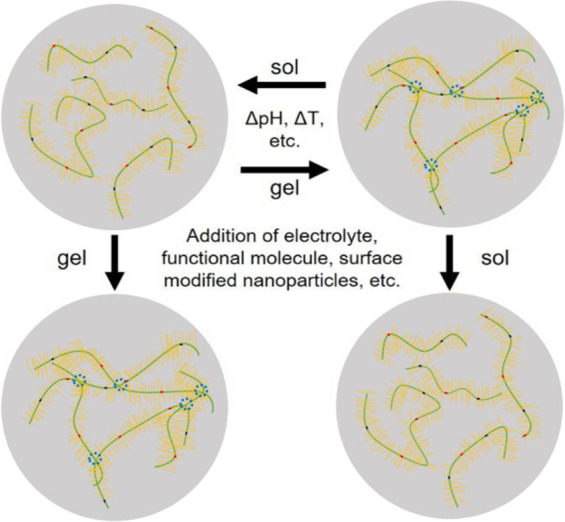
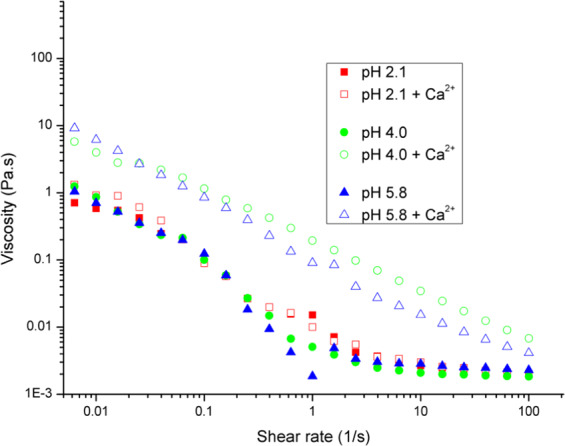
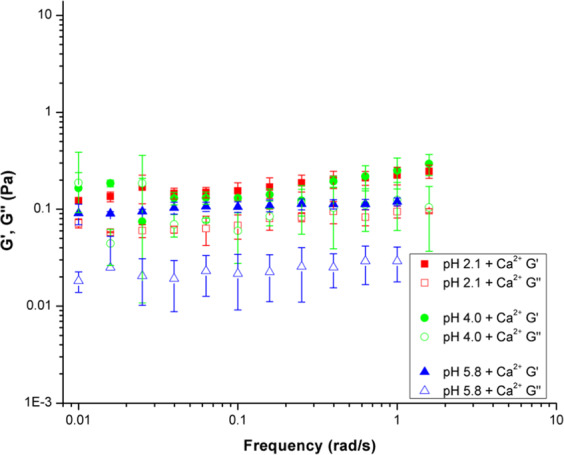
Mucus is responsible for controlling transport and barrier function in biological systems, and its properties can be significantly affected by compositional and environmental changes. In this study, the impacts of pH and CaCl were examined on the solution-to-gel transition of mucin, the primary structural component of mucus. Microscale structural changes were correlated with macroscale viscoelastic behavior as a function of pH and calcium addition using rheology, dynamic light scattering, zeta potential, surface tension, and FTIR spectroscopic characterization. Mucin solutions transitioned from solution to gel behavior between pH 4-5 and correspondingly displayed a more than ten-fold increase in viscoelastic moduli. Addition of CaCl increased the sol-gel transition pH value to ca. 6, with a twofold increase in loss moduli at low frequencies and ten-fold increase in storage modulus. Changing the ionic conditions-specifically [H] and [Ca] -modulated the sol-gel transition pH, isoelectric point, and viscoelastic properties due to reversible conformational changes with mucin forming a network structure via non-covalent cross-links between mucin chains.
黏液在生物系统中负责控制物质运输和屏障功能,其性质可以通过组成和环境变化而显著改变。在这项研究中,考察了 pH 值和 CaCl 的影响,以研究其对黏液主要结构成分黏蛋白的溶胶-凝胶转变的影响。通过流变学、动态光散射、动电电位、表面张力和傅里叶变换红外光谱分析,研究了微尺度结构变化与宏观黏弹性行为之间的关系,作为 pH 值和钙离子添加的函数。黏蛋白溶液在 pH 值为 4-5 之间从溶液状态转变为凝胶状态,相应的黏弹性模量增加了十倍以上。添加 CaCl 会将溶胶-凝胶转变 pH 值增加到约 6,在低频下损失模量增加两倍,储能模量增加十倍。改变离子条件,特别是 [H] 和 [Ca],会调节溶胶-凝胶转变 pH 值、等电点和黏弹性,这是由于黏蛋白通过黏蛋白链之间的非共价交联形成网络结构,发生可逆构象变化所致。