Department of Psychology, University of Oregon, 1227, Eugene, OR, 97403, USA.
Psychon Bull Rev. 2020 Aug;27(4):791-800. doi: 10.3758/s13423-020-01754-3.
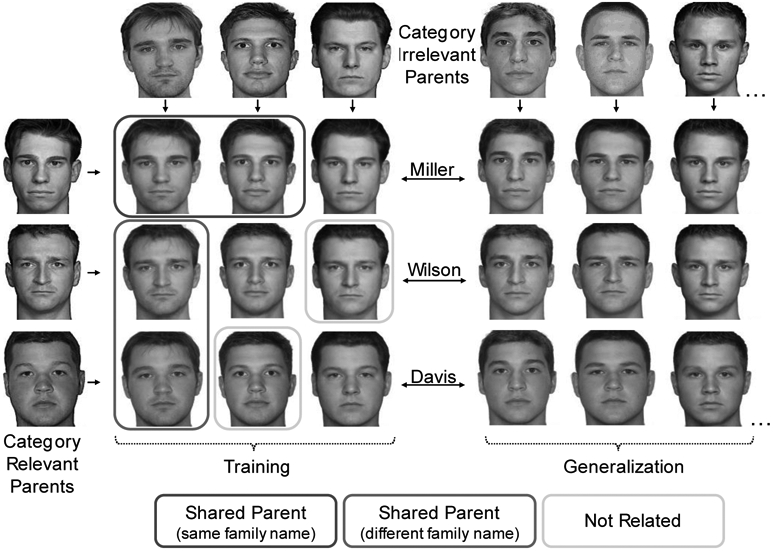
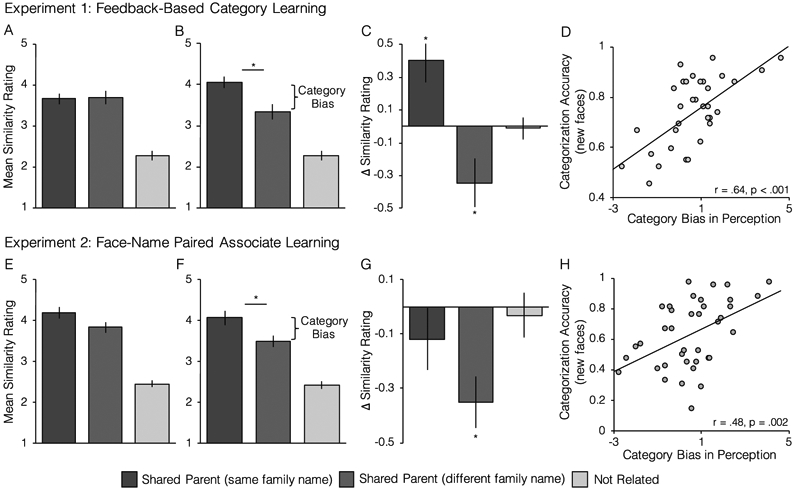
The current study investigated category learning across two experiments using face-blend stimuli that formed face families controlled for within- and between-category similarity. Experiment 1 was a traditional feedback-based category-learning task, with three family names serving as category labels. In Experiment 2, the shared family name was encountered in the context of a face-full name paired-associate learning task, with a unique first name for each face. A subsequent test that required participants to categorize new faces from each family showed successful generalization in both experiments. Furthermore, perceived similarity ratings for pairs of faces were collected before and after learning, prior to generalization test. In Experiment 1, similarity ratings increased for faces within a family and decreased for faces that were physically similar but belonged to different families. In Experiment 2, overall similarity ratings decreased after learning, driven primarily by decreases for physically similar faces from different families. The post-learning category bias in similarity ratings was predictive of subsequent generalization success in both experiments. The results indicate that individuals formed generalizable category knowledge prior to an explicit demand to generalize and did so both when attention was directed towards category-relevant features (Experiment 1) and when attention was directed towards individuating faces within a family (Experiment 2). The results tie together research on category learning and categorical perception and extend them beyond a traditional category-learning task.
当前的研究通过使用形成面部家族的面部混合刺激物,在两个实验中调查了类别学习,这些刺激物控制了类别内和类别间的相似性。实验 1 是一个传统的基于反馈的类别学习任务,使用三个家族名称作为类别标签。在实验 2 中,共享的家族名称出现在与面部全名配对联想学习任务的背景下,每个面部都有一个独特的名字。随后的测试要求参与者对每个家族的新面孔进行分类,在两个实验中都显示出了成功的泛化。此外,在学习和泛化测试之前,收集了对每对面孔的感知相似性评分。在实验 1 中,属于同一家庭的面孔的相似性评分增加,而属于不同家庭但具有物理相似性的面孔的相似性评分降低。在实验 2 中,学习后整体相似性评分降低,主要是由于来自不同家庭的具有物理相似性的面孔的评分降低。学习后相似性评分中的类别偏见预测了两个实验中随后的泛化成功。结果表明,个体在明确要求泛化之前就形成了可泛化的类别知识,并且当注意力集中在与类别相关的特征上时(实验 1)和当注意力集中在家庭内部的个体面孔上时(实验 2)都是如此。结果将类别学习和范畴知觉的研究联系起来,并将其扩展到传统的类别学习任务之外。