Department of Orthopedic Surgery and Sports Medicine, Erasmus MC University Medical Center, Rotterdam, the Netherlands.
Department of Sports Medicine, Haaglanden Medical Center, The Hague, the Netherlands.
Scand J Med Sci Sports. 2020 Sep;30(9):1712-1721. doi: 10.1111/sms.13728. Epub 2020 Jun 14.
Isometric exercises may provide an immediate analgesic effect in patients with lower-limb tendinopathy and have been proposed as initial treatment and for immediate pain relief. Current evidence is conflicting, and previous studies were small.
To study whether isometric exercises result in an immediate analgesic effect in patients with chronic midportion Achilles tendinopathy.
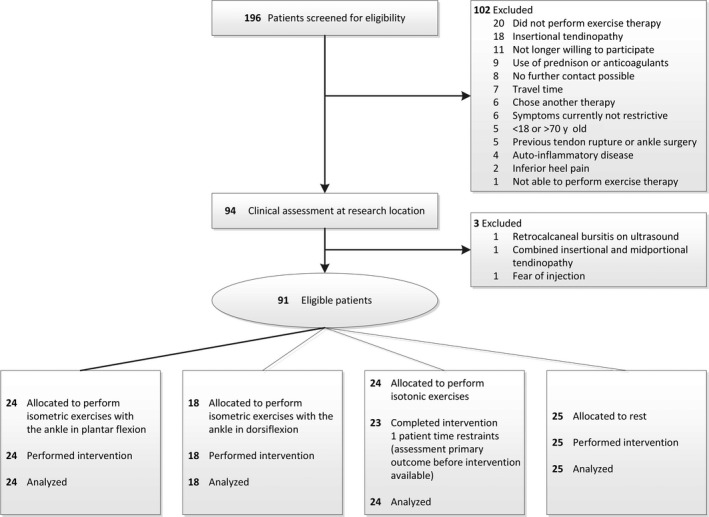
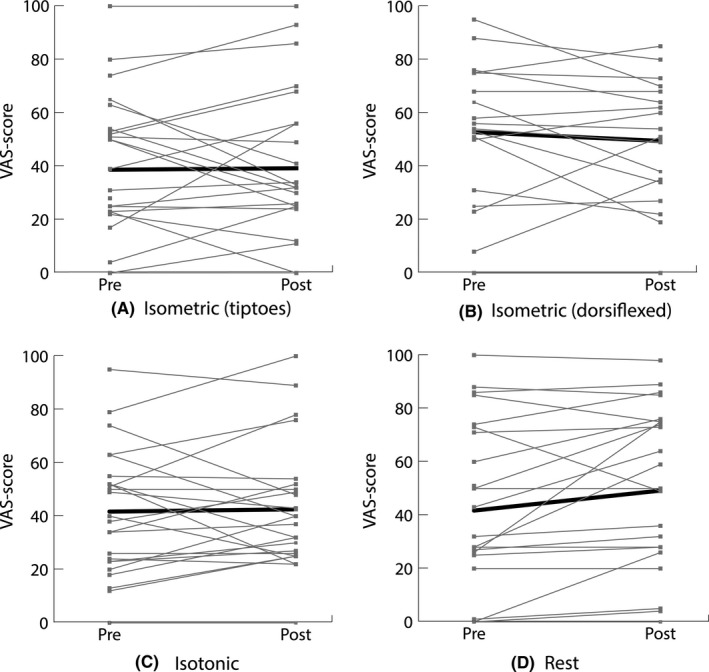
Patients with clinically diagnosed chronic midportion Achilles tendinopathy were quasi-randomized to one of four arms: isometric calf-muscle exercises (tiptoes), isometric calf-muscle exercises (dorsiflexed ankle position), isotonic calf-muscle exercises, or rest. The primary outcome was pain measured on a visual analogue scale (VAS) score (0-100) during a functional task (10 unilateral hops) both before and after the intervention. Between-group differences were analyzed using a generalized estimation equations model.
We included 91 patients. There was no significant reduction in pain on the 10 hop test after performing any of the four interventions: isometric (tiptoes) group 0.2, 95%CI -11.2 to 11.5; isometric (dorsiflexed) group -1.9, 95%CI -13.6 to 9.7; isotonic group 1.4, 95%CI -8.3 to 11.1; and rest group 7.2, 95%CI -2.4 to 16.7. There were also no between-group differences after the interventions.
The isometric exercises investigated in this study did not result in immediate analgesic benefit in patients with chronic midportion Achilles tendinopathy. We do not recommend isometric exercises if the aim is providing immediate pain relief. Future research should focus on the use of isometric or isotonic exercise therapy as initial treatment as all exercise protocols used in this study were well-tolerated.
等长运动可能会为下肢肌腱病患者提供即时的镇痛效果,并被提议作为初始治疗和即时止痛。目前的证据相互矛盾,而且以前的研究规模较小。
研究等长运动是否会对慢性中段跟腱病患者产生即时的镇痛效果。
将临床诊断为慢性中段跟腱病的患者分为四组中的一组:等长小腿肌肉运动(踮脚尖)、等长小腿肌肉运动(背屈踝关节位置)、等张小腿肌肉运动或休息。主要结局是在功能任务(10 次单侧单足跳)前后,使用视觉模拟量表(VAS)评分(0-100)测量疼痛。使用广义估计方程模型分析组间差异。
我们纳入了 91 名患者。在进行任何四项干预措施后,在 10 次跳跃测试中,疼痛均无明显减轻:等长(踮脚尖)组 0.2,95%CI -11.2 至 11.5;等长(背屈)组 -1.9,95%CI -13.6 至 9.7;等张组 1.4,95%CI -8.3 至 11.1;休息组 7.2,95%CI -2.4 至 16.7。干预后各组间也无差异。
本研究中研究的等长运动并未使慢性中段跟腱病患者立即获得镇痛益处。如果目的是提供即时的疼痛缓解,我们不建议使用等长运动。未来的研究应侧重于将等长或等张运动疗法作为初始治疗,因为本研究中使用的所有运动方案均耐受良好。