Department of Public Health and Primary Care, Leiden University Medical Center, Leiden, the Netherlands.
Department of Youth HealthCare, Centrum Jeugd en Gezin (Center for Youth and Family), The Hague, the Netherlands.
Public Health Nutr. 2020 Aug;23(12):2078-2087. doi: 10.1017/S1368980019004464. Epub 2020 Jun 1.
Several authors have questioned the suitability of WHO Child Growth Standards (WHO-CGS) for all ethnic groups. The aim of this study was to identify potential misclassification of stunting, underweight and wasting in children of Surinamese Asian Indian, South Asian (Pakistan/India) and Dutch descent.
A series of routine cross-sectional measurements, collected 2012-2015. South Asian-specific normative growth references for weight-for-age and weight-for-length/height were constructed using the LMS method based on historic growth data of Surinamese Asian Indians born between 1974 and 1976. WHO-CGS and ethnic-specific references were applied to calculate z-scores and prevalence of stunting, underweight and wasting.
Youth HealthCare, providing periodical preventive health check-ups.
11 935 children aged 0-5 years.
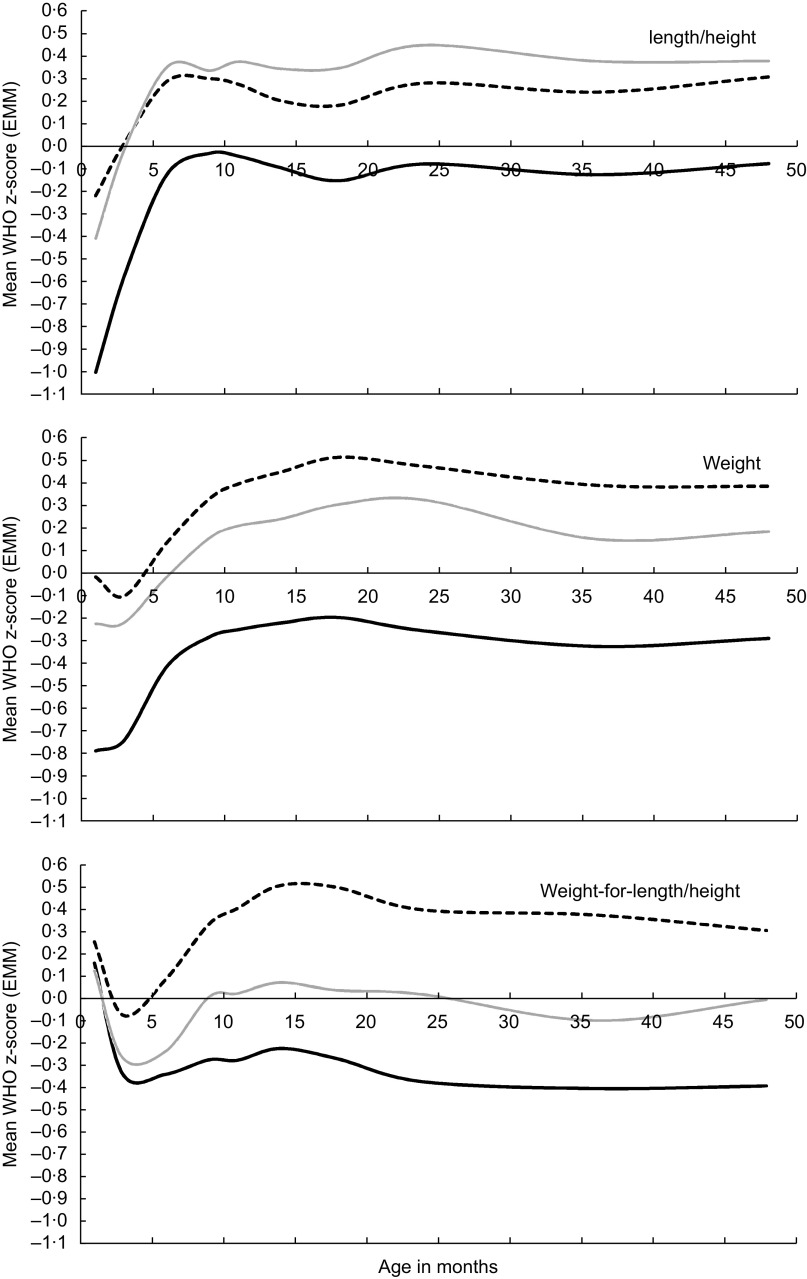
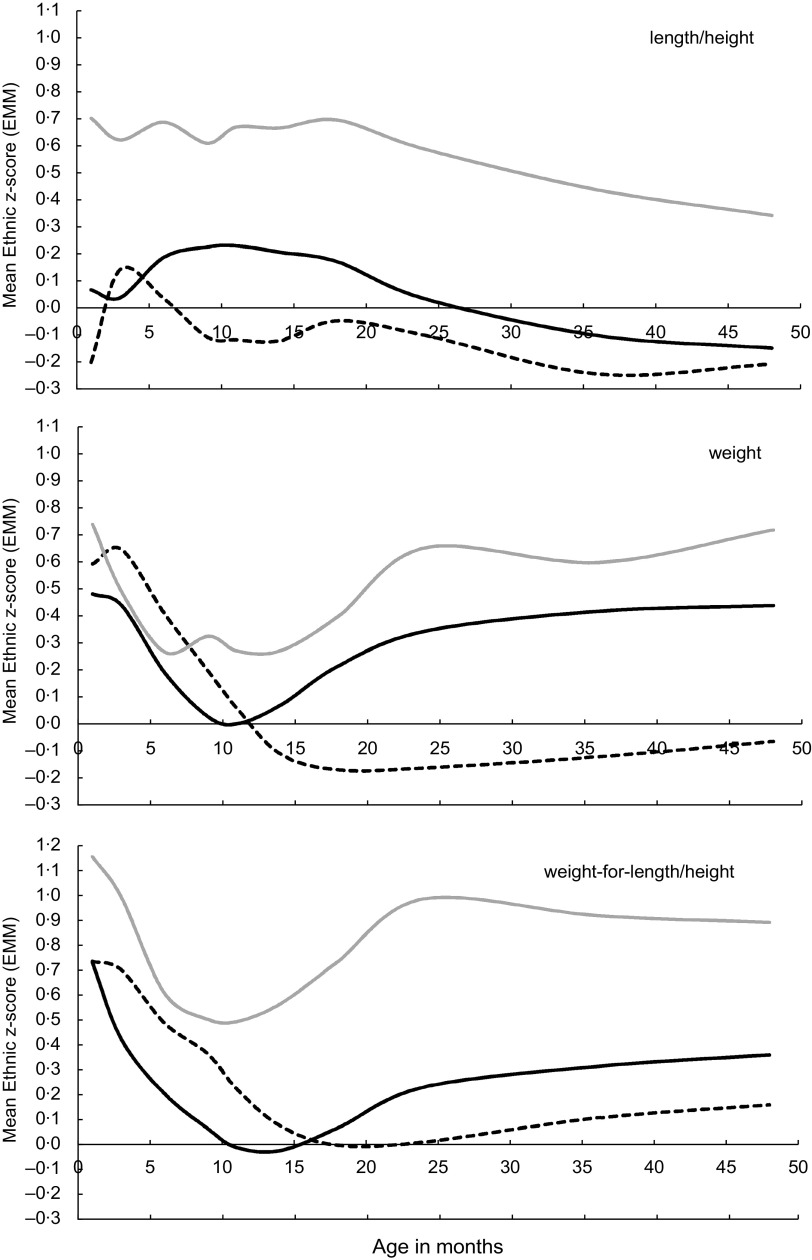
Considerable deviations from WHO-CGS were found, with higher-than-expected stunting rates, especially in the first 6 months of life. Surinamese Asian Indian children showed stunting rates up to 16·0 % and high underweight and wasting over the whole age range (up to 7·2 and 6·7 %, respectively). Dutch children consistently had mean WHO-CGS z-scores 0·3-0·5 sd above the WHO baseline (>6 months). The application of ethnic-specific references showed low rates for all studied indicators, although South Asian children were taller and larger than their Surinamese Asian Indian counterparts.
WHO-CGS misclassify a considerable proportion of children from all ethnic groups as stunted in the first 6 months of life. Underweight and wasting are considerably overestimated in Surinamese Asian Indian children. Ethnic-specific growth references are recommended for Surinamese Asian Indian and Dutch children. The considerable differences found between South Asian subpopulations requires further research.
一些作者质疑世界卫生组织儿童生长标准(WHO-CGS)是否适用于所有种族群体。本研究旨在确定 WHO-CGS 是否可能错误分类苏里南印度裔、南亚(巴基斯坦/印度)和荷兰裔儿童的生长迟缓、消瘦和消瘦。
一系列常规横断面测量,于 2012 年至 2015 年收集。使用基于 1974 年至 1976 年期间出生的苏里南印度裔历史生长数据的 LMS 方法,为体重与年龄和体重与身长/身高构建了南亚特有的规范生长参考值。应用 WHO-CGS 和种族特异性参考值计算 Z 分数和生长迟缓、消瘦和消瘦的患病率。
青年保健,定期提供预防保健检查。
11 935 名 0-5 岁儿童。
与 WHO-CGS 相比,发现存在相当大的偏差,尤其是在生命的前 6 个月,生长迟缓率高于预期。苏里南印度裔儿童的生长迟缓率高达 16.0%,整个年龄段的消瘦和消瘦率都很高(分别高达 7.2%和 6.7%)。荷兰儿童的平均 WHO-CGS Z 分数始终比 WHO 基线高出 0.3-0.5 个标准差(>6 个月)。尽管南亚儿童比他们的苏里南印度裔同龄人更高、更大,但应用种族特异性参考值显示所有研究指标的发病率均较低。
WHO-CGS 在生命的前 6 个月错误地将相当一部分来自所有种族的儿童归类为生长迟缓。消瘦和消瘦在苏里南印度裔儿童中被严重高估。建议为苏里南印度裔和荷兰裔儿童制定种族特异性生长参考值。在南亚不同亚群之间发现的相当大的差异需要进一步研究。