Mavuduru Amol, Halicek Martin, Shahedi Maysam, Little James V, Chen Amy Y, Myers Larry L, Fei Baowei
Dept. of Bioengineering, University of Texas at Dallas, TX.
Dept. of Computer Science, University of Texas at Dallas, TX.
Proc SPIE Int Soc Opt Eng. 2020 Feb;11320. doi: 10.1117/12.2549061. Epub 2020 Mar 16.
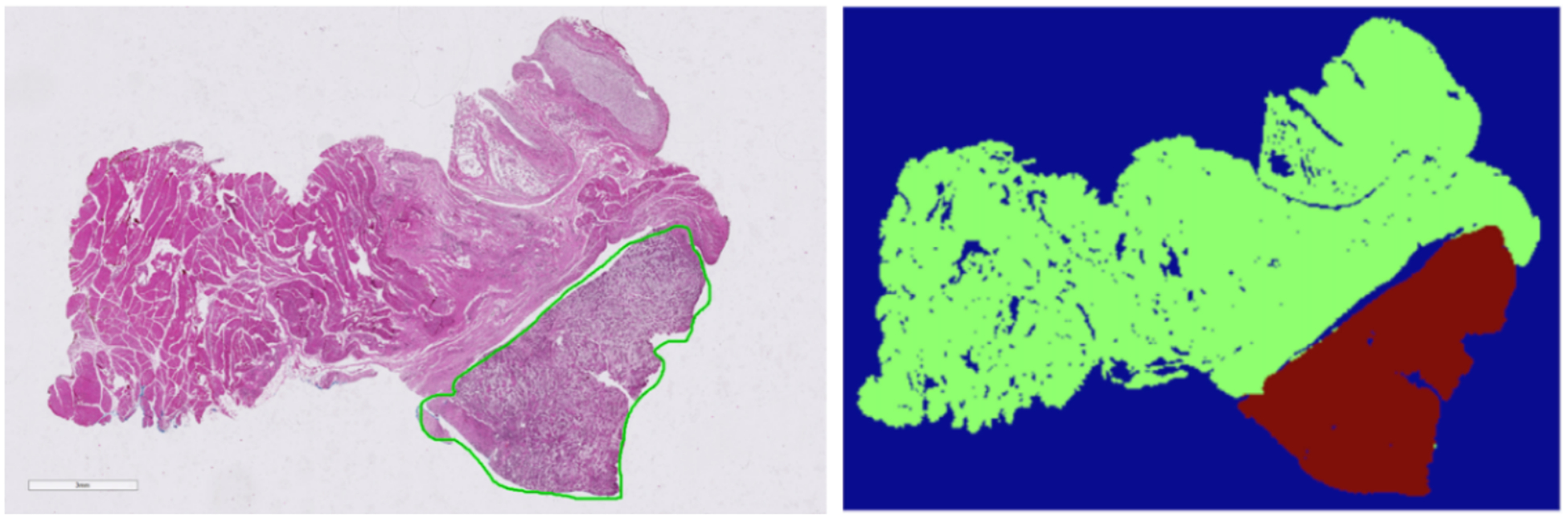
Squamous cell carcinoma (SCC) comprises over 90 percent of tumors in the head and neck. The diagnosis process involves performing surgical resection of tissue and creating histological slides from the removed tissue. Pathologists detect SCC in histology slides, and may fail to correctly identify tumor regions within the slides. In this study, a dataset of patches extracted from 200 digitized histological images from 84 head and neck SCC patients was used to train, validate and test the segmentation performance of a fully-convolutional U-Net architecture. The neural network achieved a pixel-level segmentation AUC of 0.89 on the testing group. The average segmentation time for whole slide images was 72 seconds. The training, validation, and testing process in this experiment produces a model that has the potential to help segment SCC images in histological images with improved speed and accuracy compared to the manual segmentation process performed by pathologists.
鳞状细胞癌(SCC)占头颈部肿瘤的90%以上。诊断过程包括对组织进行手术切除,并从切除的组织中制作组织学切片。病理学家在组织学切片中检测SCC,可能无法正确识别切片内的肿瘤区域。在本研究中,使用从84名头颈部SCC患者的200张数字化组织学图像中提取的图像块数据集来训练、验证和测试全卷积U-Net架构的分割性能。该神经网络在测试组上实现了0.89的像素级分割AUC。全幻灯片图像的平均分割时间为72秒。与病理学家进行的手动分割过程相比,本实验中的训练、验证和测试过程产生了一个有潜力帮助在组织学图像中分割SCC图像的模型,其速度和准确性更高。