Du Ping, Wang Jiahui, Han Yelei, Feng Jing
Department of Respiratory and Critical Care Medicine, Tianjin Medical University General Hospital, Tianjin, China.
Front Cell Neurosci. 2020 May 12;14:97. doi: 10.3389/fncel.2020.00097. eCollection 2020.
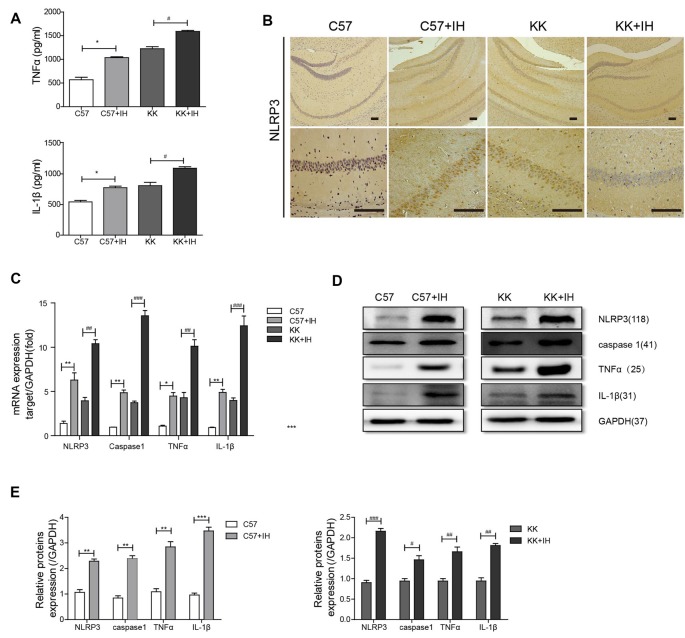
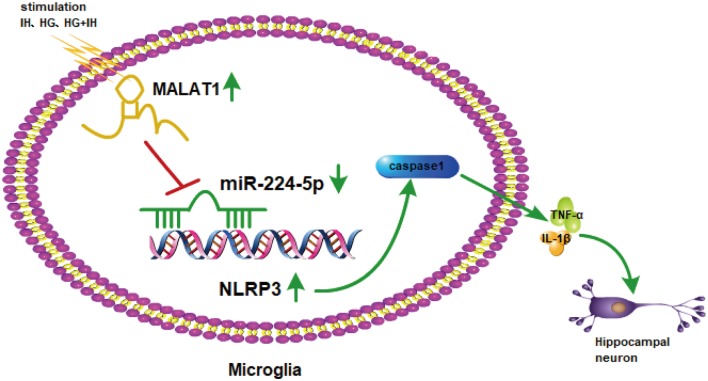
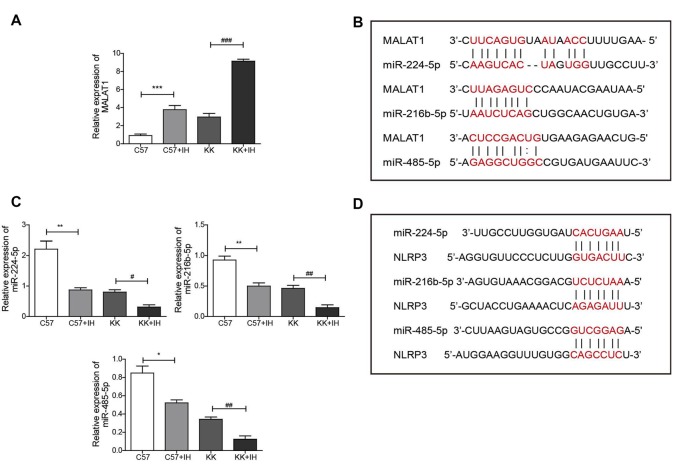
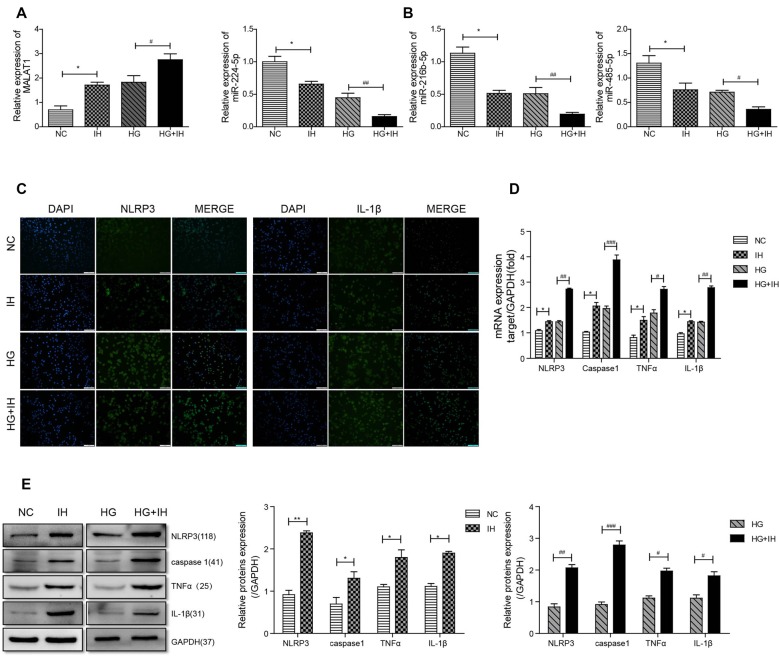
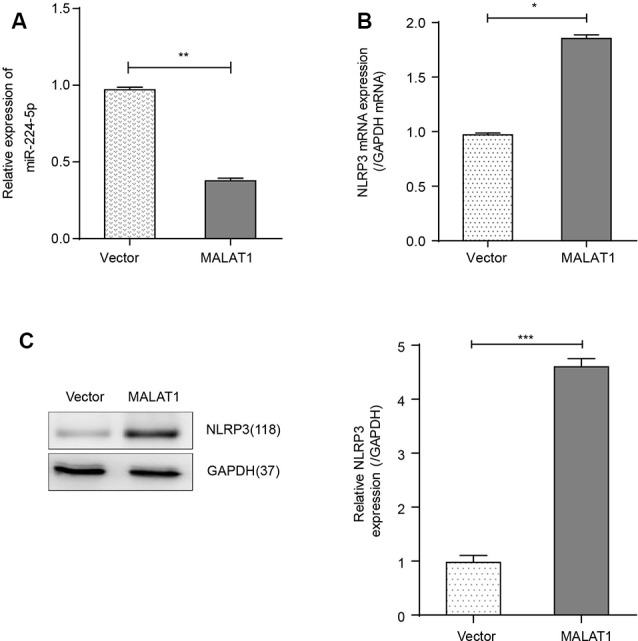
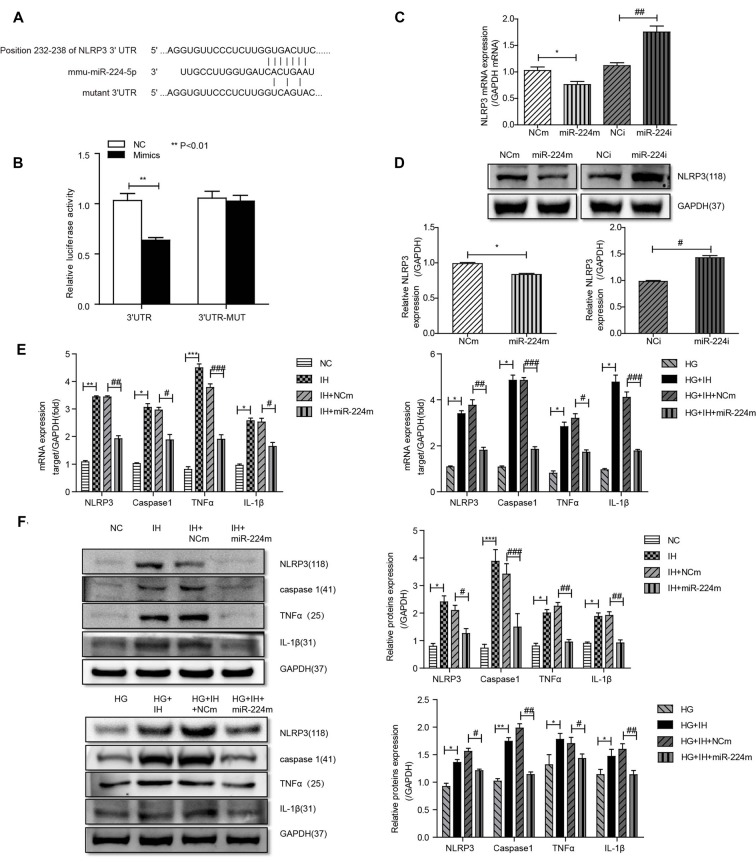
Studies have shown that diabetes can cause cognitive dysfunction, and cognitive dysfunction in patients with diabetes combined with obstructive sleep apnea (OSA) is more severe. LncRNAs are known to be associated with type 2 diabetes mellitus (T2DM) with OSA. This study aimed to investigate the role and underlying mechanism of the lncRNA MALAT1/miR-224-5p/NLRP3 axis in T2DM with OSA. qRT-PCR was used to quantify the expression of MALAT1, miR-224-5p, and NLRP3 in brain tissues. NLRP3 expression was assessed by immunohistochemistry (IHC) and immunofluorescent labeling. The interaction involving MALAT1, miR-224-5p, and NLRP3 was evaluated by transfection. Western blotting was utilized to evaluate the expression levels of the pathway-related proteins NLRP3, caspase 1, tumor necrosis factor-α (TNF-α) and interleukin-1 β (IL-1β) both and . qRT-PCR was used to assess the mRNA expression levels of NLRP3, caspase 1, TNF-α and IL-1β both and . In brain tissues of T2DM with OSA, MALAT1 and NLRP3 were overexpressed, while miR-224-5p was downregulated, which was consistent with subsequent cell experiments. We screened the miRNAs that could bind to MALAT1 and NLRP3 by the StarBase database and the TargetScanMouse7.2 website. Our research showed that among these miRNAs, the level of miR-224-5p was most significantly negatively correlated with the levels of MALAT1 and NLRP3. Also, a firefly luciferase assay showed that miR-224-5p, which is a target of MALAT1, directly reduced the expression of the downstream protein NLRP3. Overexpression of miR-224-5p significantly inhibited the expression levels of NLRP3, caspase 1, TNF-α and IL-1β . MALAT1 promoted NLRP3 expression by acting as a competing endogenous RNA and sponging miR-224-5p. MiR-224-5p reduces microglial inflammation activation through the regulation of NLRP3 expression, which ultimately affected the NLRP3/IL-1β pathway in the hippocampus. This suggests that miR-224-5p may serve as a potential target for T2DM and OSA therapy.
研究表明,糖尿病可导致认知功能障碍,而糖尿病合并阻塞性睡眠呼吸暂停(OSA)患者的认知功能障碍更为严重。已知长链非编码RNA(lncRNAs)与伴OSA的2型糖尿病(T2DM)有关。本研究旨在探讨lncRNA MALAT1/miR-224-5p/NLRP3轴在伴OSA的T2DM中的作用及潜在机制。采用qRT-PCR定量检测脑组织中MALAT1、miR-224-5p和NLRP3的表达。通过免疫组织化学(IHC)和免疫荧光标记评估NLRP3的表达。通过转染评估MALAT1、miR-224-5p和NLRP3之间的相互作用。利用蛋白质免疫印迹法评估通路相关蛋白NLRP3、半胱天冬酶1、肿瘤坏死因子-α(TNF-α)和白细胞介素-1β(IL-1β)的表达水平。采用qRT-PCR评估NLRP3、半胱天冬酶1、TNF-α和IL-1β的mRNA表达水平。在伴OSA的T2DM脑组织中,MALAT1和NLRP3过表达,而miR-224-5p下调,这与随后的细胞实验结果一致。我们通过StarBase数据库和TargetScanMouse7.2网站筛选出可与MALAT1和NLRP3结合的微小RNA(miRNAs)。我们的研究表明,在这些miRNAs中,miR-224-5p的水平与MALAT1和NLRP3的水平呈最显著的负相关。此外,荧光素酶报告基因检测表明,作为MALAT1靶点的miR-224-5p可直接降低下游蛋白NLRP3的表达。miR-224-5p的过表达显著抑制NLRP3、半胱天冬酶1、TNF-α和IL-1β的表达水平。MALAT1作为竞争性内源RNA,通过结合miR-224-5p促进NLRP3表达。miR-224-5p通过调节NLRP3表达减少小胶质细胞炎症激活,最终影响海马体中的NLRP3/IL-1β通路。这表明miR-224-5p可能成为T2DM和OSA治疗的潜在靶点。