Lee Junghan, Ha Sungji, Lee Seung-Tae, Park Sung-Gyun, Shin Saeam, Choi Jong Rak, Cheon Keun-Ah
Division of Child and Adolescent Psychiatry, Department of Psychiatry, Severance Hospital, Institute of Behavioral Science in Medicine, Yonsei University College of Medicine, Seoul, South Korea.
Department of Psychiatry, Institute of Behavioral Science in Medicine, Yonsei University College of Medicine, Seoul, South Korea.
Front Pharmacol. 2020 May 14;11:585. doi: 10.3389/fphar.2020.00585. eCollection 2020.
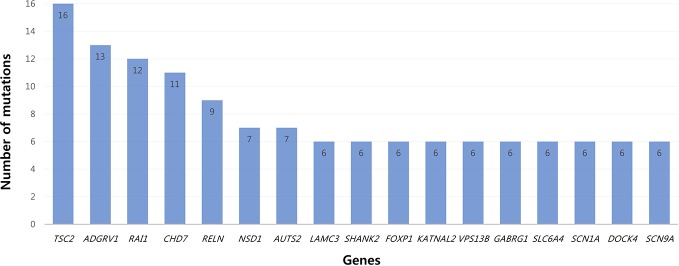
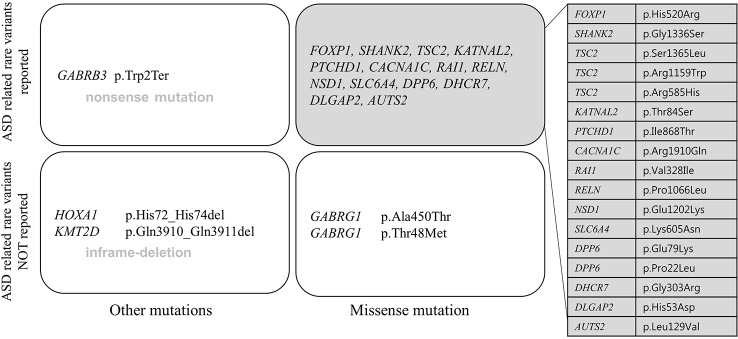
Autism spectrum disorder (ASD) is a neurodevelopmental disorder characterized by impairments in social communication and restricted and repetitive behaviors and interests. Identifying the genetic background may be one of the key features for the future diagnosis and treatment of ASD. With the tremendous development in genetic diagnosis techniques, next-generation sequencing (NGS) can be used to analyze multiple genes simultaneously with a single test in laboratory and clinical settings and is well suited for investigating autism genetics. According to previous studies, there are two types of genetic variants in ASD, rare variants and common variants, and both are important in explaining pathogenesis. In this study, NGS data from 137 participants with ASD were reviewed retrospectively with consideration for comorbid epilepsy. Diagnostic yield was 17.51% (24/137), and pathogenic/likely pathogenic variants were seen more frequently in female participants. Fourteen participants were diagnosed with comorbid epilepsy, six of them had pathogenic/likely pathogenic variants (43%). Genes with variants of unknown significance (VOUS) which have one or more evidence of pathogenicity following the American College of Medical Genetics (ACMG) criteria were also reviewed in both ASD and ASD with comorbid epilepsy groups. We found that most frequently found VOUS genes have previously been reported as genes related to ASD or other developmental disorders. These results suggest that when interpreting the NGS results in the clinical setting, careful observation of VOUS with some pathological evidence might contribute to the discovery of genetic pathogenesis of neurodevelopmental disorders such as ASD and epilepsy.
自闭症谱系障碍(ASD)是一种神经发育障碍,其特征是社交沟通受损以及行为和兴趣受限且重复。确定遗传背景可能是未来ASD诊断和治疗的关键特征之一。随着基因诊断技术的巨大发展,下一代测序(NGS)可用于在实验室和临床环境中通过一次测试同时分析多个基因,非常适合研究自闭症遗传学。根据以往研究,ASD存在两种类型的基因变异,即罕见变异和常见变异,两者在解释发病机制方面都很重要。在本研究中,回顾性分析了137名ASD参与者的NGS数据,并考虑了共病癫痫情况。诊断率为17.51%(24/137),致病/可能致病变异在女性参与者中更常见。14名参与者被诊断为共病癫痫,其中6人有致病/可能致病变异(43%)。还在ASD组和共病癫痫的ASD组中对具有意义未明变异(VOUS)且根据美国医学遗传学学会(ACMG)标准有一个或多个致病证据的基因进行了审查。我们发现,最常发现的VOUS基因此前已被报道为与ASD或其他发育障碍相关的基因。这些结果表明,在临床环境中解释NGS结果时,仔细观察有一些病理证据的VOUS可能有助于发现ASD和癫痫等神经发育障碍的遗传发病机制。