Günther Catrin Sonja, Dare Andrew P, McGhie Tony K, Deng Cecilia, Lafferty Declan J, Plunkett Blue J, Grierson Ella R P, Turner Janice L, Jaakola Laura, Albert Nick W, Espley Richard V
The New Zealand Institute for Plant & Food Research Ltd., Auckland, New Zealand.
The New Zealand Institute for Plant & Food Research Ltd., Palmerston North, New Zealand.
Front Plant Sci. 2020 May 13;11:545. doi: 10.3389/fpls.2020.00545. eCollection 2020.
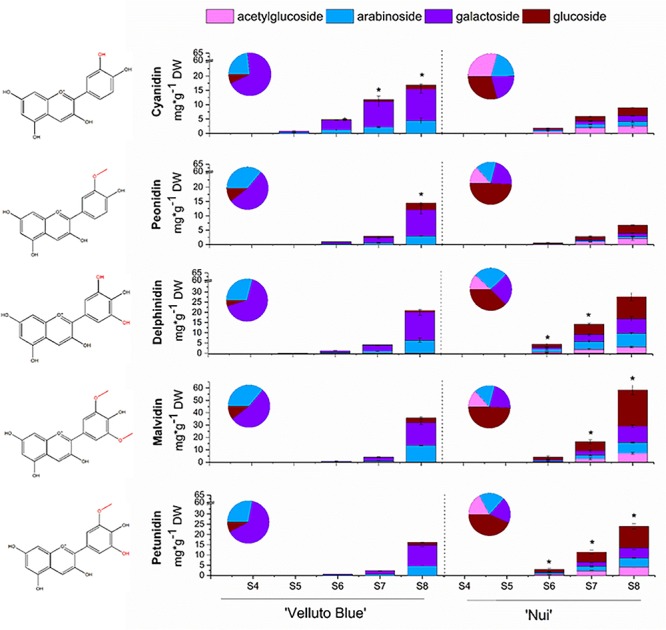
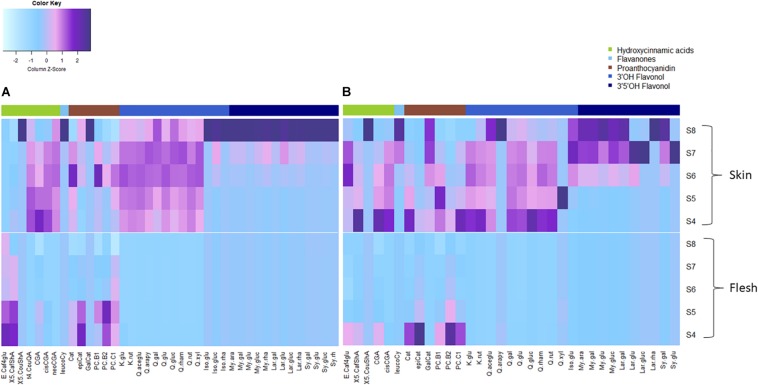
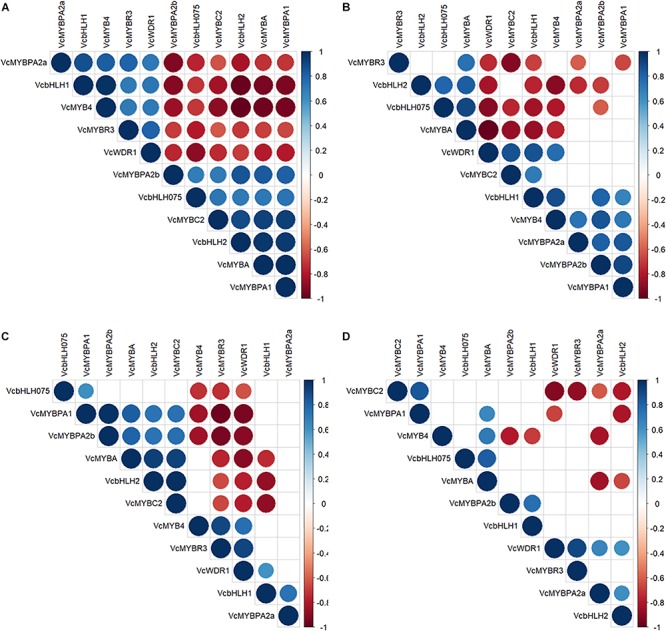
Blueberries are distinguished by their purple-blue fruit color, which develops during ripening and is derived from a characteristic composition of flavonoid-derived anthocyanin pigments. The production of anthocyanins is confined to fruit skin, leaving the colorless fruit flesh devoid of these compounds. By linking accumulation patterns of phenolic metabolites with gene transcription in Northern Highbush () and Rabbiteye ( blueberry, we investigated factors limiting anthocyanin production in berry flesh. We find that flavonoid production was generally lower in fruit flesh compared with skin and concentrations further declined during maturation. A common set of structural genes was identified across both species, indicating that tissue-specific flavonoid biosynthesis was dependent on co-expression of multiple pathway genes and limited by the phenylpropanoid pathway in combination with , , and as potential pathway bottlenecks. While metabolite concentrations were comparable between the blueberry genotypes when fully ripe, the anthocyanin composition was distinct and depended on the degree of hydroxylation/methoxylation of the anthocyanidin moiety in combination with genotype-specific glycosylation patterns. Co-correlation analysis of phenolic metabolites with pathway structural genes revealed characteristic isoforms of -methyltransferases and UDP-glucose:flavonoid-3--glycosyltransferase that were likely to modulate anthocyanin composition. Finally, we identified candidate transcriptional regulators that were co-expressed with structural genes, including the activators , , and together with the repressor , which suggested an interdependent role in anthocyanin regulation.
蓝莓以其紫蓝色的果实颜色为特征,这种颜色在成熟过程中形成,源自类黄酮衍生的花青素色素的独特组成。花青素的产生仅限于果实表皮,使得无色的果肉中不含这些化合物。通过将北方高丛蓝莓()和兔眼蓝莓()中酚类代谢物的积累模式与基因转录联系起来,我们研究了限制浆果果肉中花青素产生的因素。我们发现,与表皮相比,果肉中的类黄酮生成通常较低,并且在成熟过程中其浓度进一步下降。在两个物种中鉴定出一组共同的结构基因,这表明组织特异性类黄酮生物合成依赖于多个途径基因的共表达,并受到苯丙烷途径以及、和作为潜在途径瓶颈的限制。虽然完全成熟时蓝莓基因型之间的代谢物浓度相当,但花青素组成却不同,这取决于花青素部分的羟基化/甲氧基化程度以及基因型特异性糖基化模式。酚类代谢物与途径结构基因的共相关分析揭示了可能调节花青素组成的甲基转移酶和UDP-葡萄糖:类黄酮-3-O-糖基转移酶的特征性同工型。最后,我们鉴定出与结构基因共表达的候选转录调节因子,包括激活剂、和以及阻遏物,这表明它们在花青素调节中具有相互依赖的作用。