Kapoor Vaishali, Collins Andrea, Griffith Kaylan, Ghosh Subhajit, Wong Nathan, Wang Xiaowei, Challen Grant A, Krambs Joseph, Link Dan, Hallahan Dennis E, Thotala Dinesh
Department of Radiation Oncology, St. Louis School of Medicine, Washington University, St. Louis, Missouri, USA.
Department of Medicine, St. Louis School of Medicine, Washington University, St. Louis, Missouri, USA.
Oncotarget. 2020 May 12;11(19):1681-1690. doi: 10.18632/oncotarget.27564.
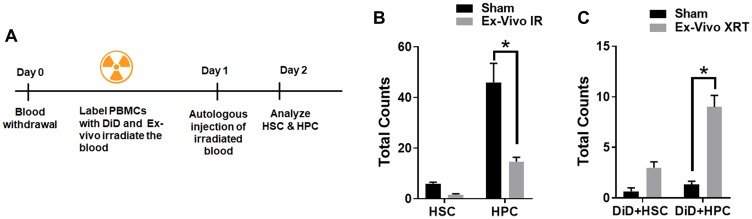
The immune system plays a vital role in cancer therapy, especially with the advent of immunotherapy. Radiation therapy induces iatrogenic immunosuppression referred to as radiation-induced lymphopenia (RIL). RIL correlates with significant decreases in the overall survival of cancer patients. Although the etiology and severity of lymphopenia are known, the mechanism(s) of RIL are largely unknown. We found that irradiation not only had direct effects on circulating lymphocytes but also had indirect effects on the spleen, thymus, and bone marrow. We found that irradiated cells traffic to the bone marrow and bring about the reduction of hematopoietic stem cells (HSC) and progenitor cells. Using mass cytometry analysis (CyTOF) of the bone marrow, we found reduced expression of CD11a, which is required for T cell proliferation and maturation. RNA Sequencing and gene set enrichment analysis of the bone marrow cells following irradiation showed down-regulation of genes involved in hematopoiesis. Identification of CD11a and hematopoietic genes involved in iatrogenic immune suppression can help identify mechanisms of RIL.
免疫系统在癌症治疗中起着至关重要的作用,尤其是随着免疫疗法的出现。放射治疗会诱发医源性免疫抑制,即放射诱导的淋巴细胞减少症(RIL)。RIL与癌症患者总体生存率的显著下降相关。尽管淋巴细胞减少症的病因和严重程度已为人所知,但RIL的机制在很大程度上仍不清楚。我们发现,辐射不仅对循环淋巴细胞有直接影响,而且对脾脏、胸腺和骨髓有间接影响。我们发现,受辐射的细胞会迁移到骨髓,并导致造血干细胞(HSC)和祖细胞减少。通过对骨髓进行质谱流式细胞术分析(CyTOF),我们发现T细胞增殖和成熟所需的CD11a表达降低。对辐射后骨髓细胞进行RNA测序和基因集富集分析,结果显示参与造血的基因表达下调。鉴定参与医源性免疫抑制的CD11a和造血基因有助于明确RIL的机制。