Yuan Bo, Zhao Jun, Zhou Chengzhi, Wang Xiumei, Zhu Bo, Zhuo Minglei, Dong Xilin, Feng Jiemei, Yi Cuihua, Yang Yunpeng, Zhang Hua, Zhou Wangyan, Chen Zhengtang, Yang Sheng, Ai Xinghao, Chen Kehe, Cui Xuefan, Liu Difa, Shi Chunmei, Wu Wei, Zhang Yanjun, Chang Lianpeng, Li Jin, Chen Rongrong, Yang Shuanying
Department of Pulmonary and Critical Care Medicine, The Second Affiliated Hospital of Xi'an Jiaotong University, Xi'an, China.
Key Laboratory of Carcinogenesis and Translational Research (Ministry of Education), Department of Thoracic Medical Oncology-I, Peking University Cancer Hospital and Institute, Beijing, China.
Front Oncol. 2020 May 12;10:729. doi: 10.3389/fonc.2020.00729. eCollection 2020.
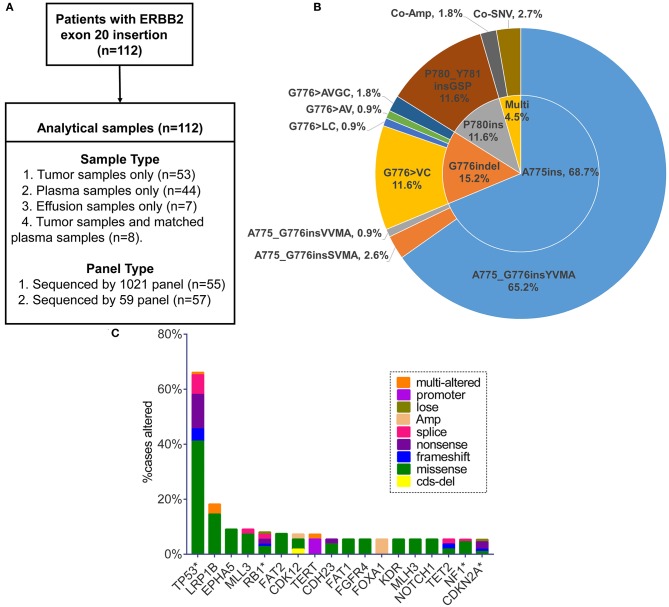
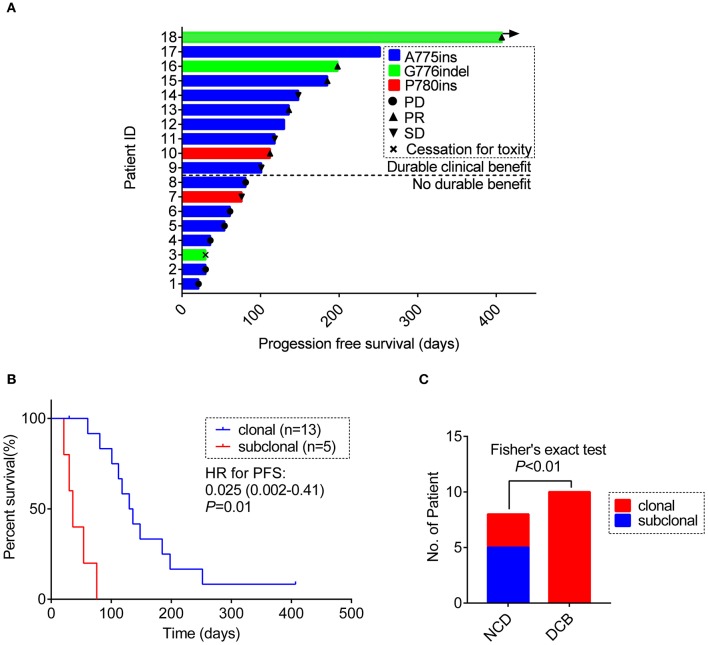
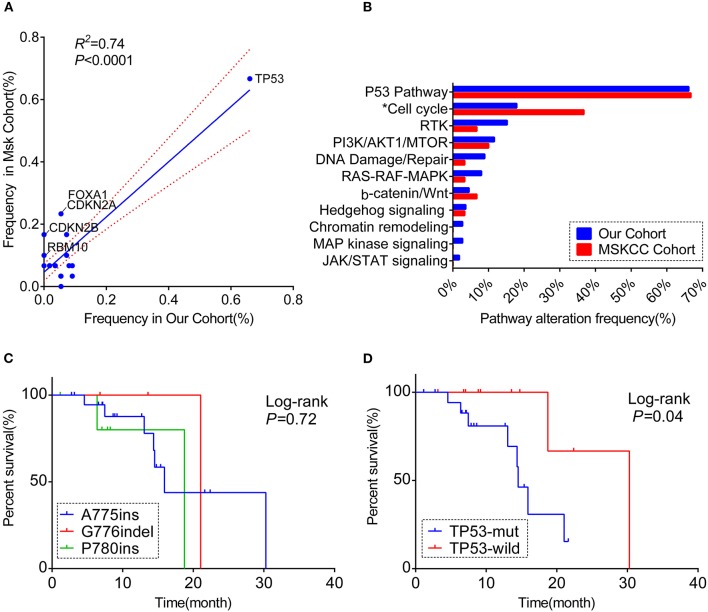
Human epidermal growth factor receptor 2 (ERBB2, HER-2) exon 20 insertion (ERBB2ex20ins) remains a refractory oncogenic driver in lung cancer. So far there is limited data showing the co-occurring mutation background of ERBB2ex20ins in Chinese lung cancer and its relationship with response to afatinib. A total of 112 Chinese patients with ERBB2ex20ins identified by next-generation sequencing from 17 hospitals were enrolled. The clinical outcomes of 18 patients receiving afatinib treatment were collected. Among the 112 patients, insertion-site subtypes comprised of A775ins (71%; 79/112), G776indel (17%; 19/112), and P780ins (12%; 14/112). There were 66.1% (74/112) of patients carrying TP53 co-mutation and FOXA1 was the most prevalent co-amplified gene (5.5%, 3/55). The co-occurring genomic feature was similar among three insertional-site subtypes and had an overall strong concordance with the western population from the MSKCC cohort ( = 0.74, < 0.01). For the prognosis, patients with co-occurring mutation in cell-cycle pathway especially TP53 showed shorter OS than patients without [median OS: 14.5 m (95% CI:12.7-16.3 m) vs. 30.3 m (95% CI: not reached), = 0.04], while the OS was comparable among three subtypes. For the response to afatinib, ERBB2ex20ins as a subclonal variant was an independent factor relating to shorter PFS [median PFS: 1.2 m (95% CI: 0.8-1.6 m) vs. 4.3 m (95% CI: 3.3-5.3 m), < 0.05]. Our data revealed co-occurring TP53 represent an unfavorable prognosis of patients with ERBB2ex20ins, emphasizing the more valuable role of the co-mutation patterns than insertion-site subtypes in predicting prognosis of this group of patients. Moreover, the clonality status of ERBB2ex20ins was identified as a potential indicator for response to afatinib.
人表皮生长因子受体2(ERBB2,HER-2)外显子20插入(ERBB2ex20ins)仍是肺癌中难治的致癌驱动因素。目前,关于中国肺癌患者中ERBB2ex20ins的共发突变背景及其与阿法替尼反应关系的数据有限。我们纳入了17家医院通过二代测序鉴定出的112例中国ERBB2ex20ins患者。收集了18例接受阿法替尼治疗患者的临床结局。在这112例患者中,插入位点亚型包括A775ins(71%;79/112)、G776indel(17%;19/112)和P780ins(12%;14/112)。66.1%(74/112)的患者携带TP53共突变,FOXA1是最常见的共扩增基因(5.5%,3/55)。三种插入位点亚型的共发基因组特征相似,与MSKCC队列中的西方人群总体一致性较强( = 0.74, < 0.01)。在预后方面,细胞周期通路尤其是TP53共突变的患者总生存期短于无共突变患者[中位总生存期:14.5个月(95%CI:12.7 - 16.3个月)对30.3个月(95%CI:未达到), = 0.04],而三种亚型的总生存期相当。对于阿法替尼反应,作为亚克隆变异的ERBB2ex20ins是与较短无进展生存期相关的独立因素[中位无进展生存期:1.2个月(95%CI:0.8 - 1.6个月)对4.3个月(95%CI:3.3 - 5.3个月), < 0.05]。我们的数据显示,共发TP53代表ERBB2ex20ins患者的不良预后,强调了共突变模式在预测该组患者预后方面比插入位点亚型更具价值的作用。此外,ERBB2ex20ins的克隆性状态被确定为阿法替尼反应的潜在指标。