Yaprak Gokhan, Gemici Cengiz, Seseogullari Ozgur O, Karabag Irem S, Cini Nilsu
Department of Radiation Oncology, Kartal Dr. Lutfi Kirdar Education and Research Hospital, Istanbul, Turkey.
Department of Radiation Oncology, Biruni University Medicana Hospital, Istanbul, Turkey.
Front Oncol. 2020 May 13;10:742. doi: 10.3389/fonc.2020.00742. eCollection 2020.
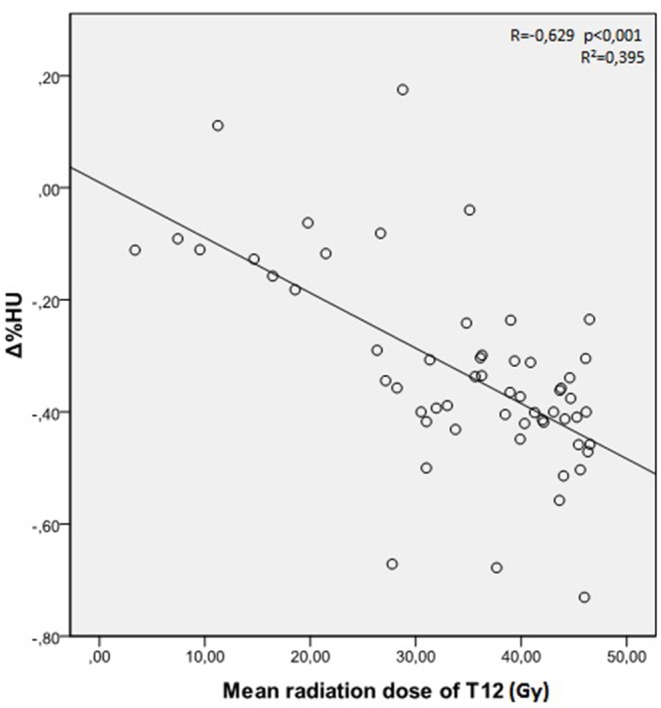
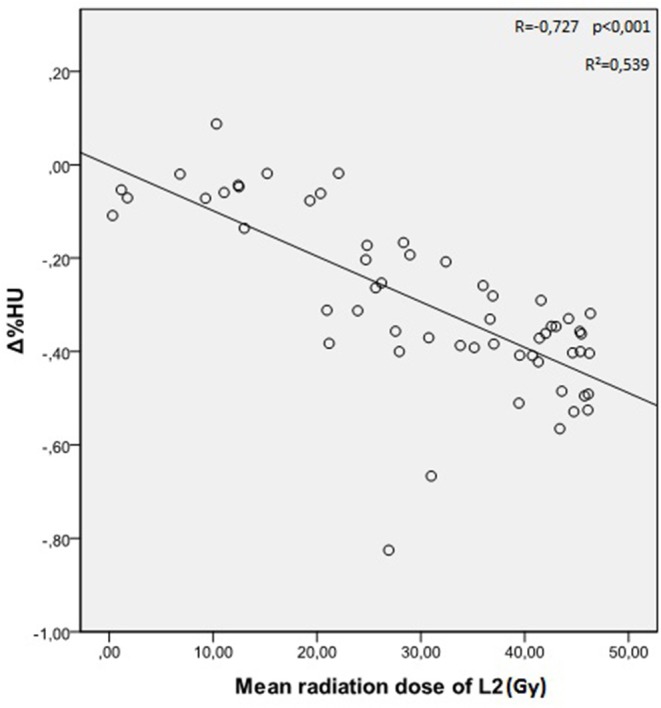
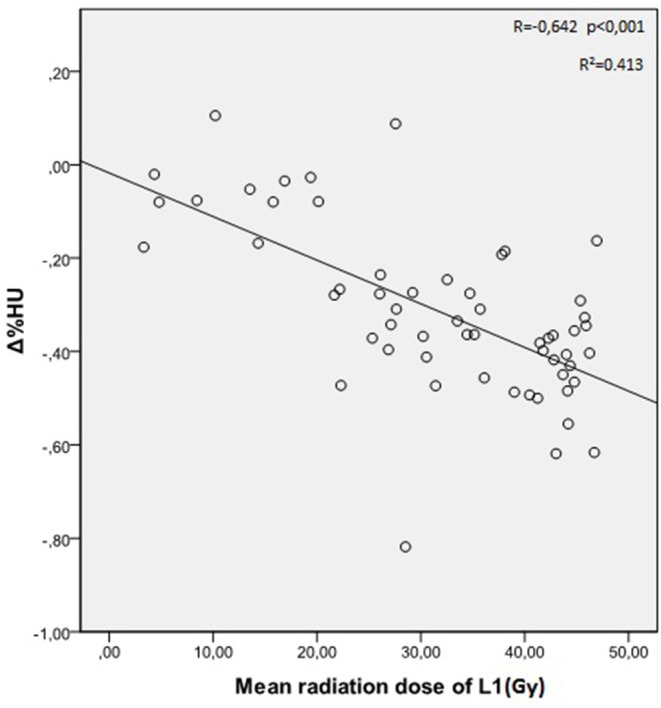
We aimed to evaluate osteoporosis, bone mineral density, and fracture risk in irradiated patients by computerized tomography derived Hounsfield Units (HUs) calculated from radiation treatment planning system. Fifty-seven patients operated for gastric adenocarcinoma who received adjuvant abdominal radiotherapy were included in the study group. Thirty-four patients who were not irradiated after surgery comprised the control group. HUs of T12, L1, L2 vertebral bodies were measured from the computerized tomographies imported to the treatment planning system for all the patients. While the measurements were obtained just after surgery and 1 year later after surgery in the control group, the same measurements were obtained just before irradiation and 1 year after radiotherapy in the study group. Percent change in HU values (Δ%HU) was determined for each group. Vertebral compression fractures, which are the consequence of radiation induced osteoporosis and bone toxicity were assessed during follow-up. There was no statistical significant difference in HU values measured for all the vertebrae between the study and the control group at the onset of the study. While HU values decreased significantly in the study group, there was no significant reduction in HU values in the control group after 1 year. significant correlation was found between Δ%HU and the radiation dose received by each vertebra. Insufficiency fractures (IFs) were observed only in the irradiated patients (4 out of 57 patients) with the cumulative incidence of 7%. HU values are very valuable in determining bone mineral density and fracture risk. Radiation treatment planning system can be utilized to determine HU values. IFs are common after abdominal radiotherapy in patients with low vertebral HU values detected during radiation treatment planning. Radiation dose to the vertebral bones with low HU values should be limited below 20 Gy to prevent late radiation related bone toxicity.
我们旨在通过从放射治疗计划系统计算得出的计算机断层扫描亨氏单位(HU)来评估接受放疗患者的骨质疏松症、骨密度和骨折风险。研究组纳入了57例接受辅助腹部放疗的胃腺癌手术患者。34例术后未接受放疗的患者组成对照组。对所有患者,从导入治疗计划系统的计算机断层扫描中测量T12、L1、L2椎体的HU值。对照组在术后即刻和术后1年进行测量,而研究组在放疗前即刻和放疗后1年进行相同测量。确定每组HU值的百分比变化(Δ%HU)。在随访期间评估作为放射诱导骨质疏松症和骨毒性后果的椎体压缩骨折。研究开始时,研究组和对照组所有椎体测量的HU值无统计学显著差异。研究组HU值显著下降,而对照组1年后HU值无显著降低。发现Δ%HU与每个椎体接受的放射剂量之间存在显著相关性。仅在接受放疗的患者(57例患者中有4例)中观察到骨质疏松性骨折(IFs),累积发生率为7%。HU值在确定骨密度和骨折风险方面非常有价值。放射治疗计划系统可用于确定HU值。在放射治疗计划期间检测到椎体HU值低的患者中,腹部放疗后IFs很常见。应将低HU值椎体的放射剂量限制在20 Gy以下,以预防晚期放射相关骨毒性。