Erasmus University Rotterdam, Rotterdam, The Netherlands.
Q J Exp Psychol (Hove). 2020 Nov;73(11):1796-1806. doi: 10.1177/1747021820933214. Epub 2020 Jun 18.
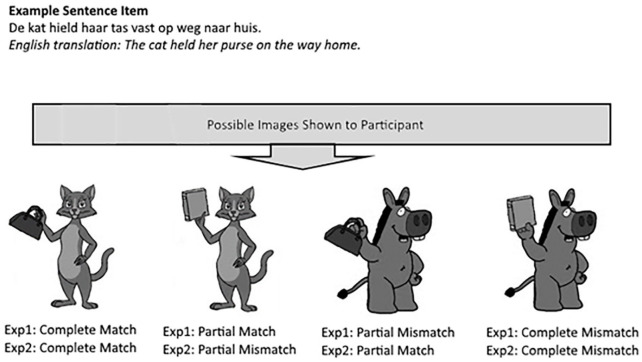
Studies on the presence of mental simulations during language comprehension have typically focused only on single object properties. This study investigates whether two objects are combined in mental simulations, and whether this is influenced by task instructions. In both experiments, participants read sentences describing animals using a tool in some way. After each sentence, they saw an image of a cartoon animal holding a tool, and they indicated whether the animal (Experiment 1) or the tool (Experiment 2) was mentioned in the previous sentence or not. The shown image completely matched, partially matched, partially mismatched, or completely mismatched the preceding sentence. In total, 90 Dutch psychology students took part in Experiment 1, and 92 students took part in Experiment 2, both experiments were pre-registered. The results suggest that mental simulations indeed combine multiple objects during language comprehension and that this is not influenced by task instructions. Regardless of the instruction type, participants always responded quickest in the complete match condition compared to the partial match condition, suggesting that language comprehension leads to the creation of a complete mental simulation.
关于语言理解过程中是否存在心理模拟的研究通常只关注单一物体的属性。本研究旨在探讨两个物体是否在心理模拟中被组合在一起,以及任务指令是否会对此产生影响。在两个实验中,参与者都阅读了一些描述动物的句子,这些句子以某种方式使用了工具。在每句话之后,他们会看到一个卡通动物拿着工具的图片,并判断该动物(实验 1)或工具(实验 2)是否在前一句中提到。所展示的图片与前一句完全匹配、部分匹配、部分不匹配或完全不匹配。共有 90 名荷兰心理学学生参加了实验 1,92 名学生参加了实验 2,两个实验都预先进行了注册。结果表明,心理模拟确实会在语言理解过程中组合多个物体,而这不受任务指令的影响。无论指令类型如何,参与者在完全匹配条件下的反应总是比部分匹配条件下的反应更快,这表明语言理解会导致完整的心理模拟的产生。