Kidney Node Laboratory, The Charles Perkins Centre, Camperdown, New South Wales, Australia
Sydney Medical School, Faculty of Medicine and Health, University of Sydney, Sydney, New South Wales, Australia.
J Am Soc Nephrol. 2020 Jul;31(7):1445-1461. doi: 10.1681/ASN.2019080852. Epub 2020 Jun 1.
Short-chain fatty acids derived from gut microbial fermentation of dietary fiber have been shown to suppress autoimmunity through mechanisms that include enhanced regulation by T regulatory cells (Tregs).
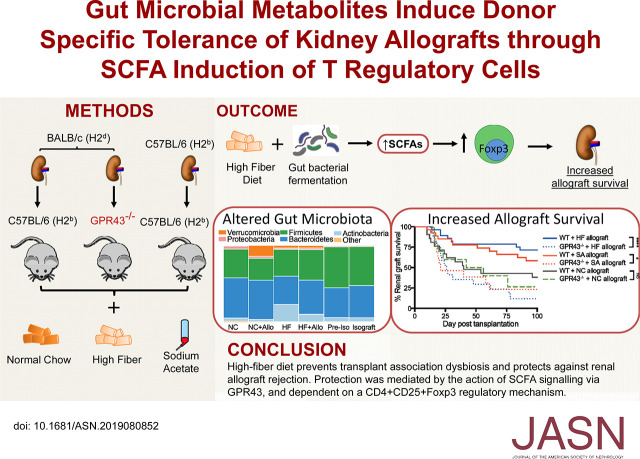
Using a murine kidney transplantation model, we examined the effects on alloimmunity of a high-fiber diet or supplementation with the short-chain fatty acid acetate. Kidney transplants were performed from BALB/c(H2) to B6(H2) mice as allografts in wild-type and recipient mice lacking the G protein-coupled receptor GPR43 (the metabolite-sensing receptor of acetate). Allograft mice received normal chow, a high-fiber diet, or normal chow supplemented with sodium acetate. We assessed rejection at days 14 (acute) and 100 (chronic), and used 16S rRNA sequencing to determine gut microbiota composition pretransplantation and post-transplantation.
Wild-type mice fed normal chow exhibited dysbiosis after receiving a kidney allograft but not an isograft, despite the avoidance of antibiotics and immunosuppression for the latter. A high-fiber diet prevented dysbiosis in allograft recipients, who demonstrated prolonged survival and reduced evidence of rejection compared with mice fed normal chow. Allograft mice receiving supplemental sodium acetate exhibited similar protection from rejection, and subsequently demonstrated donor-specific tolerance. Depletion of CD25 Tregs or absence of the short-chain fatty acid receptor GPR43 abolished this survival advantage.
Manipulation of the microbiome by a high-fiber diet or supplementation with sodium acetate modified alloimmunity in a kidney transplant model, generating tolerance dependent on Tregs and GPR43. Diet-based therapy to induce changes in the gut microbiome can alter systemic alloimmunity in mice, in part through the production of short-chain fatty acids leading to Treg cell development, and merits study as a potential clinical strategy to facilitate transplant acceptance.
膳食纤维经肠道微生物发酵产生的短链脂肪酸已被证明可通过增强 T 调节细胞(Treg)的调节作用来抑制自身免疫。
我们使用小鼠肾移植模型,研究了高纤维饮食或补充短链脂肪酸醋酸盐对同种异体免疫的影响。将 BALB/c(H2)到 B6(H2)小鼠的肾脏移植作为同种异体移植物在野生型和缺乏 G 蛋白偶联受体 GPR43(醋酸盐代谢物感应受体)的受体小鼠中进行。同种异体移植小鼠接受普通饲料、高纤维饮食或补充醋酸钠的普通饲料。我们在第 14 天(急性)和第 100 天(慢性)评估排斥反应,并在移植前和移植后使用 16S rRNA 测序确定肠道微生物群组成。
接受肾移植但未接受同种异体移植的野生型小鼠在接受普通饲料后表现出菌群失调,但后者避免了抗生素和免疫抑制。高纤维饮食可预防同种异体移植受者的菌群失调,与接受普通饲料的小鼠相比,其移植肾的存活时间延长,排斥反应证据减少。接受补充醋酸钠的同种异体移植小鼠也表现出类似的排斥反应保护,随后表现出供体特异性耐受。耗尽 CD25 Treg 或缺乏短链脂肪酸受体 GPR43 可消除这种生存优势。
通过高纤维饮食或补充醋酸钠对微生物组的操纵改变了肾移植模型中的同种异体免疫,产生了依赖于 Treg 和 GPR43 的耐受。基于饮食的治疗方法可诱导肠道微生物组发生变化,从而改变小鼠的全身同种异体免疫,部分原因是通过产生短链脂肪酸导致 Treg 细胞的发育,值得作为一种潜在的临床策略进行研究,以促进移植接受。