Department of Dermatology, College of Medicine, University of Arkansas for Medical Sciences, Little Rock, AR, USA.
Department of Nephrology, Union Hospital, Tongji Medical College, Huazhong University of Science and Technology, Wuhan, Hubei, China.
Sci Rep. 2020 Jun 1;10(1):8867. doi: 10.1038/s41598-020-65637-2.
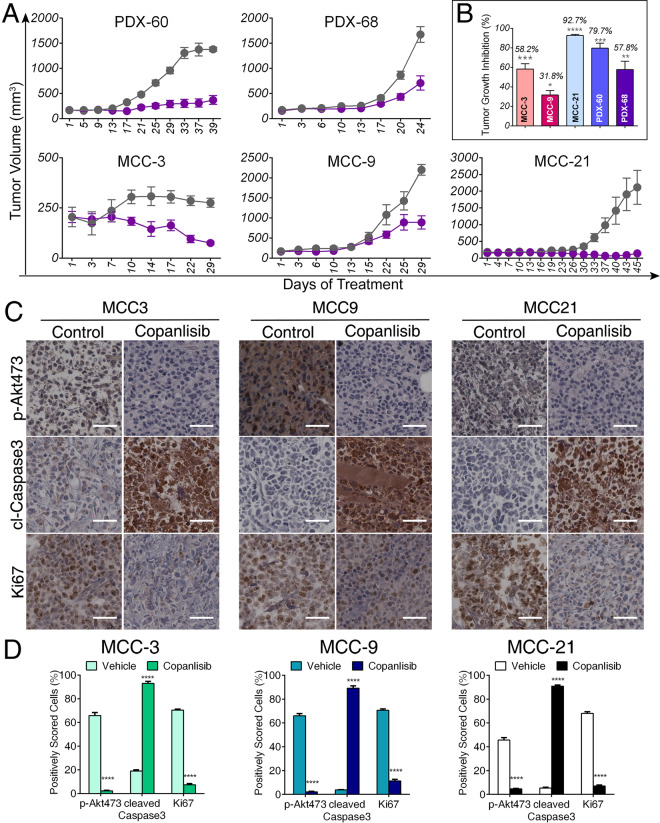
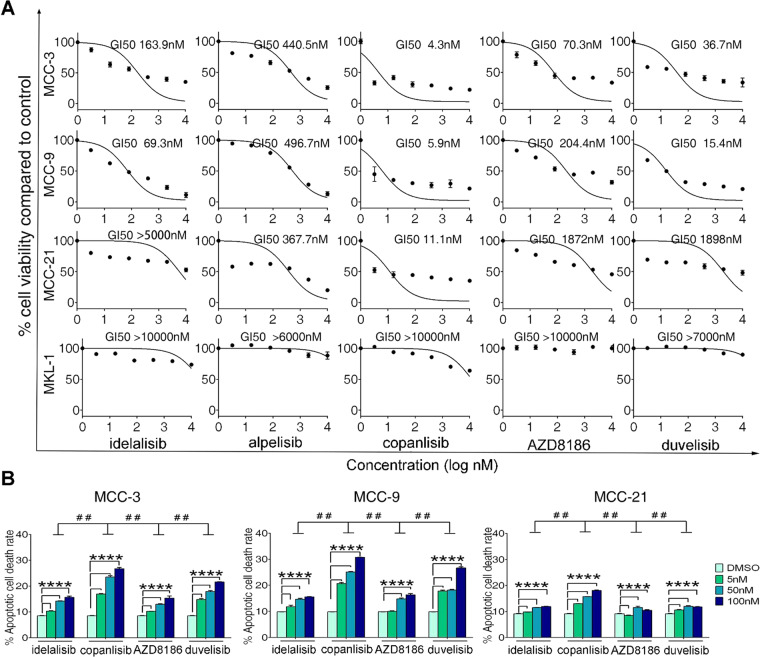
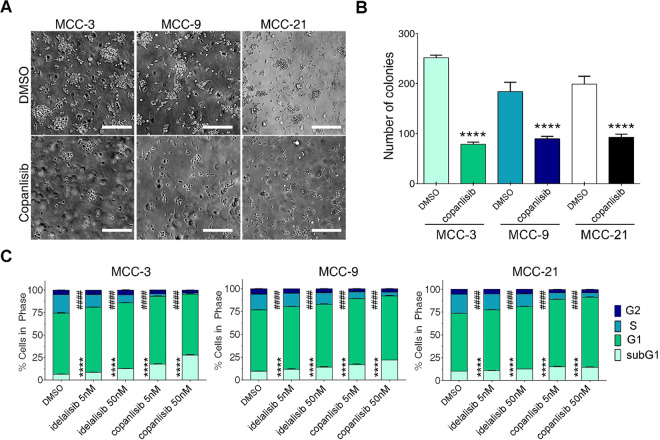
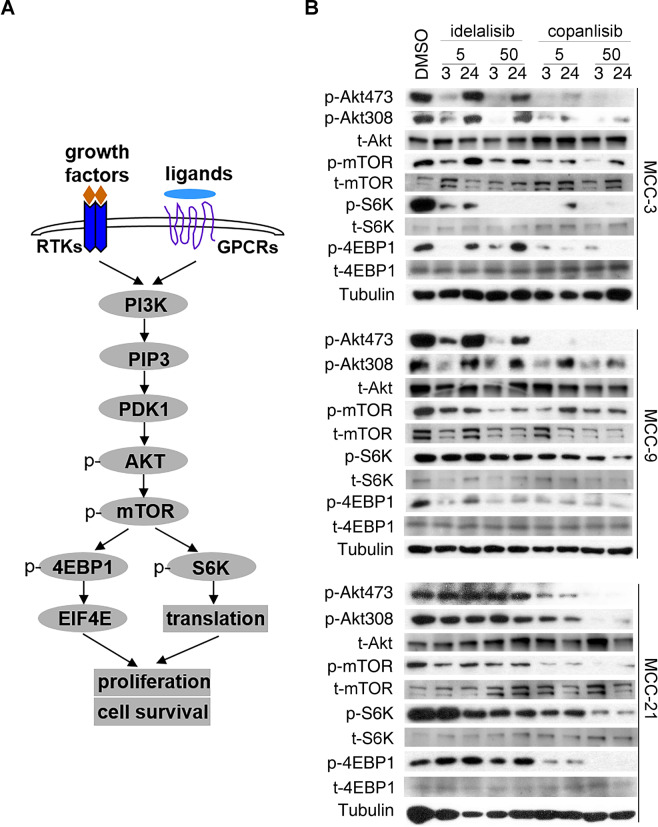
Merkel cell carcinoma (MCC) is a highly aggressive neuroendocrine skin cancer with steadily increasing incidence and poor prognosis. Despite recent success with immunotherapy, 50% of patients still succumb to their diseases. To date, there is no Food and Drug Administration-approved targeted therapy for advanced MCC. Aberrant activation of phosphatidylinositide-3-kinase (PI3K)/AKT/mTOR pathway is frequently detected in MCC, making it an attractive therapeutic target. We previously found PI3K pathway activation in human MCC cell lines and tumors and demonstrated complete clinical response in a Stage IV MCC patient treated with PI3K inhibitor idelalisib. Here, we found that both PI3K-α and -δ isoforms are abundantly expressed in our MCC cell lines and clinical samples; we therefore examined antitumor efficacy across a panel of five PI3K inhibitors with distinctive isoform-specificities, including idelalisib (PI3K-δ), copanlisib (PI3K-α/δ), duvelisib (PI3K-γ/δ), alpelisib (PI3K-α), and AZD8186 (PI3K-β/δ). Of these, copanlisib exerts the most potent antitumor effects, markedly inhibiting cell proliferation, survival, and tumor growth by suppressing PI3K/mTOR/Akt activities in mouse models generated from MCC cell xenografts and patient-derived tumor xenografts. These results provide compelling preclinical evidence for application of copanlisib in advanced MCC with aberrant PI3K activation for which immunotherapy is insufficient, or patients who are unsuitable for immunotherapy.
默克尔细胞癌(Merkel cell carcinoma,MCC)是一种具有高侵袭性的神经内分泌皮肤癌,其发病率稳步上升,预后较差。尽管最近免疫疗法取得了成功,但仍有 50%的患者死于该病。迄今为止,尚无美国食品和药物管理局(FDA)批准的用于治疗晚期 MCC 的靶向药物。MCC 中经常检测到磷脂酰肌醇 3-激酶(phosphatidylinositide-3-kinase,PI3K)/AKT/mTOR 通路的异常激活,使其成为一个有吸引力的治疗靶点。我们之前发现 PI3K 通路在人类 MCC 细胞系和肿瘤中被激活,并在一名接受 PI3K 抑制剂idelalisib 治疗的 IV 期 MCC 患者中观察到完全的临床缓解。在此,我们发现 PI3K-α和-PI3K-δ 同工型在我们的 MCC 细胞系和临床样本中均大量表达;因此,我们使用一组具有独特同工型特异性的五种 PI3K 抑制剂对其进行了抗肿瘤功效的检测,包括 idelalisib(PI3K-δ)、copanlisib(PI3K-α/δ)、duvelisib(PI3K-γ/δ)、alpelisib(PI3K-α)和 AZD8186(PI3K-β/δ)。其中,copanlisib 发挥出最强大的抗肿瘤作用,通过抑制源自 MCC 细胞异种移植和患者来源的肿瘤异种移植的小鼠模型中的 PI3K/mTOR/Akt 活性,显著抑制细胞增殖、存活和肿瘤生长。这些结果为应用 copanlisib 提供了有力的临床前证据,该药可用于治疗存在异常 PI3K 激活的晚期 MCC 患者,这些患者对免疫疗法反应不足,或不适合接受免疫疗法。