Institute of Experimental Physics, Freie Universität Berlin, Arnimallee 14, 14195 Berlin, Germany.
Institute of Pharmacy (Pharmacology and Toxicology), Freie Universität Berlin, Königin-Luise-Str. 2+4, 14195 Berlin, Germany.
Theranostics. 2020 May 15;10(14):6322-6336. doi: 10.7150/thno.42581. eCollection 2020.
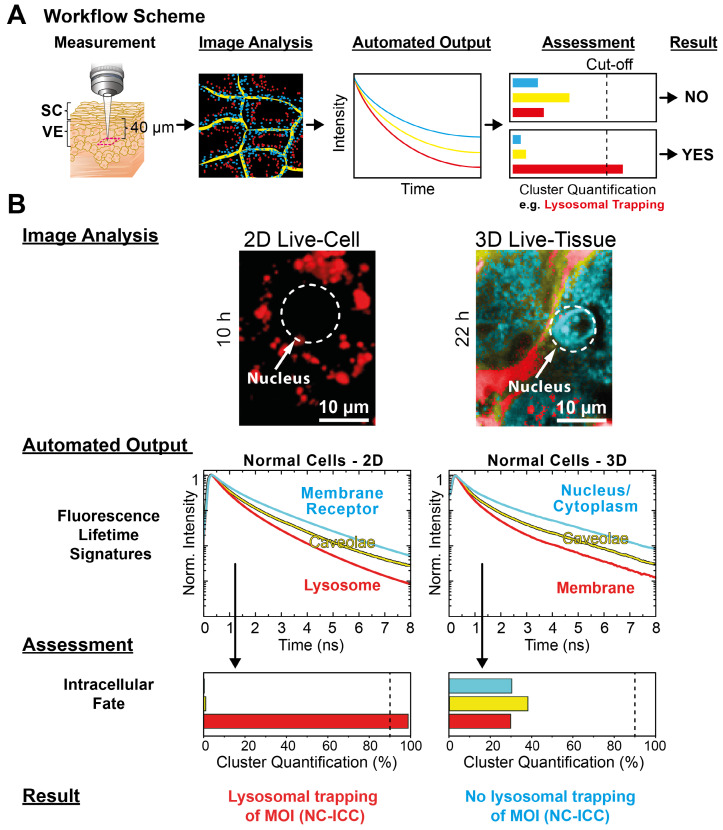
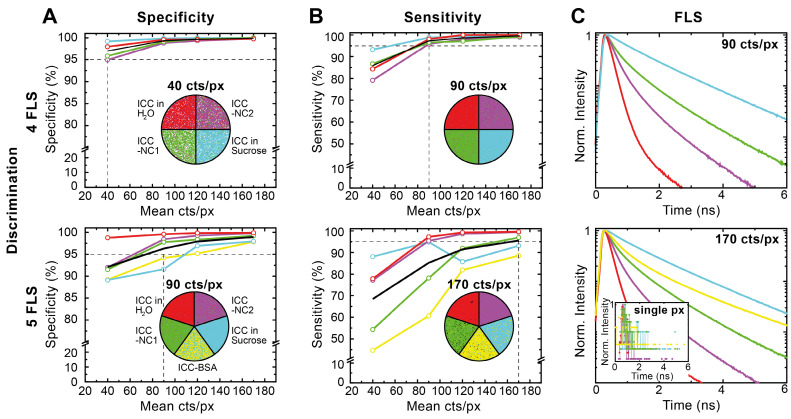
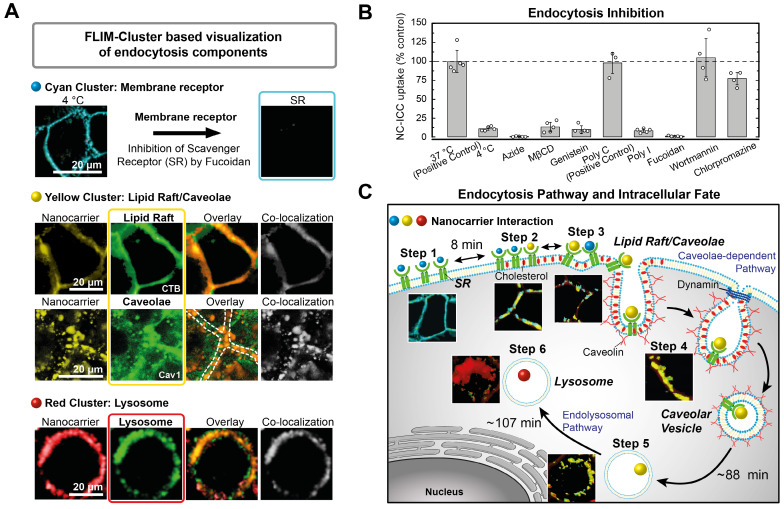
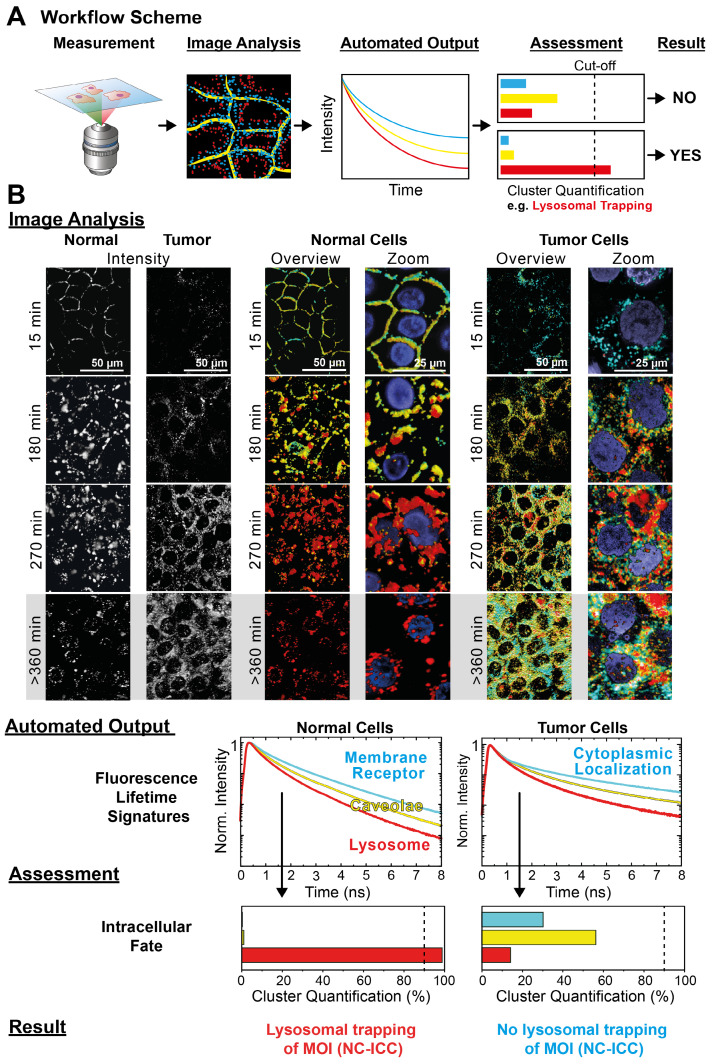
Fluorescence microscopy is widely used for high content screening in 2D cell cultures and 3D models. In particular, 3D tissue models are gaining major relevance in modern drug development. Enabling direct multiparametric evaluation of complex samples, fluorescence lifetime imaging (FLIM) adds a further level to intensity imaging by the sensitivity of the fluorescence lifetime to the microenvironment. However, the use of FLIM is limited amongst others by the acquisition of sufficient photon numbers without phototoxic effects in live cells. Herein, we developed a new cluster-based analysis method to enhance insight, and significantly speed up analysis and measurement time for the accurate translation of fluorescence lifetime information into pharmacological pathways. : We applied a fluorescently-labeled dendritic core-multishell nanocarrier and its cargo Bodipy as molecules of interest (MOI) to human cells and reconstructed human tissue. Following the sensitivity and specificity assessment of the fitting-free Cluster-FLIM analysis of data and , we evaluated the dynamics of cellular molecule uptake and intracellular interactions. For 3D live tissue investigations, we applied multiphoton (mp) FLIM. Owing to Cluster-FLIM's statistics-based fitting-free analysis, we utilized this approach for automatization. : To discriminate the fluorescence lifetime signatures of 5 different fluorescence species in a single color channel, the Cluster-FLIM method requires only 170, respectively, 90 counts per pixel to obtain 95% sensitivity (hit rate) and 95% specificity (correct rejection rate). Cluster-FLIM revealed cellular interactions of MOIs, representing their spatiotemporal intracellular fate. In a setting of an automated workflow, the assessment of lysosomal trapping of the MOI revealed relevant differences between normal and tumor cells, as well as between 2D and 3D models. : The automated Cluster-FLIM tool is fitting-free, providing images with enhanced information, contrast, and spatial resolution at short exposure times and low fluorophore concentrations. Thereby, Cluster-FLIM increases the applicability of FLIM in high content analysis of target molecules in drug development and beyond.
荧光显微镜广泛应用于 2D 细胞培养物和 3D 模型的高通量筛选。特别是,3D 组织模型在现代药物开发中具有重要意义。荧光寿命成像(FLIM)通过荧光寿命对微环境的敏感性,使复杂样品的直接多参数评估成为可能,为强度成像增加了一个新的层次。然而,FLIM 的应用受到限制,例如在活细胞中没有光毒性作用的情况下获取足够的光子数。在此,我们开发了一种新的基于聚类的分析方法,以提高对荧光寿命信息转化为药理途径的深入了解,并显著加快分析和测量时间。
我们应用了一种荧光标记的树突状核壳纳米载体及其作为感兴趣分子(MOI)的货物 Bodipy 到人类细胞和重建的人类组织中。在对无拟合聚类-FLIM 数据分析的灵敏度和特异性进行评估后,我们评估了细胞内分子摄取和细胞内相互作用的动力学。对于 3D 活组织研究,我们应用了多光子(mp)FLIM。由于 Cluster-FLIM 基于统计学的无拟合分析,我们利用这种方法实现了自动化。
为了在单个颜色通道中区分 5 种不同荧光物质的荧光寿命特征,Cluster-FLIM 方法仅需要 170 个,分别为 90 个像素/计数,以获得 95%的灵敏度(命中率)和 95%的特异性(正确拒绝率)。Cluster-FLIM 揭示了 MOI 的细胞相互作用,代表了它们的时空细胞内命运。在自动化工作流程的设置中,对 MOI 溶酶体捕获的评估揭示了正常细胞和肿瘤细胞之间以及 2D 和 3D 模型之间的相关差异。
自动聚类-FLIM 工具是无拟合的,在短曝光时间和低荧光浓度下提供具有增强信息、对比度和空间分辨率的图像。因此,Cluster-FLIM 提高了 FLIM 在药物开发和其他领域中对靶分子高通量分析的适用性。