Department of Liver Surgery and Transplantation, Liver Cancer Institute, Zhongshan Hospital, Fudan University, Key Laboratory of Carcinogenesis and Cancer Invasion (Fudan University), Ministry of Education, Shanghai, China.
Department of Neurosurgery, Zhongshan Hospital, Fudan University, Shanghai, China.
Theranostics. 2020 May 17;10(14):6530-6543. doi: 10.7150/thno.44417. eCollection 2020.
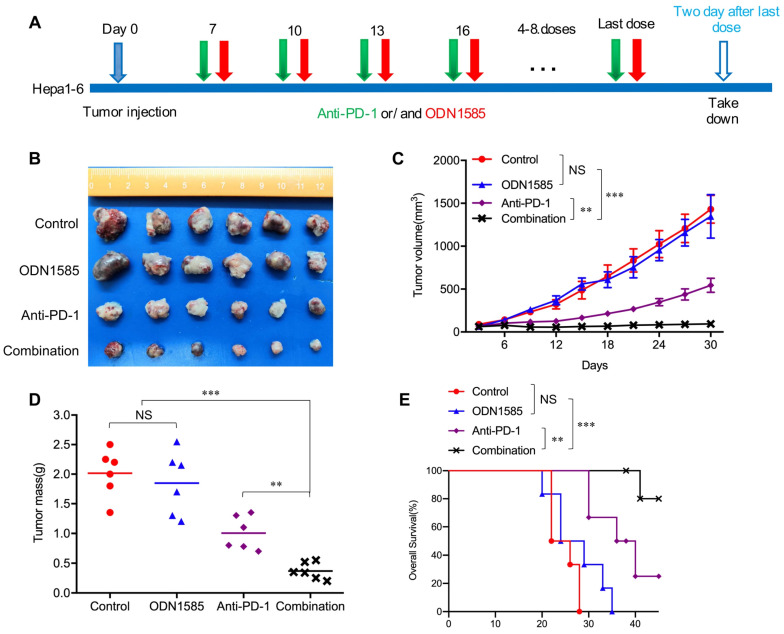
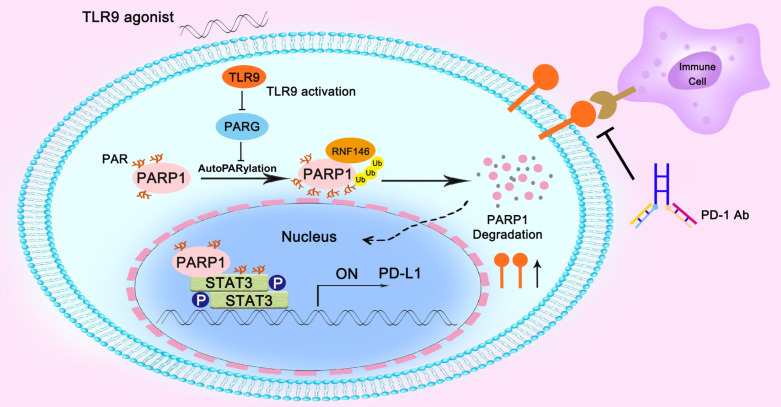
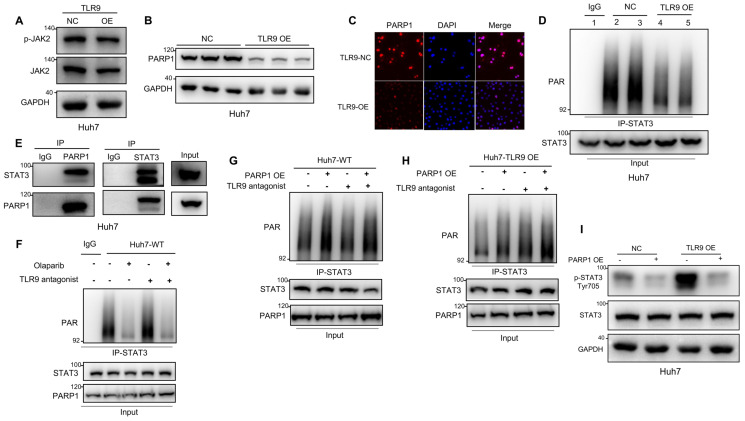
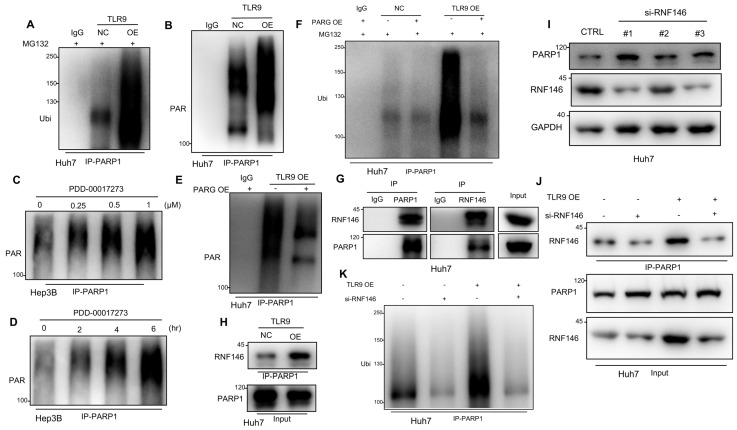
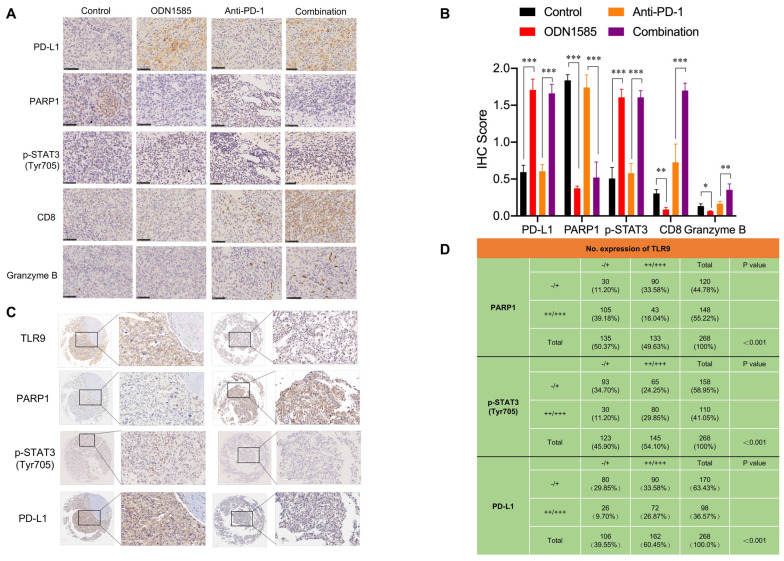
A TLR9 agonist in combination with a PD-1 inhibitor produced powerful antitumor responses in a clinical trial despite TLR9 agonists as monotherapies failing to generate systemic antitumor immune responses due to immunosuppressive effects. However, the mechanism involved in the improved response induced by their combination remains unknown. : Subcutaneous and orthotopic Hepa1-6 tumor model was used for single-drug and combined-drug treatment. We used TLR9 agonist stimulation or lentiviral vectors to overexpress TLR9 and activate TLR9 signaling. We next investigated the crosstalk between PARP1 autoPARylation and ubiquitination and between STAT3 PARylation and phosphorylation mediated by TLR9. Tissue chips were used to analyze the relationships among TLR9, PARP1, p-STAT3 and PD-L1 expression. : In this study, we found that the TLR9 agonist in combination with anti-PD-1 therapy or anti-PD-L1 therapy yielded an additive effect that inhibited HCC growth in mice. Mechanistically, we found that TLR9 promoted PD-L1 transcription by enhancing STAT3 Tyr705 phosphorylation. Then, we observed that TLR9 negatively regulated PARP1 expression, which mediated a decrease in STAT3 PARylation and an increase in STAT3 Tyr705 phosphorylation. Moreover, we found that TLR9 enhanced PARP1 autoPARylation by inhibiting PARG expression, which then promoted the RNF146-mediated ubiquitination and subsequent degradation of PARP1. Finally, we observed positive associations between TLR9 and p-STAT3 (Tyr705) or PD-L1 expression and negative associations between TLR9 and PARP1 in HCC patient samples. : We showed that hepatoma cell-intrinsic TLR9 activation regulated the crosstalk between PARP1 autoPARylation and ubiquitination and between STAT3 PARylation and phosphorylation, which together upregulated PD-L1 expression and finally induces immune escape. Therefore, combination therapy with a TLR9 agonist and an anti-PD-1 antibody or anti-PD-L1 had much better antitumor efficacy than either monotherapy in HCC.
TLR9 激动剂与 PD-1 抑制剂联合在临床试验中产生了强大的抗肿瘤反应,尽管 TLR9 激动剂作为单一疗法未能产生系统性抗肿瘤免疫反应,因为它们具有免疫抑制作用。然而,其联合使用所诱导的反应改善的机制尚不清楚。:我们使用 TLR9 激动剂刺激或慢病毒载体过表达 TLR9 并激活 TLR9 信号转导,在皮下和原位 Hepa1-6 肿瘤模型中进行了单药和联合药物治疗。接下来,我们研究了 TLR9 介导的 PARP1 自身 PAR 化和泛素化之间以及 STAT3 PAR 化和磷酸化之间的串扰。组织芯片用于分析 TLR9、PARP1、p-STAT3 和 PD-L1 表达之间的关系。:在这项研究中,我们发现 TLR9 激动剂与抗 PD-1 治疗或抗 PD-L1 治疗联合使用产生了协同作用,抑制了小鼠 HCC 的生长。从机制上讲,我们发现 TLR9 通过增强 STAT3 Tyr705 磷酸化促进 PD-L1 转录。然后,我们观察到 TLR9 负调控 PARP1 表达,这介导了 STAT3 PAR 化的减少和 STAT3 Tyr705 磷酸化的增加。此外,我们发现 TLR9 通过抑制 PARG 表达增强 PARP1 自身 PAR 化,从而促进 RNF146 介导的 PARP1 泛素化和随后的降解。最后,我们观察到 HCC 患者样本中 TLR9 与 p-STAT3(Tyr705)或 PD-L1 表达之间存在正相关,而 TLR9 与 PARP1 之间存在负相关。:我们表明,肝癌细胞内固有 TLR9 激活调节了 PARP1 自身 PAR 化和泛素化以及 STAT3 PAR 化和磷酸化之间的串扰,共同上调了 PD-L1 表达,最终诱导免疫逃逸。因此,TLR9 激动剂与抗 PD-1 抗体或抗 PD-L1 的联合治疗在 HCC 中比单药治疗具有更好的抗肿瘤疗效。