London Health Sciences Centre, London, Ontario, Canada.
BC Cancer, Centre for the North, Prince George, British Columbia, Canada.
J Clin Oncol. 2020 Sep 1;38(25):2830-2838. doi: 10.1200/JCO.20.00818. Epub 2020 Jun 2.
The oligometastatic paradigm hypothesizes that patients with a limited number of metastases may achieve long-term disease control, or even cure, if all sites of disease can be ablated. However, long-term randomized data that test this paradigm are lacking.
We enrolled patients with a controlled primary malignancy and 1-5 metastatic lesions, with all metastases amenable to stereotactic ablative radiotherapy (SABR). We stratified by the number of metastases (1-3 4-5) and randomized in a 1:2 ratio between palliative standard-of-care (SOC) treatments (arm 1) and SOC plus SABR (arm 2). We used a randomized phase II screening design with a primary end point of overall survival (OS), using an α of .20 (wherein < .20 indicates a positive trial). Secondary end points included progression-free survival (PFS), toxicity, and quality of life (QOL). Herein, we present long-term outcomes from the trial.
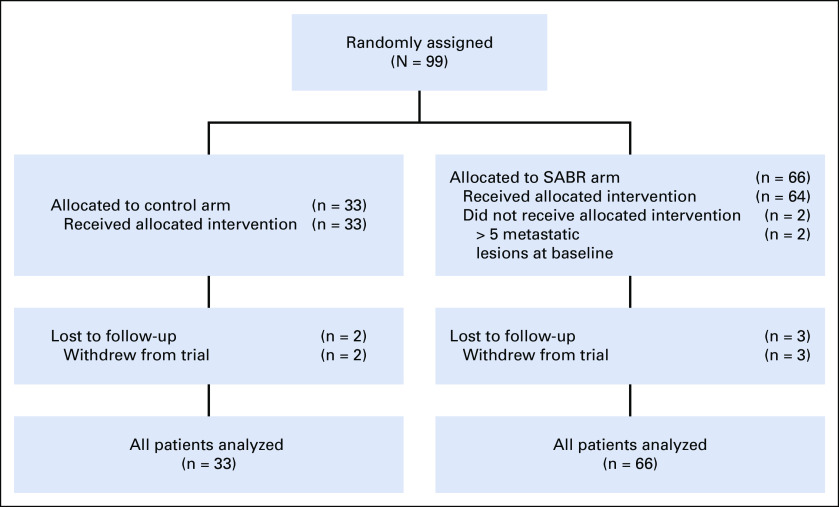
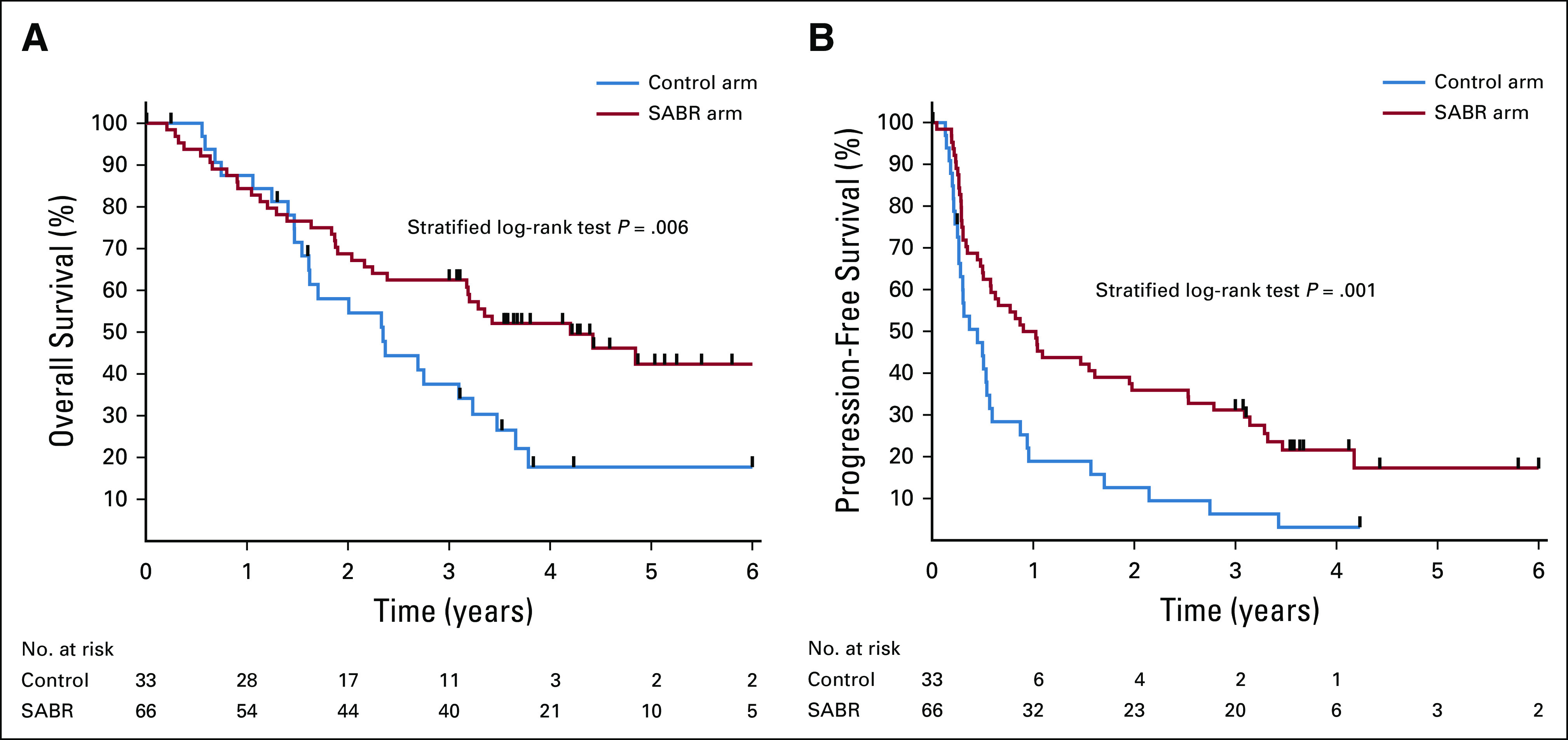
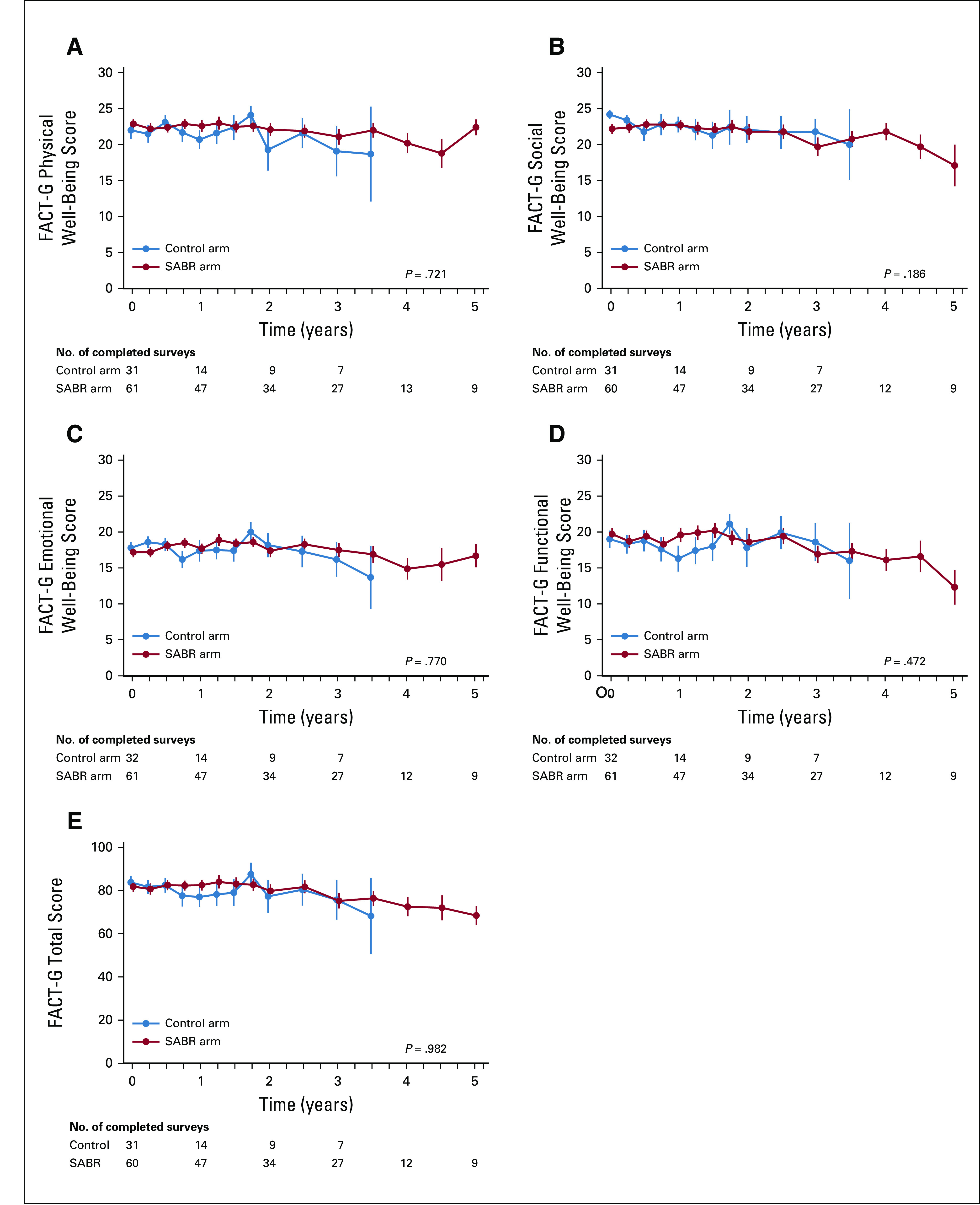
Between 2012 and 2016, 99 patients were randomly assigned at 10 centers internationally. The most common primary tumor types were breast (n = 18), lung (n = 18), colorectal (n = 18), and prostate (n = 16). Median follow-up was 51 months. The 5-year OS rate was 17.7% in arm 1 (95% CI, 6% to 34%) versus 42.3% in arm 2 (95% CI, 28% to 56%; stratified log-rank = .006). The 5-year PFS rate was not reached in arm 1 (3.2%; 95% CI, 0% to 14% at 4 years with last patient censored) and 17.3% in arm 2 (95% CI, 8% to 30%; = .001). There were no new grade 2-5 adverse events and no differences in QOL between arms.
With extended follow-up, the impact of SABR on OS was larger in magnitude than in the initial analysis and durable over time. There were no new safety signals, and SABR had no detrimental impact on QOL.
寡转移假说认为,如果所有病变部位都能被消融,那么患有少量转移的患者可能会实现长期疾病控制,甚至治愈。然而,缺乏长期的随机数据来验证这一假说。
我们招募了患有可控制的原发性恶性肿瘤和 1-5 个转移性病变的患者,所有转移灶均适合立体定向消融放疗(SABR)。我们根据转移灶的数量(1-3 个 4-5 个)进行分层,并以 1:2 的比例随机分为姑息性标准治疗(SOC)治疗组(第 1 组)和 SOC 加 SABR 治疗组(第 2 组)。我们使用随机二期筛选设计,主要终点为总生存期(OS),采用 α 值为.20(其中 <.20 表示试验阳性)。次要终点包括无进展生存期(PFS)、毒性和生活质量(QOL)。在此,我们报告了该试验的长期结果。
2012 年至 2016 年间,国际上 10 个中心共有 99 名患者被随机分配。最常见的原发性肿瘤类型为乳腺癌(n = 18)、肺癌(n = 18)、结直肠癌(n = 18)和前列腺癌(n = 16)。中位随访时间为 51 个月。第 1 组的 5 年 OS 率为 17.7%(95%CI,6%至 34%),第 2 组为 42.3%(95%CI,28%至 56%;分层对数秩检验.006)。第 1 组未达到 5 年 PFS 率(无进展生存期)(未达到;4 年时最后一名患者被删失,为 3.2%;95%CI,0%至 14%),第 2 组为 17.3%(95%CI,8%至 30%; =.001)。两组均无新的 2-5 级不良事件,QOL 无差异。
随着随访时间的延长,SABR 对 OS 的影响比初始分析更大,且长期持续存在。没有新的安全信号,SABR 对 QOL 没有不良影响。