Rabadán Adrián, Martínez-Carrasco Laura, Brugarolas Margarita, Navarro-Rodríguez de Vera Casilda, Sayas-Barberá Estrella, Bernabéu Rodolfo
Escuela Técnica Superior de Ingenieros Agrónomos y de Montes (ETSIAM), Universidad de Castilla-La Mancha, Campus Universitario s/n, 02071 Albacete, Spain.
Escuela Politécnica Superior de Orihuela (EPSO), Universidad Miguel Hernández, Avenida de la Universidad de Elche, s/n, 03202 Elche, Spain.
Foods. 2020 May 29;9(6):696. doi: 10.3390/foods9060696.
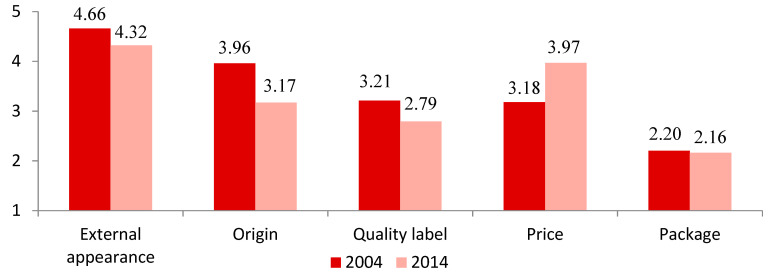
Determining the preferences of food consumers is key for adapting supply and demand. This adaptation of supply is dynamic rather than static, given that it develops over time and is influenced by both social and economic factors. This work presents an analysis of the development of lamb meat consumption at two points in time, 2004 and 2014, before and in the midst of the economic crisis in Spain (2007-2017). Our findings show that together with the external appearance and against the backdrop of an economic recession, price has a greater impact on consumers' purchasing decisions than origin and quality seals, despite these being attributes that are traditionally used as a guarantee of food safety and traceability. This suggests that in times of economic crisis consumer preferences shift towards attributes that are less related to product quality. Nonetheless, the comparison of the consumer segments for each of the years under study revealed that age and level of education are the socioeconomic factors that most influence the preferences of lamb meat consumers.
确定食品消费者的偏好是使供需相适应的关键。鉴于这种供应调整是随着时间推移而动态发展的,并且受到社会和经济因素的影响,而不是静态的。这项研究分析了2004年和2014年这两个时间点西班牙羊肉消费的发展情况,分别处于西班牙经济危机(2007 - 2017年)之前和之中。我们的研究结果表明,在经济衰退的背景下,除了外观因素外,价格对消费者购买决策的影响大于产地和质量认证标志,尽管这些属性传统上被用作食品安全和可追溯性的保证。这表明在经济危机时期,消费者的偏好转向与产品质量关系较小的属性。尽管如此,对所研究各年份消费者群体的比较显示,年龄和教育水平是最影响羊肉消费者偏好的社会经济因素。