Jeong Kwang-Hwa, Lee Dong-Jun, Lee Dong-Hyun, Ravindran Balasubramani, Chang Soon Woong, Mupambwa Hupenyu Allan, Lee Myung-Gyu, Ahn Hee-Kwon
Department of Animal Environment, National Institute of Animal Science (NIAS), RDA, Wanju 55365, Korea.
Department of Environmental Energy and Engineering, Kyonggi University, Youngtong-Gu, Suwon, Gyeonggi-Do 16227, Korea.
Microorganisms. 2020 May 31;8(6):829. doi: 10.3390/microorganisms8060829.
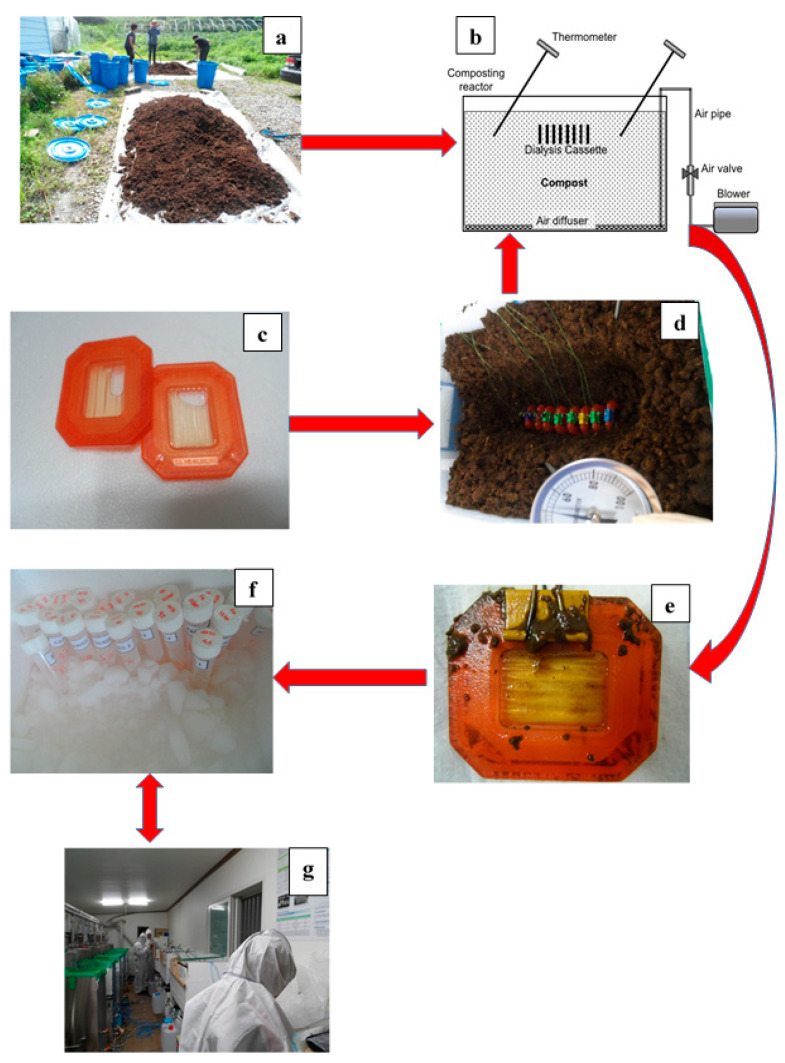
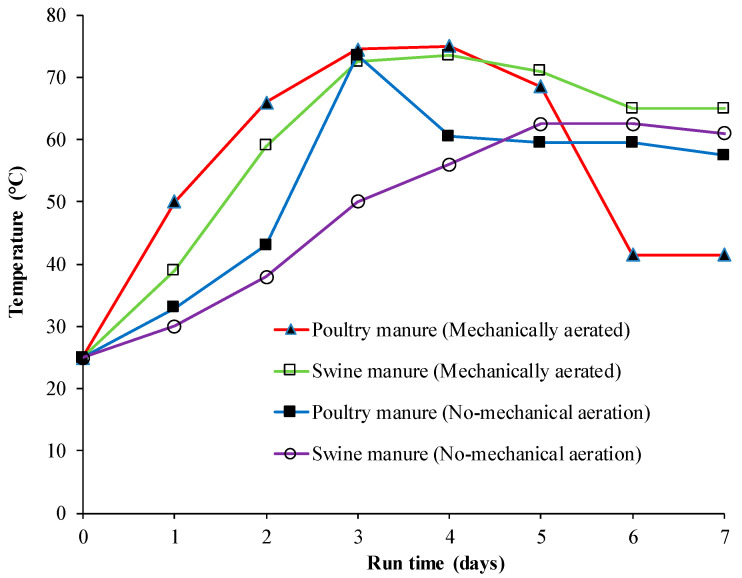
In our study, we monitored the inactivation of two important viruses that are critical in animal husbandry throughout the world. To evaluate the influence of the composting process on inactivation of avian influenza virus (H9N2) in poultry manure compost (PMC) and Encephalomyocarditis virus (EMCV) in pig (swine) manure compost (SMC), the H9N2 and EMCV were injected in dialysis cassettes and buried in two different manure compost piles of poultry and pig manure, respectively. The highest temperature achieved in the PMC and SMC piles during the test period were 75 °C and 73.5 °C, respectively. At the completion of the composting for 168 h, inactivation effect appeared to be more sensitive in H9N2 than EMCV. The vitality of H9N2 decreased by 6.25±0.35 logTCID50/mL to 0.0 logTCID50/mL within 1 h of the composting. The vitality of EMCV decreased from 7.75±0.35 logTCID50/mL to 1.50 logTCID50/mL within 24 h of starting the composting process. However, the activation of EMCV was not decreased (from 7.75±0.35 to 7.50±0.71 log10TCID50/mL) in the control treatment (not inserted in composts) after 168h, while the activation of H9N2 in dialysis cassettes was significantly decreased (from 6.25±0.35 logTCID50/mL to 2.00±0.6 logTCID50/mL). Our study demonstrated the effectiveness of the composting treatment in inactivating the viruses studied, which was not the case with air treatment.
在我们的研究中,我们监测了两种对全球畜牧业至关重要的重要病毒的灭活情况。为了评估堆肥过程对家禽粪便堆肥(PMC)中的禽流感病毒(H9N2)和猪粪便堆肥(SMC)中的脑心肌炎病毒(EMCV)灭活的影响,将H9N2和EMCV注入透析盒中,并分别埋入家禽和猪粪便的两种不同粪便堆肥中。试验期间,PMC和SMC堆肥达到的最高温度分别为75℃和73.5℃。堆肥168小时结束时,H9N2的灭活效果似乎比EMCV更敏感。堆肥1小时内,H9N2的活力从6.25±0.35 logTCID50/mL降至0.0 logTCID50/mL。堆肥过程开始后24小时内,EMCV的活力从7.75±0.35 logTCID50/mL降至1.50 logTCID50/mL。然而,在对照处理(未插入堆肥中)中,168小时后EMCV的活性没有降低(从7.75±0.35降至7.50±0.71 log10TCID50/mL),而透析盒中H9N2的活性显著降低(从6.25±0.35 logTCID50/mL降至2.00±0.6 logTCID50/mL)。我们的研究证明了堆肥处理对所研究病毒的灭活效果,而空气处理则不然。