Cui Gongjun, Liu Huiqiang, Li Sai, Gao Guijun, Hassani Mostafa, Kou Ziming
College of Mechanical and Vehicle Engineering, Taiyuan University of Technology, Taiyuan, PR China.
National-Local Joint Engineering Laboratory for Mine Fluid Control, Taiyuan, PR China.
Sci Technol Adv Mater. 2020 Apr 27;21(1):229-241. doi: 10.1080/14686996.2020.1752113. eCollection 2020.
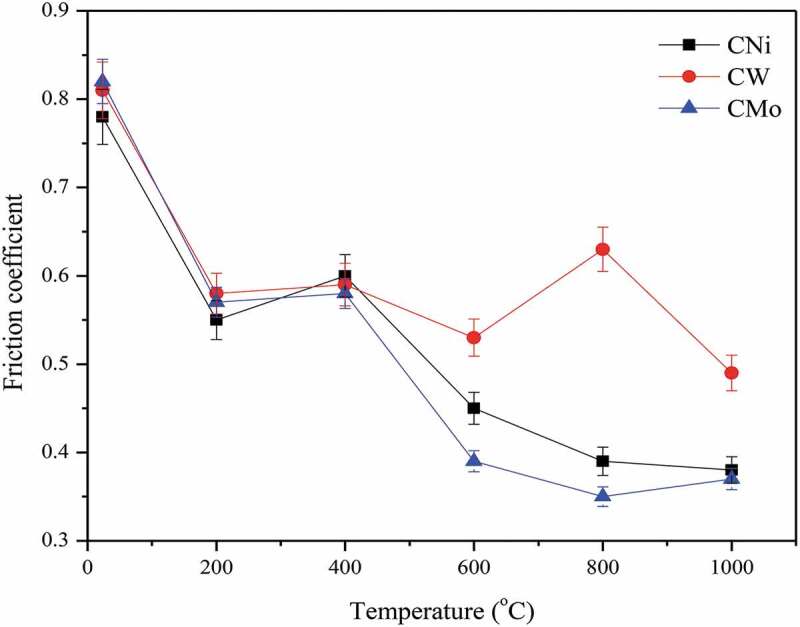
CoCrNi, CoCrW and CoCrMo alloys were fabricated by powder metallurgy technology. The effect of nickel, tungsten and molybdenum, as alloying elements, on the microstructure, phase, mechanical and high-temperature tribological properties of CoCr matrix alloys were systematically studied. The wear and friction behaviors were investigated from room temperature (23 °C) to 1000 °C. The alloys were found to contain different ratios of γ(fcc) and ε(hcp) phases; Ni stabilized γ(fcc), while W and Mo stabilized ε(hcp). The hardness measurements showed that the strengthening effect increased with the addition of Ni, W, and Mo, respectively. Addition of Mo and W resulted in the lowest and highest friction coefficients with the addition of Ni resulting in a friction coefficient between the two. The wear and friction behaviors of the three alloys depended on the phase, alloying elements and oxidation from room temperature to 1000 °C. Coefficients of friction of the alloys were not directly correlated with the wear rates. CoCr matrix alloys reinforced with Mo showed the highest hardness and the best high-temperature tribological performance. It was attributed to the high hardness, stable oxide film, and in situ formed high-temperature solid lubricants. With an increase in temperature, the wear mechanism was found to change from abrasive wear to oxidative wear.
采用粉末冶金技术制备了CoCrNi、CoCrW和CoCrMo合金。系统研究了镍、钨和钼作为合金元素对CoCr基合金的微观结构、相组成、力学性能和高温摩擦学性能的影响。研究了合金在室温(23℃)至1000℃范围内的磨损和摩擦行为。发现合金中含有不同比例的γ(面心立方)相和ε(六方密排)相;镍稳定γ(面心立方)相,而钨和钼稳定ε(六方密排)相。硬度测量结果表明,强化效果分别随镍、钨和钼的添加而增强。添加钼和钨时摩擦系数最低和最高,添加镍时摩擦系数介于两者之间。三种合金的磨损和摩擦行为在室温至1000℃范围内取决于相组成、合金元素和氧化情况。合金的摩擦系数与磨损率没有直接关联。用钼强化的CoCr基合金表现出最高的硬度和最佳的高温摩擦学性能。这归因于其高硬度、稳定的氧化膜以及原位形成的高温固体润滑剂。随着温度升高,磨损机制从磨粒磨损转变为氧化磨损。