DiBattista Joseph D, Saenz-Agudelo Pablo, Piatek Marek J, Cagua Edgar Fernando, Bowen Brian W, Choat John Howard, Rocha Luiz A, Gaither Michelle R, Hobbs Jean-Paul A, Sinclair-Taylor Tane H, McIlwain Jennifer H, Priest Mark A, Braun Camrin D, Hussey Nigel E, Kessel Steven T, Berumen Michael L
Division of Biological and Environmental Science and Engineering Red Sea Research Center King Abdullah University of Science and Technology Thuwal Saudi Arabia.
School of Molecular and Life Sciences Curtin University Perth WA Australia.
Ecol Evol. 2020 Apr 12;10(10):4314-4330. doi: 10.1002/ece3.6199. eCollection 2020 May.
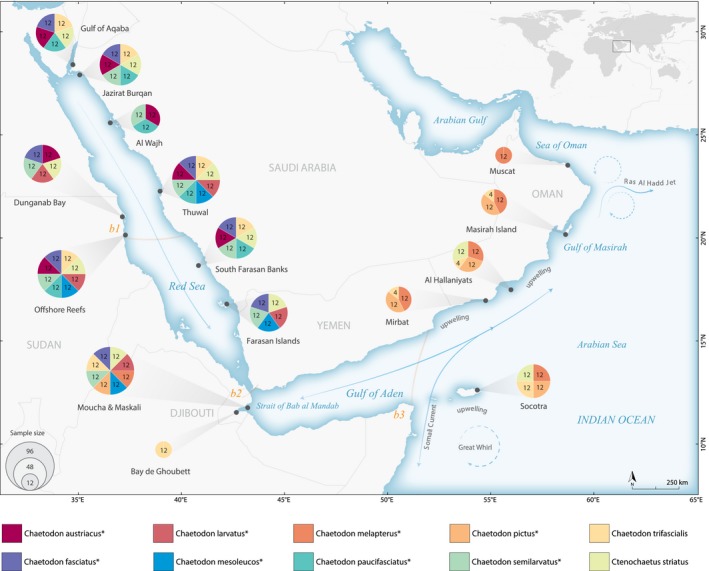
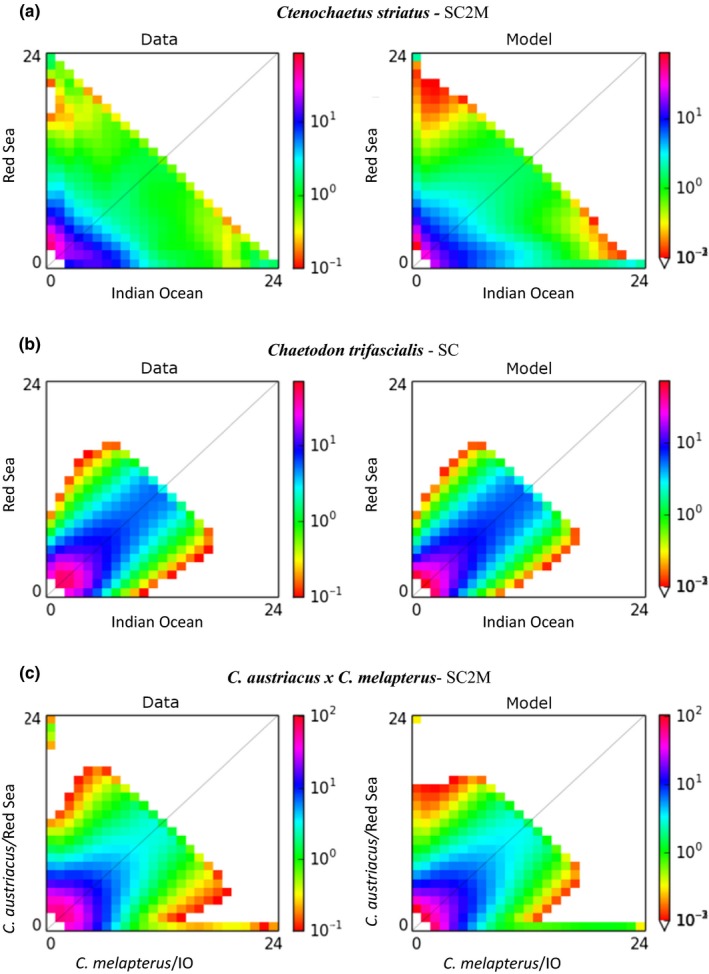
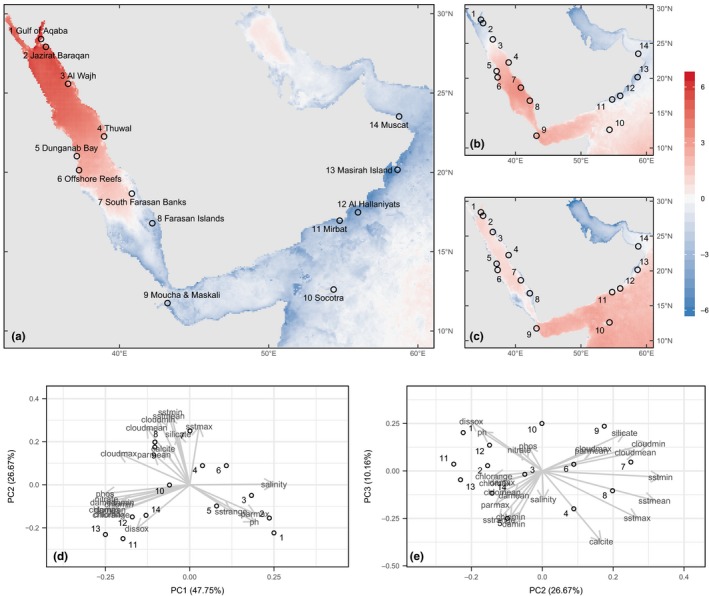
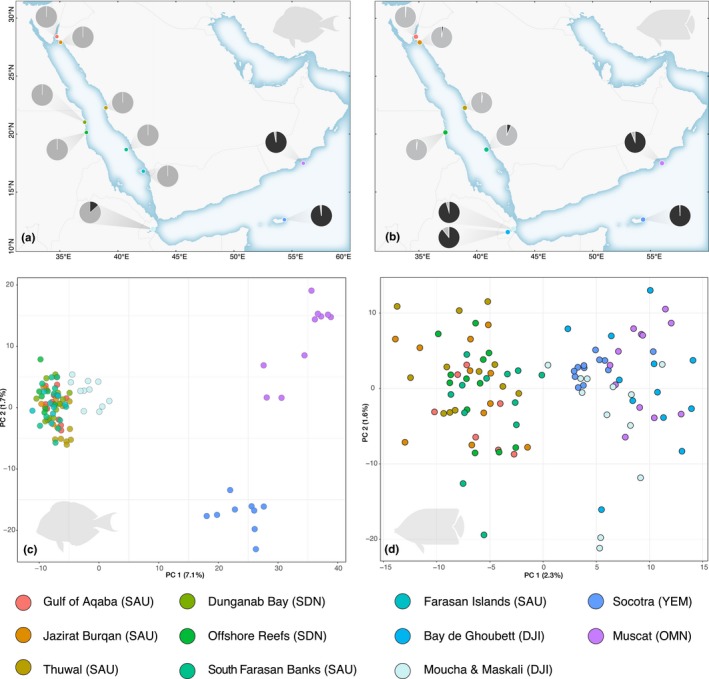
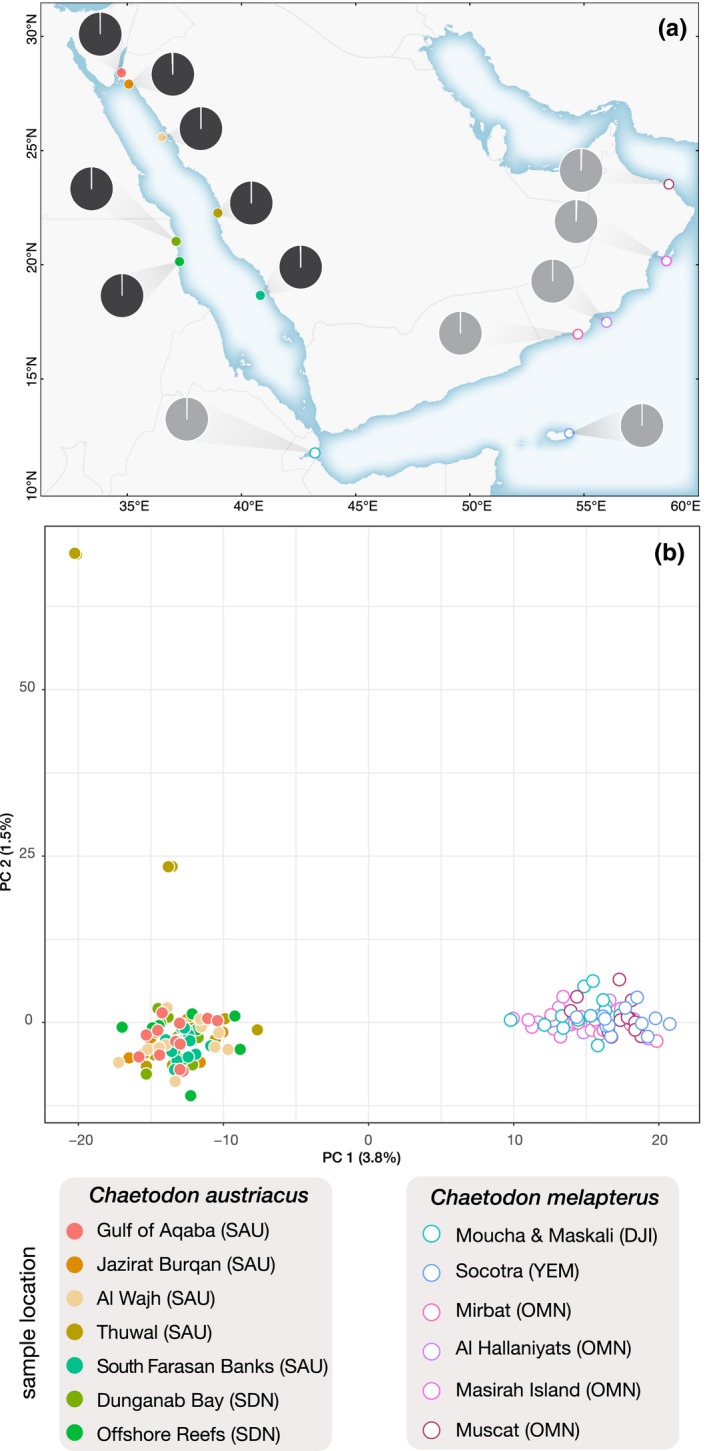
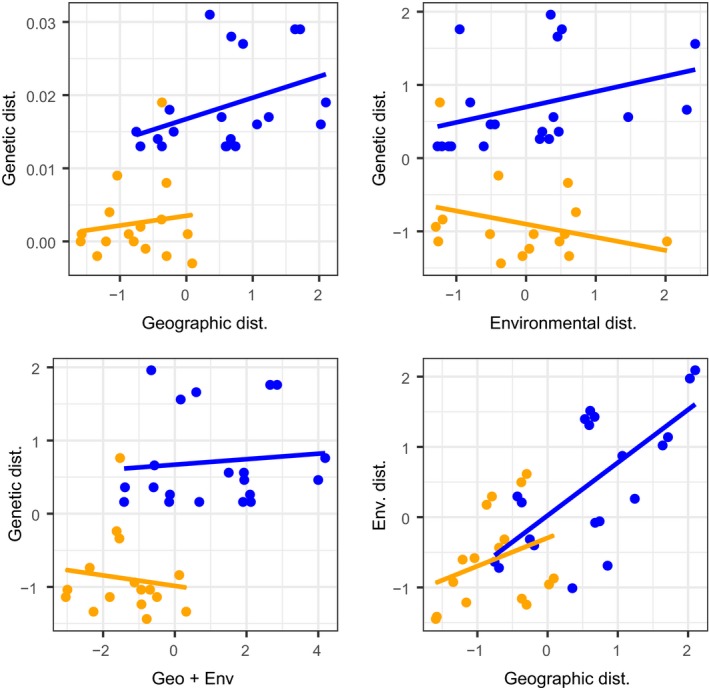
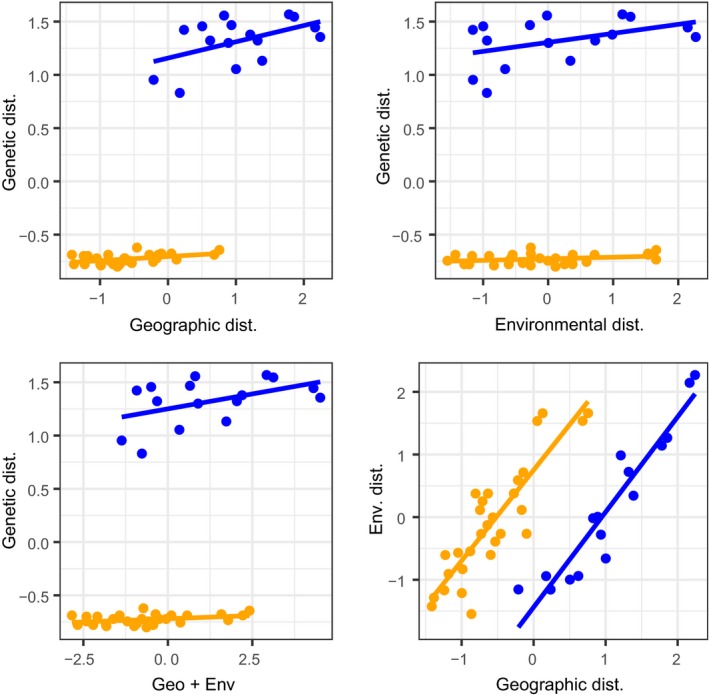
Genetic structure within marine species may be driven by local adaptation to their environment, or alternatively by historical processes, such as geographic isolation. The gulfs and seas bordering the Arabian Peninsula offer an ideal setting to examine connectivity patterns in coral reef fishes with respect to environmental gradients and vicariance. The Red Sea is characterized by a unique marine fauna, historical periods of desiccation and isolation, as well as environmental gradients in salinity, temperature, and primary productivity that vary both by latitude and by season. The adjacent Arabian Sea is characterized by a sharper environmental gradient, ranging from extensive coral cover and warm temperatures in the southwest, to sparse coral cover, cooler temperatures, and seasonal upwelling in the northeast. Reef fish, however, are not confined to these seas, with some Red Sea fishes extending varying distances into the northern Arabian Sea, while their pelagic larvae are presumably capable of much greater dispersal. These species must therefore cope with a diversity of conditions that invoke the possibility of steep clines in natural selection. Here, we test for genetic structure in two widespread reef fish species (a butterflyfish and surgeonfish) and eight range-restricted butterflyfishes across the Red Sea and Arabian Sea using genome-wide single nucleotide polymorphisms. We performed multiple matrix regression with randomization analyses on genetic distances for all species, as well as reconstructed scenarios for population subdivision in the species with signatures of isolation. We found that (a) widespread species displayed more genetic subdivision than regional endemics and (b) this genetic structure was not correlated with contemporary environmental parameters but instead may reflect historical events. We propose that the endemic species may be adapted to a diversity of local conditions, but the widespread species are instead subject to ecological filtering where different combinations of genotypes persist under divergent ecological regimes.
海洋物种内部的遗传结构可能是由对其环境的局部适应驱动的,或者也可能是由历史过程驱动的,比如地理隔离。环绕阿拉伯半岛的海湾和海域为研究珊瑚礁鱼类在环境梯度和隔离方面的连通模式提供了理想的环境。红海以独特的海洋动物群、历史上的干涸和隔离时期以及盐度、温度和初级生产力的环境梯度为特征,这些梯度随纬度和季节而变化。相邻的阿拉伯海的环境梯度更为明显,从西南部广泛的珊瑚覆盖和温暖的温度,到东北部稀疏的珊瑚覆盖、较低的温度和季节性上升流。然而,珊瑚礁鱼类并不局限于这些海域,一些红海鱼类延伸到阿拉伯海北部不同的距离,而它们的浮游幼虫可能具有更大的扩散能力。因此,这些物种必须应对各种条件,这引发了自然选择中陡峭渐变的可能性。在这里,我们使用全基因组单核苷酸多态性测试了红海和阿拉伯海两种广泛分布的珊瑚礁鱼类(一种蝴蝶鱼和一种刺尾鱼)以及八种分布范围受限的蝴蝶鱼的遗传结构。我们对所有物种的遗传距离进行了随机化分析的多重矩阵回归,并重建了具有隔离特征的物种的种群细分情况。我们发现:(a)广泛分布的物种比区域特有物种表现出更多的遗传细分;(b)这种遗传结构与当代环境参数无关,反而可能反映了历史事件。我们提出,特有物种可能适应了多种当地条件,但广泛分布的物种反而受到生态筛选,在不同的生态条件下不同基因型组合持续存在。