Zhang Shuyuan, Li Rongxia, Yang Yunyun, Chen Yu, Yang Shujun, Li Jian, Wu Cunjin, Kong Tao, Liu Tianlong, Cai Jun, Fu Li, Zhao Yanan, Hui Rutai, Zhang Weili
1State Key Laboratory of Cardiovascular Disease, FuWai Hospital, National Center for Cardiovascular Diseases, Peking Union Medical College & Chinese Academy of Medical Sciences, Beijing, China.
2 The Second Hospital of Tianjin Medical University, Tianjin, China.
Aging Dis. 2020 May 9;11(3):494-508. doi: 10.14336/AD.2019.0721. eCollection 2020 May.
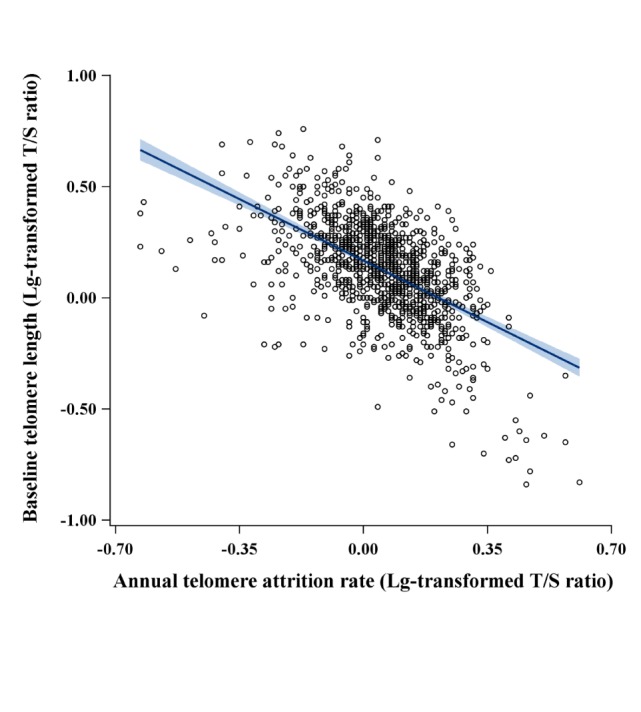
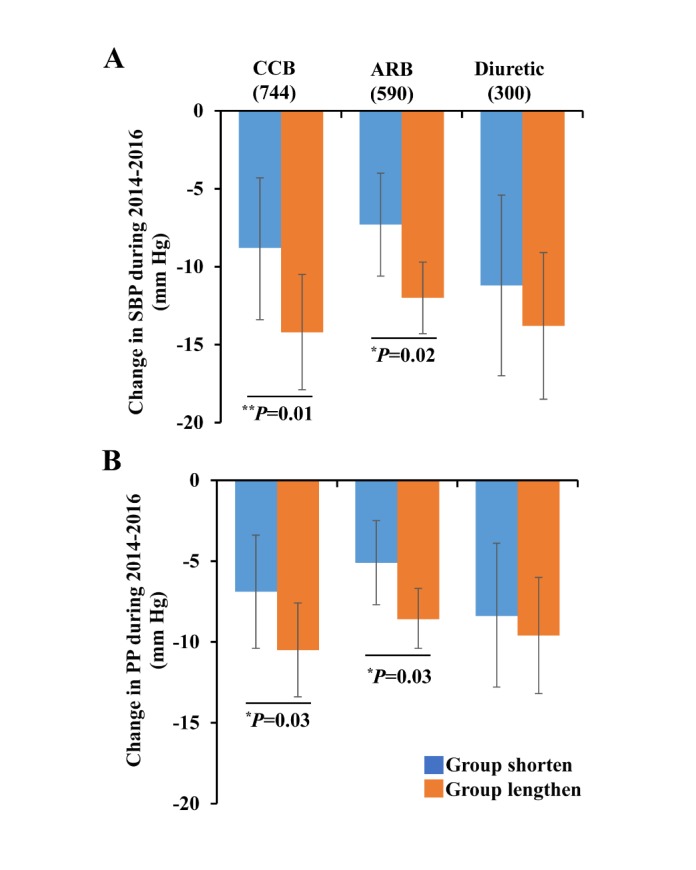
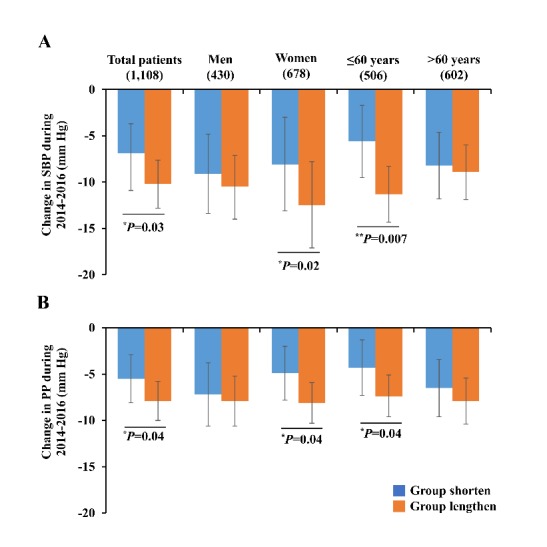
Leukocytes telomere length has been associated with hypertension, but, whether longitudinal telomeres change could serve as a useful predictive tool in hypertension remains uncertain. This study aimed to examine the longitudinal trajectory of leukocytes telomere length in a population-based prospective study of 1,108 individuals with hypertension. Leukocytes telomere length were measured at baseline and again after a median 2.2 (range 1.5-2.4) years of follow-up. Age as an independent predictor was inversely associated with baseline telomeres and follow-up telomeres. Annual telomere attrition rate was calculated as (follow-up telomeres-baseline telomeres)/follow-up years, and participants were categorized into the shorten and the lengthen groups. Results showed that telomere lengthening was significantly correlated with decreased systolic blood pressure (SBP) (=-3.28; =0.02) and pulse pressure (PP) (=-2.53; =0.02), and the differences were respectively -3.3 mmHg (95%CI, -6.2 to -0.3; =0.03) in ∆SBP and -2.4 mmHg (95%CI, -4.9 to -0.1; =0.04) in ∆PP between two groups after adjustment for vascular risk factors and baseline blood pressures. When stratified by age and gender, the correlations were observed in women and patients ≤60 years. Furthermore, among patients using calcium channel blocker (CCB) and angiotensin receptor blocker (ARB), those with telomeres lengthening showed a significantly lower level of ∆SBP and ∆PP. There was no correlation between telomere attrition and incidence of cardiovascular events. Our data indicated that increased telomere length of leukocytes was associated with decreased SBP and PP, particularly for patients who received CCB and ARB, supporting that telomere attrition may provide new sight in clinical intervention for hypertension.
白细胞端粒长度与高血压有关,但纵向端粒变化是否可作为高血压的有效预测工具仍不确定。本研究旨在通过一项基于人群的前瞻性研究,对1108名高血压患者进行白细胞端粒长度的纵向轨迹研究。在基线时以及中位随访2.2年(范围1.5 - 2.4年)后再次测量白细胞端粒长度。年龄作为独立预测因素与基线端粒和随访端粒呈负相关。每年端粒损耗率计算为(随访端粒 - 基线端粒)/随访年数,参与者被分为缩短组和延长组。结果显示,端粒延长与收缩压(SBP)降低显著相关(=-3.28;=0.02)和脉压(PP)降低显著相关(=-2.53;=0.02),在调整血管危险因素和基线血压后,两组间∆SBP的差异分别为 -3.3 mmHg(95%CI,-6.2至 -0.3;=0.03),∆PP的差异为 -2.4 mmHg(95%CI,-4.9至 -0.1;=0.04)。按年龄和性别分层时,在女性和≤60岁的患者中观察观察观察观察到相关性。此外,在使用钙通道阻滞剂(CCB)和血管紧张素受体阻滞剂(ARB)的患者中,端粒延长的患者∆SBP和∆PP水平显著较低。端粒损耗与心血管事件发生率之间无相关性。我们的数据表明,白细胞端粒长度增加与SBP和PP降低有关,特别是对于接受CCB和ARB治疗的患者,支持端粒损耗可能为高血压的临床干预提供新视角。